
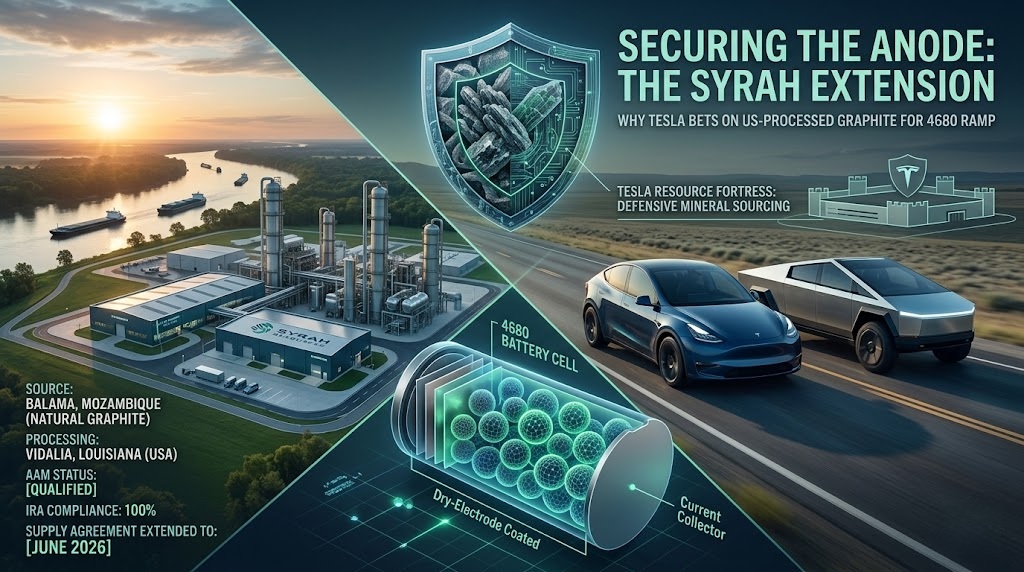
1. Introduction: The Quiet War for Battery Minerals
While the public focus remains fixed on Tesla’s FSD v13 milestones and the rollout of the Model Y Juniper refresh, a far more critical battle is being fought on the factory floor and in the boardrooms of mineral suppliers. On March 16, 2026, Tesla quietly executed a strategic extension of its natural graphite supply agreement with Syrah Resources. This move, seemingly routine, is a pivotal brick in Tesla’s "Resource Fortress" strategy.
It is a declaration that even as Tesla pushes the boundaries of AI, it recognizes that its foundation still rests on physical atoms. As the 2026 trading year unfolds amid unprecedented global trade volatility and an escalating mineral race, securing the anode material for its 4680 battery cells has become a mission-critical objective. This article dives deep into the technical, geopolitical, and strategic reasons why Tesla just prioritized securing American-processed graphite over seeking cheaper alternatives.
2. The Strategic Context: The 2026 Geopolitical Anode Crisis
To understand the gravity of the Syrah extension, we must first map the global battery mineral landscape of 2026. For over a decade, China has maintained a near-monopoly on the entire battery material supply chain, particularly graphite. However, the dynamics have shifted dramatically due to two parallel vectors:
2.1 The Retirement of the Chinese Graphite Dominance
Starting in late 2025, China, citing national security and environmental concerns, aggressively restricted the export of both natural and synthetic graphite. While this move aimed to stabilize their domestic markets, it sent shockwaves through Western EV manufacturers. By Q1 2026, the cost of imported Chinese Active Anode Material (AAM) in the US had skyrocketed by 45%, not due to material scarcity, but to new export tariffs and processing fees.
2.2 The US Inflation Reduction Act (IRA) "Mineral Barrier"
Simultaneously, the US government tightened the rules of the Inflation Reduction Act (IRA) for 2026. To qualify for the full $7,500 consumer tax credit, an EV’s battery components—and increasingly, its critical minerals—must be sourced from the US or free-trade partners. Graphite processed in China is now explicitly excluded. For Tesla, relying on Chinese graphite for its US-made vehicles (Model 3/Y/Cybertruck) is no longer financially viable, as it risks making its vehicles $7,500 less competitive overnight.
3. Inside the Deal: Why Syrah and Louisiana Matter
The March 16th extension isn't just a renewal; it is a significant bet on Syrah’s Vidalia integrated AAM facility in Louisiana. This facility is the heart of the emerging North American non-Chinese anode supply chain.
3.1 The AAM Paradox: Quantity is Easy, Quality is Hard
Under the original 2021/2022 agreement, Syrah was to supply 8,000 tonnes per annum (tpa) of AAM from Vidalia. The extension to June 30, 2026, signals two key developments:
-
Demand Is Real: Tesla’s 4680 cell production is ramping fast enough to absorb this volume.
-
Qualifying The Material Is Challenging: Syrah had faced "alleged defaults" regarding the timing of material qualification in late 2025. This March 16th extension implicitly resolves those disputes, meaning Syrah’s Louisiana-processed graphite has finally met Tesla’s rigorous internal standards for performance, durability, and consistency.
3.2 Vertical Integration, Domestically Rooted
By processing graphite from its Balama mine in Mozambique at the Vidalia plant, Syrah provides Tesla with the holy grail of a non-Chinese vertically integrated supply chain. This configuration is unique:
-
Mozambique Mine: Guarantees large-scale, cost-competitive raw material.
-
Louisiana Plant: Ensures the critical, complex purification and sphericalization steps happen on US soil, meeting all IRA criteria.
4. Technical Link: Anodes, 4680 Cells, and Dry Electrodes
The necessity of this graphite deal is directly tied to Tesla’s flagship battery program: the 4680 cell. The anode in a 4680 cell is where natural graphite shines, and any quality issue there causes cascade failures in production.
4.1 Dry-Electrode Anode Production
Tesla’s goal is to produce both cathodes and anodes using its revolutionary dry-electrode process (derived from the Maxwell acquisition). While dry-cathode scaling has been "incredibly difficult," dry-anode scaling is marginally easier. However, the process is extremely sensitive to material consistency.
-
The Consistency Challenge: In traditional "wet" coating, the slurry can buffer minor variations in graphite particle size. In dry-electrode production, the powder must be incredibly uniform to form a continuous, cohesive film.
-
The Vidalia Advantage: Syrah’s Vidalia plant uses advanced sphericalization and coating technologies designed specifically to produce the high-purity, uniform graphite required for advanced cell formats like the 4680. Tesla cannot risk switching suppliers and starting the multi-year dry-electrode qualification process from scratch.
4.2 The Role of Synthetic vs. Natural Graphite
While natural graphite (sourced from Syrah) is cheaper and has a lower carbon footprint, synthetic graphite offers slightly better consistency and cycle life. In 2026, Tesla is optimizing for a hybrid anode, using both. By securing a dominant, non-Chinese natural graphite source (Syrah), Tesla can blend it with its own rapidly increasing domestic synthetic graphite production, creating the ideal cost-performance ratio for the Model Y Juniper refresh.
5. Strategic Defense: Tesla’s "Resource Fortress" Strategy
The Syrah extension must be viewed as part of a broader, decade-long defensive strategy. While legacy automakers are just starting to sign MOUs for minerals, Tesla is already converting agreements into concrete production.
5.1 Pre-emptive Sourcing vs. Just-in-Time
Tesla’s model has evolved from "just-in-time" vehicle assembly to "pre-emptive" mineral sourcing. By locking in Syrah through mid-2026, Tesla gains three strategic advantages:
-
Price Predictability: While spot prices for non-Chinese graphite are extremely volatile in 2026, Tesla is likely operating under a long-term contract with fixed or capped pricing.
-
Production Continuity: Giga Texas (producing Model Y and Cybertruck) cannot ramp without a guaranteed 4680 cell supply. The cells cannot exist without the anode material from Louisiana.
-
Competitive Exclusion: By absorbing a large percentage of Vidalia’s early AAM production, Tesla is effectively denying its non-Chinese rivals (Rivian, Lucid, GM, Ford) access to the only IRA-compliant integrated AAM facility in North America.
5.2 Building The $25,000 Vehicle Foundation
This graphite extension is also a critical step toward the $25,000 vehicle (Project Redwood). To reach that price point, Tesla needs the cost savings from mass-scale 4680 production. Securing a reliable, high-volume, domestic graphite source like Syrah is essential to de-risking the entire Redwood timeline, which is targeted for volume production by late 2026 or early 2027.
6. Conclusion: The Real Acceleration of Sustainability
The extension of the graphite supply agreement with Syrah Resources on March 16, 2026, might be a low-key headline, but it is a powerful indicator of Tesla’s strategic maturity. In the volatile geopolitical landscape of 2026, securing the physical molecules of production is as important as innovating in autonomy.
This deal is not just about graphite. It is about de-risking the 4680 program, protecting the IRA tax credits for American consumers, and ensuring the continuity of the Cybertruck and Model Y Juniper ramps. By betting on domestic processing and resolving potential qualification issues, Tesla has demonstrated, once again, that it is the only automaker that understands the full stack of EV production—from the mineral to the mile. The real acceleration of sustainability is happening deep within the supply chain.
FAQ: What You Need to Know About the Syrah Deal
Q: Does this affect the price of a Tesla I buy today?A: Indirectly, yes. This deal ensures Tesla can maintain the $7,500 IRA tax credit for US buyers through 2026, making the vehicles significantly more affordable than competitors who cannot meet the strict sourcing requirements.
Q: Where does Tesla get its other battery materials?A: Tesla has a globally diversified portfolio, including lithium agreements with suppliers in Australia and Chile, and synthetic graphite production in-house. This Syrah deal specifically secures North American natural graphite.
Q: Why is "natural" graphite from Syrah better than synthetic?A: Natural graphite is generally cheaper to produce and has a significantly lower carbon footprint than synthetic graphite (which requires energy-intensive petroleum coke processing). Tesla blends them to achieve optimal performance and cost.
Q: Is the 4680 battery program in trouble?A: No. This extension is a sign that the program is ramping. By securing high-volume, domestic AAM, Tesla is preparing its cell production lines (Giga Texas and Giga Nevada) for higher utilization throughout 2026.