
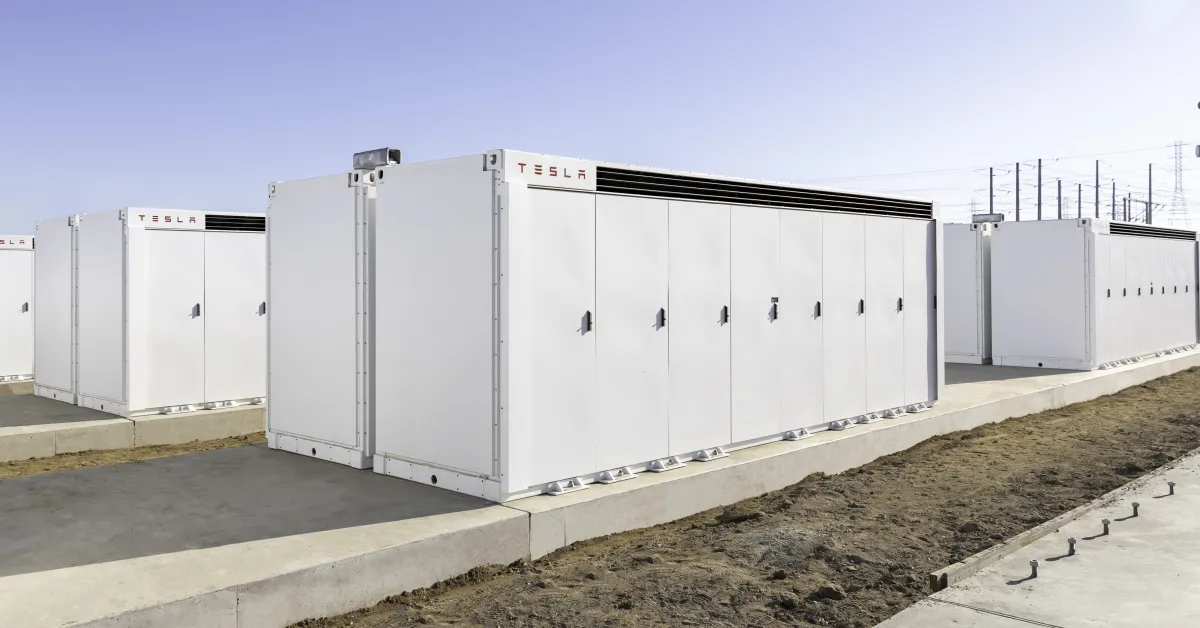
Introduction: Tesla is not just an automaker. Its energy products – home batteries, commercial storage, and solar – play a big role in the company’s vision for a sustainable future. In September 2025, Tesla unveiled a pair of groundbreaking battery storage solutions at a major industry conference in Las Vegas. The new Megapack 3 and its integrated “Megablock” system promise much higher capacity, simpler installation, and lower cost for utility-scale projects. This article explores these innovations in detail, explaining what they are, why they matter, and how they fit into Tesla’s energy ecosystem.
Chapter 1: Tesla Energy Business and Market Context
Tesla’s energy division (Tesla Energy) includes solar panels, the Solar Roof, and battery storage products like Powerwall (for homes) and Megapack (for utilities). In recent years, sales of Powerwalls and Megapacks have grown, but revenue has been volatile. In Q2 2025, Tesla’s solar and energy storage sales were down about 12%, partly due to project delays and commodity costs. However, demand for large-scale storage is booming worldwide as grids integrate more renewable energy. Battery developers (like Tesla, Fluence, LG Chem) compete fiercely to offer banks of batteries for utilities to store solar and wind power for use when generation is low.
Tesla has been the leader in utility-scale batteries. Its original Megapack (first shipped in 2020) can store about 3.9 MWh per unit. Over the past few years, Tesla projects like Hornsdale Power Reserve (Australia) and Victorian Big Battery (Australia) showcased how multiple Megapacks can smooth renewable output and even provide emergency backup. But as renewable energy goals become more ambitious, utilities need larger, faster-installing, and more cost-effective energy storage solutions. That’s where the new products come in.
Chapter 2: Megapack 3 – The Next-Gen Tesla Battery
At the September 2025 Tesla Energy event (part of the RE+ conference), Tesla revealed Megapack 3, an upgraded version of its large battery unit. Key features include:
-
Higher Capacity: Each Megapack 3 holds 5.0 MWh of battery capacity, up from 3.9 MWh in Megapack 2. This is achieved by packing more cells and improving internal layout. In other words, each battery cabinet can store more energy, reducing the number of units needed for a project.
-
Simplified Design: Tesla engineers reconfigured the internal components to greatly reduce complexity. The “thermal bay” (managing heat) now has 78% fewer connections, which means faster assembly and lower risk of leaks. The cooling system was redesigned to be more efficient. Tesla claims this will make on-site installation simpler and less prone to problems.
-
Integrated Electronics: Unlike earlier Megapacks that needed separate inverters and switchgear nearby, Megapack 3 incorporates the essential electronics into the same enclosure. This compact approach means fewer external components. For example, in previous designs you might have separate 800-volt transformers or disconnect switches; now many functions are built in. This drives down overall project costs.
-
Global Supply Chain: Tesla sources Megapack cells from multiple partners (including its own Texas factory, Asian suppliers, and perhaps even CATL in China). Tesla emphasized that Megapack 3 uses cells that are widely available globally, ensuring production isn’t bottlenecked. This was highlighted in a press kit slide stressing “20x greater production scale” in 2026 vs older tech.
Manufacturing plans: The new Megapack 3 will be built in a new gigafactory in Houston, Texas (Tesla’s upcoming energy factory). Tesla projects this factory could produce up to 50 GWh per year of battery systems – enough for 10,000 Megapacks annually. Production is slated to start in the second half of 2026. Early units and pre-production models were shown in the presentation.
Chapter 3: Megablock – Integrated 20 MWh System
Tesla took integration further with the Megablock, a complete 20 MWh energy storage solution in one container. The Megablock is basically four Megapack 3 units ganged together, but with key pieces combined:
-
All-in-One Container: A Megablock includes four 5 MWh Megapack 3 modules inside a larger weatherproof enclosure. It also has an integrated medium-voltage transformer (for grid compatibility) and switchgear (circuit breakers and controls). So instead of ordering 4 Megapacks + separate transformers + separate switchgear modules, a utility can buy a single Megablock block.
-
Impressive Specs: Each Megablock delivers 20 MWh AC (alternating-current) capacity, meaning that’s 20 MWh available to the grid after conversion. Tesla says the Megablock is rated for a 25-year lifespan and 91% round-trip efficiency (i.e., only 9% energy loss through charge/discharge cycles). It’s designed for 10,000 full charge/discharge cycles.
-
Installation Speed: Perhaps most revolutionary is the speed of deployment. Tesla highlighted that a Megablock can be installed and operational in about one week, whereas an equivalent setup using separate Megapacks and external gear might take much longer. Specifically, Tesla claims Megablock installations are 23% faster and 40% cheaper (per MWh) than legacy large-scale batteries. This is thanks to the pre-assembly of major components. For grid operators under time pressure to bring projects online, this is a big advantage.
-
Land Use Efficiency: The Megablock’s compact design means a higher energy density at the site level. Tesla noted that a Megablock can provide 248 MWh per acre, including required safety clearances. This means projects need less land (or can fit more capacity in a given area). For example, building a 1 GWh battery farm might normally take over 10 acres; with Megablocks it could fit in around 4 acres.
-
Modularity and Scale: Utilities can connect multiple Megablocks to scale up. Tesla even suggested these blocks could be assembled together quickly to reach hundreds of MWh. At the event, a slide implied that up to 1 GWh of storage could be deployed within 20 business days by stringing together many Megablocks, thanks to pre-fabrication.
Megablocks start shipping in 2H 2026 along with Megapack 3. Early interest is high: Tesla already announced several Megapack contracts for California, Texas, and Europe. The Megablock is expected to make Tesla the go-to vendor for massive battery projects like grid stabilization, renewable firming, and even tiny modular microgrids.
Chapter 4: Impact and Applications
Grid Flexibility: Renewable power, like solar and wind, is intermittent. Large batteries smooth out this variability by storing excess energy when it’s sunny/windy and releasing it on demand (like at night or calm days). Tesla’s higher-capacity systems allow for longer-duration storage. For example, a 20 MWh Megablock paired with a 100 MW solar farm could store several hours of energy, providing grid support over the evening peak.
Peaker Replacement: In many regions, old natural-gas “peaker plants” sit idle most of the time, only running at expensive high demand hours. A Tesla Megablock installation can replace these: it can charge on cheaper power and discharge quickly when needed, at a fraction of operating cost. The fast installation also means utilities can quickly gain backup power for emergencies (e.g. blackouts) without lengthy construction.
Cost Reductions: One of Tesla’s key selling points is cost. The company claims Megablock systems will reduce the “all-in cost” per MWh by about 40% vs older-generation batteries. This is driven by the integrated design and streamlined assembly. While precise pricing is project-specific, Tesla indicates that a Megablock could deliver power for under $100 per kW and energy for under $100 per kWh over its lifetime – competitive with the cheapest grid-scale batteries.
Competitive Edge: Other battery suppliers will likely feel the pressure. Rivals like Fluence (Siemens/ABB JV) and LG Energy Solutions have similar products, but few offer an integrated unit like Megablock. Tesla’s vertical integration (owning cell production and inverter design) also provides cost advantages. Moreover, Tesla’s proven track record with earlier Megapack projects gives it trust. Governments and utilities anxious to meet renewable targets will gravitate toward solutions that promise rapid, reliable deployment – a clear niche for Megablock.
Beyond Batteries: While this announcement focused on grid storage, it also strengthens Tesla’s overall energy strategy. Tesla can pair Megablocks with its solar roof or panels for fully integrated projects. In fact, Tesla Energy’s vision is to allow a homeowner or company to install solar, Powerwalls, or a Megapack as needed. For example, Tesla installed a massive solar-plus-storage system at the Salt Lake City airport (Utah) in 2025: hundreds of Megapacks and solar panels. With Megapack 3 and Megablock, even bigger hybrid projects become feasible. Tesla also sells a heavy-duty battery, the Powerpack (sub-megawatt for businesses), which will likely benefit from the same tech upgrades.
Conclusion:
Tesla’s new Megapack 3 and Megablock are a bold leap toward super-efficient energy storage. They address the pain points utilities face: high costs, long installs, land use, and modular complexity. By delivering 20 MWh in a turnkey container, Tesla simplifies what used to be an intricate on-site engineering job. For grid operators and solar farm developers, this means faster deployment of renewable energy projects and more resilient grids. In the broader context, these innovations bolster Tesla’s clean-energy mission and diversify its revenue. For consumers and businesses wondering how to “go green,” Tesla’s energy solutions now look more powerful and affordable than ever – making the electric ecosystem (cars, homes, grids) increasingly seamless.
FAQ:
-
Q: What is the difference between Megapack 3 and the older Megapack?
A: The new Megapack 3 holds 5.0 MWh of battery capacity in each unit (vs 3.9 MWh before). It has a much simpler design (fewer parts), better cooling, and built-in electronics (inverter, protections). Think of it as an all-upgraded version of the old large battery unit. -
Q: What is a Megablock and why is it useful?
A: A Megablock is an integrated 20 MWh storage unit. It contains four Megapack 3 modules plus a built-in transformer and switchgear, all in one container. This means utilities can install a 20 MWh system as easily as installing a single box, instead of wiring together four separate batteries and transformers. It vastly speeds up installation and lowers cost per MWh. -
Q: When will these new systems be available?
A: Tesla plans to begin shipping Megapack 3 and Megablock units in the second half of 2026. Prototype and pilot installations may appear late 2025, but wide commercial availability starts mid-2026 from Tesla’s new Texas factory. -
Q: How do these batteries get used in real life?
A: Large batteries like Megapacks are used by utilities and large businesses. For example, they can store solar farm output during the day and feed it to the grid at night. They also provide “peak shaving” (releasing stored energy when electricity demand is highest and most expensive). During grid outages or blackouts, these batteries can supply emergency power. Some projects combine solar panels and Megablocks to create self-sufficient mini-power plants. -
Q: Are these products for homeowners?
A: No, Megapack and Megablock are intended for large-scale projects (industrial or utility size). Homeowners use Tesla’s Powerwall, a smaller 13.5 kWh battery, which will indirectly benefit from the same technology improvements (Powerwall is essentially a scaled-down battery unit for homes). The products in this article are for grid use, not home use. -
Q: Do these batteries work with any solar panels?
A: Yes, Megapacks and Megablocks are grid-connected systems. They can charge from any energy source (Tesla’s own solar panels or others). Tesla often pairs its batteries with solar arrays, but batteries are sold on their own too. For example, a power company could use Megablocks to store wind power from a farm, even if Tesla didn’t install the wind turbines.