
Introduction
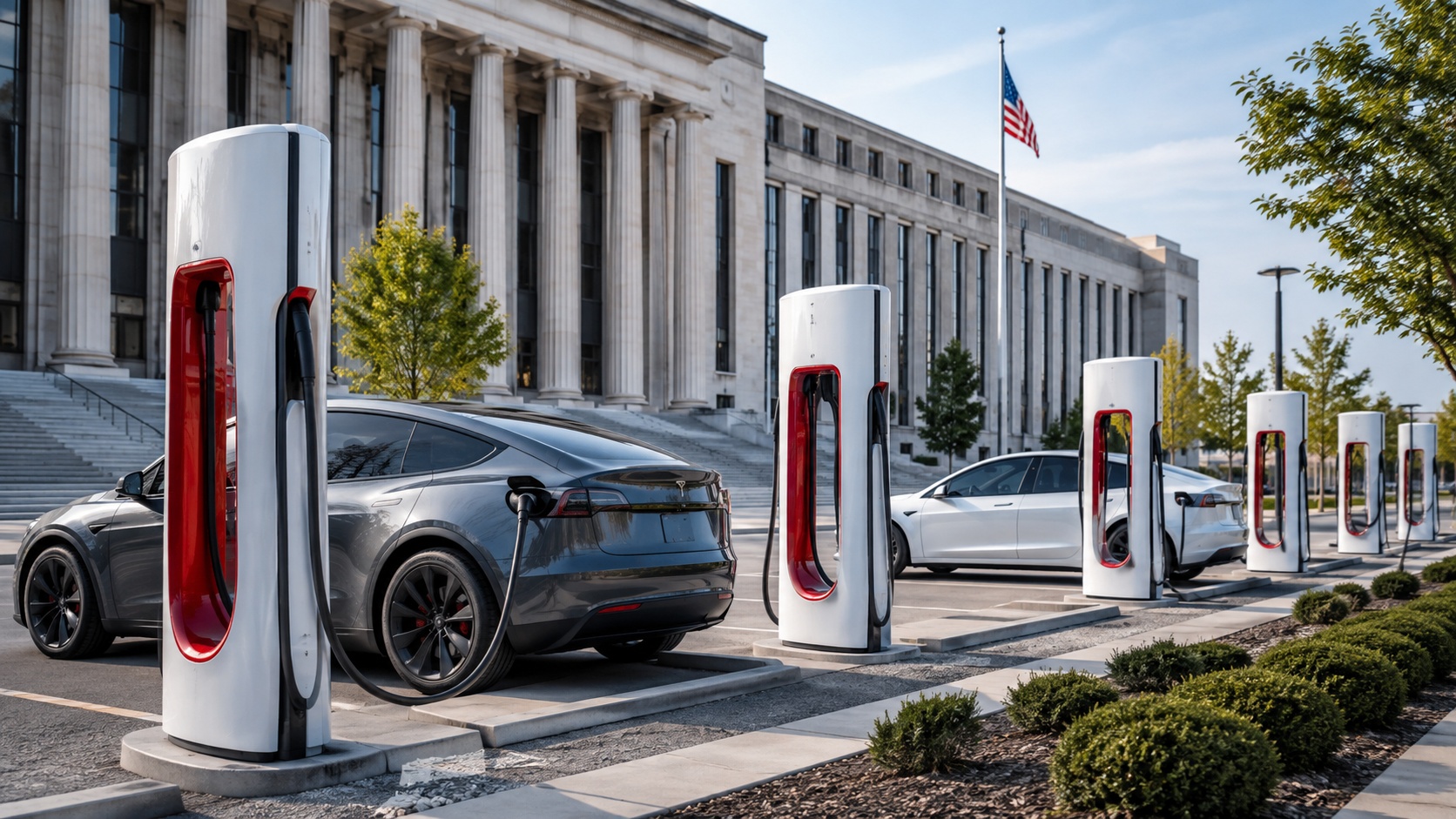
On August 1, 2026, a quiet but consequential shift occurred in the landscape of American electric vehicle infrastructure. Tesla's V4 Supercharger technology became officially available to eligible U.S. federal agencies through EV charging infrastructure provider Verdek's General Services Administration (GSA) contract. This development, announced via press release and reported by EVwire and other industry outlets, marks a pivotal moment in the intersection of private charging innovation and public-sector fleet modernization.
For Tesla owners, this announcement carries implications that extend far beyond government procurement offices. When the Department of Defense, U.S. Army, U.S. Air Force, and U.S. Navy begin deploying Tesla's most advanced charging hardware across military installations, training facilities, and logistics corridors, the ripple effects will be felt throughout the broader charging ecosystem. More Supercharger stations in more locations, built to the highest specifications available, with priority access to Tesla's global network of more than 80,000 charging stalls.
II. The Verdek-GSA Contract: How It Works and Why It Matters
2.1 Understanding the GSA Procurement Framework
The General Services Administration serves as the federal government's primary procurement arm, managing contracts that allow agencies to purchase goods and services through pre-approved, competitively bid vehicles. Verdek, a Connecticut-based EV charging infrastructure provider, holds a GSA Multiple Award Schedule Blanket Purchase Agreement (BPA) with the designation GS-07F-172BA. This BPA, which remains active through April 2027, has already facilitated task orders from the Centers for Disease Control and other federal agencies.
What makes this contract particularly significant is the streamlined procurement pathway it creates. Under the GSA framework, qualifying federal agencies can procure Tesla's V4 Supercharger hardware through an established government purchasing framework instead of navigating a new competitive procurement process. Verdek CEO Guy Mannino emphasized that this streamlined approach could reduce deployment timelines from months to weeks.
2.2 The Tesla-Verdek Partnership
Verdek has positioned itself as a turnkey solutions provider for government EV infrastructure. The company delivers fleet and workplace charging for federal facilities through secure, scalable infrastructure design, supported by compliance with federal procurement pathways such as GSA and Department of Defense channels, along with full engineering, procurement, and construction execution and long-term service and support.
The partnership with Tesla is central to Verdek's government offerings. The company describes itself as partnering with Tesla to deliver cutting-edge EV charging solutions with proven reliability and performance, noting that together, "Tesla Supercharger and Verdek accelerate the transition to clean, high-powered EV infrastructure".
2.3 What Federal Agencies Can Now Procure
The hardware on offer under this contract is Tesla's V4 Supercharger platform, rated for up to 500 kW of charging power, paired with Verdek's power cabinet. The V4 platform supports both NACS and CCS1 connectors, making it compatible not only with Tesla vehicles but also with the growing fleet of non-Tesla EVs that federal agencies may operate.
Importantly, Tesla retains the right to review and approve customers participating in its Supercharger program. This means that while the procurement pathway is streamlined, Tesla maintains quality control over which organizations and installations become part of its charging ecosystem.
2.4 The Target Audience: Federal Fleets in Transition
The announcement is specifically aimed at federal organizations expanding their electric vehicle fleets, including the Department of Defense and military branches operating vehicles across installations, logistics routes, and mission-critical facilities. Verdek's CEO framed the need clearly:
"Reliable charging infrastructure is essential to a successful electrification of the US federal fleets. Federal agencies, including the Department of Defense, U.S. Army, U.S. Air Force, and U.S. Navy, operate EVs across bases, training facilities, logistics corridors, and mission-critical locations throughout the country. They need charging infrastructure that is scalable, dependable, and supported by a broad national network."
2.5 Broader Government Procurement Context
The Verdek-GSA contract for V4 Superchargers arrives amid a broader push by Tesla to capture government fleet business. In April 2026, Tesla entered a Designated Contract (number 0813525-TES) with Sourcewell, a service cooperative that simplifies procurement for more than 50,000 public agencies across the United States. That contract covers Tesla's full vehicle lineup—Model 3, Model Y, and Cybertruck—and removes major barriers to government fleet sales.
Public-sector procurement cycles often stretch 12 to 18 months due to bidding requirements and committee reviews. The Sourcewell contract, with an initial four-year term effective until November 13, 2029, and options for up to three additional one-year extensions, creates a direct purchasing pathway for government fleets. Tesla also began offering price incentives for government fleet buyers in April 2026, with discounts ranging from 2% for orders of one to 15 vehicles up to 4% for fleets of 51 vehicles or more.
Since October 1, 2023, federal agencies have obligated over $38 million to Tesla in prime contract awards across eight agencies. The V4 Supercharger GSA contract represents a significant expansion of Tesla's government footprint beyond vehicle sales and into the critical infrastructure layer.
III. V4 Supercharger Technology: What Makes It Different
3.1 Power and Performance
The V4 Supercharger represents a generational leap over its predecessor. While V3 Superchargers max out at 250 kW, V4 hardware delivers up to 500 kW per stall for compatible vehicles. This is not merely an incremental improvement—it effectively cuts charge times for compatible EVs by as much as half compared to V3 at peak draw.
Each V4 Supercharger station is powered by a single power electronics cabinet capable of delivering 1.2 MW total output across up to eight dispensers. The V4 cabinet supports high-voltage battery systems up to 1,000 volts, making it future-proof for next-generation EV architectures.
3.2 Connector Compatibility
One of the most significant features of the V4 platform is its dual-connector support. The V4 Supercharger supports both NACS (North American Charging Standard) and CCS1 connectors. This dual compatibility is crucial for government fleets, which may operate a mix of Tesla and non-Tesla vehicles from various manufacturers.
The shift toward NACS as a de facto standard has accelerated dramatically. Ford, GM, Rivian, Hyundai, Stellantis, and others have signed on to the NACS connector standard. As of early 2026, more than 27,500 Supercharger stalls globally are accessible to non-Tesla electric vehicles. In Canada, over 90% of all Supercharger stations are already open to all EV brands.
3.3 The V4 Production Transition
The hardware transition that defines Tesla's 2026 charging roadmap is the complete shift from V3 to V4 Supercharger production. Gigafactory New York—Tesla's primary Supercharger manufacturing facility—completed its last V3 cabinet production run in March 2026 and has since shifted entirely to scaling V4 production.
Every new Supercharger site opened from spring 2026 onward is being built with V4 hardware. The first operational 500 kW Supercharger site opened in Kissimmee, Florida in early 2026, and V4 hardware capable of 500 kW per stall is now rolling out to all new domestic locations. Tesla has indicated it will upgrade existing V4 installations to 500 kW as stall electronics become available, meaning early-V4 sites will see their peak charging speeds increase without requiring new construction.
3.4 Folding Supercharger Units: A Deployment Innovation
In March 2026, Tesla unveiled a new folding Supercharger unit design that dramatically reduces installation time and cost. The system uses Tesla's latest V4 Supercharger hardware, enabling up to 500 kW per stall, with the power cabinet supporting up to 1.2 MW. The folding units can be pre-assembled at the factory, transported as a single package, and unfolded into eight stalls on site.
The benefits are substantial: the new design achieves approximately 20% cost reduction in installation, halves the deployment timeline, and improves transportation efficiency by about 33%. These efficiencies are particularly relevant for government deployments, where budget constraints and timeline pressures are constant considerations.
Tesla has already begun deploying these folding Supercharger units in Europe, with the first 28-stall V4 site in Hellerudsletta, Norway, representing the first 500 kW Supercharger deployment outside the United States.
IV. The Supercharger Network in Q2 2026: Record-Breaking Performance
4.1 The Numbers That Define the Network
The Tesla Supercharger network delivered a record 2.0 terawatt-hours of energy in the second quarter of 2026, up 30% year-over-year. The network also opened approximately 2,700 new stalls in the quarter, a 17% year-over-year increase in its footprint. Quarterly charging sessions climbed 32% year-over-year to 60 million.
The environmental impact is equally impressive. The network saved 934 million liters of gasoline and avoided 3.8 billion kilograms of CO₂ equivalent over the three months.
Tesla also highlighted a newer in-app feature on the Q2 scorecard: 5,000 Supercharger site maps are now live, covering more than 58,000 mapped stalls. This represents a significant improvement in visibility and trip planning capabilities for drivers.
4.2 Utilization Efficiency: More Charging, Less Waiting
Perhaps the most remarkable aspect of the Q2 2026 data is the network's utilization efficiency. Despite record energy delivery and session counts, the share of drivers encountering wait times has actually declined.
Tesla's utilization curve shows average sessions per stall per day rising from roughly 3 to 4 in 2019 to approximately 8 by 2026. More recent data from Basenor suggests the global average has reached approximately 9 sessions per stall per day—an all-time high. Over the same stretch, the share of drivers who have to wait has fallen from peaks near 2% to 2.5% down to about 0.5% to 1% today. The wait rate has reached as low as 0.4% to 0.5% in recent measurements.
This efficiency is achieved despite the network no longer being Tesla-only. More than 27,500 Supercharger stalls globally are now accessible to non-Tesla electric vehicles. The 9-sessions-per-stall figure and the sub-0.5% wait rate are being achieved on a network absorbing meaningful third-party traffic, not just Tesla fleet growth.
4.3 Year-over-Year Growth Trajectory
The Q2 numbers build on a strong start to 2026. In Q1 2026, the network delivered 1.8 TWh (up 22% year-over-year), opened about 2,500 stalls, and logged 53 million charging sessions, while saving 823 million liters of gasoline and avoiding 3.4 billion kg of CO₂.
Set side by side, Q2 extends the climb on nearly every line: energy up from 1.8 to 2.0 TWh, sessions from 53 to 60 million, and both growing faster year-over-year than they did in Q1—energy at 30% versus 22% and sessions at 32% versus 26%. Tesla delivered close to 7 TWh across all of 2025, and 2026 is already well on its way, with roughly 3.8 TWh banked through the first half.
4.4 The 80,000-Stall Milestone
In early April 2026, Tesla installed its 80,000th Supercharging stall. The network had crossed 77,682 stalls at the end of 2025, meaning the first quarter alone added more than 2,300 stalls. With the Q2 addition of approximately 2,700 stalls, the total network now stands at roughly 82,000 stalls globally.
In the United States alone, Tesla operates 3,088 stations covering 52% of U.S. DC fast charging capacity. With 37,428 individual stalls in the U.S. and a network-wide uptime exceeding 99.9%, Tesla's charging infrastructure remains the brand's most durable competitive advantage.
V. Implications for Federal Fleet Electrification
5.1 The Scale of the Opportunity
The U.S. federal government operates one of the largest vehicle fleets in the world. Transitioning this fleet to electric propulsion requires charging infrastructure at a scale that matches—or exceeds—the commercial charging network.
The Verdek-GSA contract for V4 Superchargers addresses a critical bottleneck in federal fleet electrification: the lack of reliable, high-power charging at government facilities. By making Tesla's V4 hardware available through an established procurement pathway, agencies can now deploy charging infrastructure that is scalable, dependable, and supported by a broad national network.
5.2 Strategic Importance for the Department of Defense
The Department of Defense and military branches represent a particularly significant opportunity. These organizations operate EVs across bases, training facilities, logistics corridors, and mission-critical locations throughout the country. The ability to deploy V4 Superchargers at these locations ensures that electric vehicles can support operational requirements without range or charging constraints.
The V4 platform's 500 kW capability is especially relevant for military applications, where rapid turnaround times may be operationally necessary. The platform's dual NACS/CCS1 compatibility also provides flexibility for mixed fleets.
5.3 Ripple Effects for Tesla Owners
For Tesla owners, federal deployment of V4 Superchargers creates several positive outcomes:
Expanded Coverage: Federal installations are located throughout the country, often in areas that may not be priorities for commercial charging networks. As these sites add Supercharger access, they fill gaps in the charging map.
Higher Standards: Federal procurement typically demands the highest reliability and performance standards. The V4 platform's 500 kW capability and 99.9%+ uptime meet these requirements, ensuring that Tesla owners benefit from best-in-class hardware.
Network Effects: More Supercharger stations mean more redundancy and less congestion. The Q2 2026 data already shows declining wait times despite record utilization. Federal deployments will further improve this metric.
Standardization: Federal adoption of NACS-compatible V4 hardware reinforces NACS as the dominant standard, which benefits all Tesla owners by ensuring compatibility across the expanding charging ecosystem.
VI. The European Dimension: V4 Goes Global
6.1 First 500 kW V4 Site in Europe
While the GSA contract represents a major U.S. development, Tesla's V4 expansion is a global story. In June 2026, Tesla switched on its first V4 Supercharger in Europe capable of delivering up to 500 kW. The site is located in Hellerudsletta, Norway—a fitting location given that virtually all new cars sold in Norway are already electric.
The Norwegian site features 28 brand-new stalls open to both Teslas and other electric vehicles, and it supports 800-volt EV architectures from manufacturers including Hyundai, Kia, Xpeng, and Zeekr.
6.2 Folding Superchargers Arrive in Europe
Tesla has also begun deploying its folding Supercharger units in Europe. The fourth-generation folding Supercharger stations use a modular design, pre-assembled at the factory with industrial-grade hinge systems mounted on concrete bases, delivered to site as a complete package.
Tesla has additionally launched a "white-label" Supercharger business in Europe, selling complete V4 charging station solutions to third parties. The V4 supports up to 500 kW charging power and is compatible with 400V to 1000V electrical architectures. A standard eight-stall V4 charging station carries equipment costs of approximately €264,000 (about $2.08 million RMB at current exchange rates), with installation and electrical connection costs adding to the total.
6.3 Transatlantic Implications
The simultaneous expansion of V4 infrastructure in the United States and Europe creates a unified global standard for high-power charging. Tesla owners traveling between continents—or EV manufacturers building vehicles for global markets—benefit from consistent hardware specifications and charging experiences.
The European rollout also demonstrates Tesla's willingness to open its charging technology to third parties, a strategy that could eventually extend to the U.S. market. If Tesla begins selling V4 hardware to commercial charging operators in the United States, the government procurement pathway established through the Verdek-GSA contract could serve as a template for broader commercial adoption.
VII. Challenges and Considerations
7.1 The NEVI Funding Context
The federal procurement pathway for V4 Superchargers exists within a complex policy environment. The $5 billion National Electric Vehicle Infrastructure (NEVI) program, designed to build a national network of EV chargers, has been the subject of political controversy. The Trump administration suspended the program in early 2025, though a federal district judge later ordered that the funds must be made available to states.
Tesla has been a major recipient of NEVI funding, and the company has stated it will continue expanding its network regardless of federal money. The Verdek-GSA contract provides an alternative procurement pathway that is less dependent on the political fate of the NEVI program.
7.2 Reliability and Uptime Standards
Federal procurement requires high reliability standards. The NEVI program, for example, requires that each individual charging port have an average annual uptime greater than 97%, excluding scheduled maintenance, vandalism, and natural disasters. Stations along Alternative Fuel Corridors must be open 24/7.
Tesla's Supercharger network maintains a fleet average uptime exceeding 99.9%, well above the NEVI requirement. However, maintaining this level of reliability across federal installations—which may be in remote or harsh environments—will require careful planning and ongoing maintenance.
7.3 The Non-Tesla Factor
The V4 platform's compatibility with non-Tesla EVs through CCS1 connectors means that federal installations will serve a mixed fleet. This is positive from a policy perspective but introduces complexity in terms of charging session management, billing, and maintenance.
Tesla's Supercharger network has demonstrated that it can handle significant third-party traffic while maintaining low wait times. However, as the percentage of non-Tesla vehicles on the network grows, Tesla will need to continue investing in capacity expansion to maintain the current level of service.
Conclusion
The addition of Tesla's V4 Supercharger to Verdek's GSA contract represents a significant milestone in the evolution of electric vehicle infrastructure in the United States. For the first time, federal agencies can procure Tesla's most advanced charging hardware through a streamlined procurement pathway, potentially accelerating the electrification of government fleets from months to weeks.
The timing is auspicious. Tesla's Supercharger network just delivered a record 2.0 TWh of energy in Q2 2026, with 60 million charging sessions and approximately 2,700 new stalls added. The network has crossed 80,000 stalls globally, with V4 hardware now the standard for all new installations. Utilization efficiency has reached new highs, with average sessions per stall per day climbing to approximately 9 while wait times have fallen to record lows.
For Tesla owners, this development brings tangible benefits: expanded charging coverage at federal installations, access to the fastest charging hardware available, and reinforcement of the NACS standard that ensures long-term compatibility. The government's embrace of Tesla charging technology also validates the company's infrastructure strategy and positions the Supercharger network as a public asset rather than merely a proprietary advantage.
The European parallel—with the first 500 kW V4 site in Norway, folding Supercharger deployments, and the launch of a white-label charging business—demonstrates that this is not merely a U.S. story but a global transition toward a unified, high-power charging ecosystem.
As federal agencies begin deploying V4 Superchargers across military installations, logistics corridors, and mission-critical facilities, the Tesla charging network will become more deeply embedded in the nation's critical infrastructure. For Tesla owners, that means more places to charge, faster charging speeds, and greater confidence in the reliability of the network that supports their vehicles.
The Verdek-GSA contract is not just a procurement announcement—it is a signal that Tesla's charging technology has achieved the level of reliability, performance, and scalability required for the highest-stakes applications. And for the millions of Tesla owners who depend on the Supercharger network every day, that is a development worth watching closely.
FAQ
Q: What is the Verdek-GSA contract, and how does it affect Tesla owners?
A: The Verdek-GSA contract is a federal procurement agreement that allows U.S. government agencies to purchase Tesla V4 Supercharger hardware through an established purchasing framework. For Tesla owners, this means more Supercharger stations at federal installations, faster charging speeds (up to 500 kW), and reinforcement of the NACS standard that Tesla vehicles use.
Q: What makes the V4 Supercharger different from V3?
A: The V4 Supercharger delivers up to 500 kW per stall, compared to V3's 250 kW maximum. It supports both NACS and CCS1 connectors, making it compatible with non-Tesla EVs. Each V4 station is powered by a 1.2 MW power cabinet that can support up to eight dispensers. V4 hardware is now the standard for all new Supercharger installations.
Q: Can non-Tesla EVs use V4 Superchargers?
A: Yes. The V4 platform supports CCS1 connectors in addition to NACS. As of early 2026, more than 27,500 Supercharger stalls globally are accessible to non-Tesla electric vehicles.
Q: How is the Supercharger network performing in 2026?
A: In Q2 2026, the network delivered a record 2.0 TWh of energy, up 30% year-over-year. It handled 60 million charging sessions, up 32% year-over-year, and added approximately 2,700 new stalls. Average sessions per stall per day reached approximately 9, while wait times fell to 0.5% or less.
Q: Will federal deployment of V4 Superchargers affect public access?
A: Federal installations may have restricted access depending on the facility. However, the broader effect is positive: more Supercharger stations overall mean less congestion at public sites and expanded coverage in areas that may not be commercial priorities. Tesla maintains quality control over all Supercharger program participants.
Q: Is the V4 Supercharger available in Europe?
A: Yes. Tesla switched on its first 500 kW V4 Supercharger in Europe in June 2026, located in Hellerudsletta, Norway, with 28 stalls. Tesla has also begun deploying folding Supercharger units in Europe and launched a white-label V4 charging business for third parties.
Q: How does the GSA contract relate to other government EV initiatives?
A: The GSA contract provides an alternative procurement pathway that is independent of the politically controversial NEVI program. It complements Tesla's Sourcewell contract for government vehicle sales and the company's broader push into federal fleet electrification.
Q: What does the V4 Supercharger mean for Cybertruck owners?
A: The Cybertruck is one of the vehicles that can take full advantage of V4's 500 kW capability. V4 hardware can charge the Cybertruck significantly faster than V3, making it one of the fastest public charging stops available to Cybertruck owners.