
1. Introduction: The Steel Curtain Descends
For months, it has been the great, unasked question looming over Tesla's most radical creation. Today, we have the definitive, official answer.
The Tesla Cybertruck, in its current form, is banned from European public roads.
This is no longer a matter of speculation, heated forum debates, or "what-if" scenarios. As of today, November 4, 2025, two separate and powerful official sources have confirmed the Cybertruck's fate.
-
Germany's Federal Ministry of Transport (KBA): The powerful German type-approval agency has stated that the vehicle, as designed, cannot be certified due to "significant passive safety concerns," primarily related to its "external projections" and rigid body structure.
-
The U.S. Army Customs Agency for Europe (USAREUR-AF): In a stunning and practical confirmation, the US military's own customs agency for Europe has issued a formal warning to all US service members stationed in Europe, advising them not to personally import a Cybertruck, as it "lacks EU Type Approval and cannot be registered for use on public roads" in any EU country.
When the US Army tells its own soldiers they can't legally drive a vehicle off-base, you know the ban is real.
But this story is far more profound than a simple case of "bureaucrats saying no." The Cybertruck's demise in Europe was not due to its electric powertrain, its size, or its weight, although those are factors. It was sealed the moment it was designed, because its core design philosophy—a rigid, stainless-steel exoskeleton with sharp, unyielding edges—is in direct, fundamental, and unresolvable conflict with 50 years of European safety laws built around one sacred principle: protecting the pedestrian.
This article is a deep dive into the specific regulations that killed the Cybertruck in Europe, why it's not a simple fix, and what this reveals about the great, dividing chasm between American and European automotive philosophy.
2. Body Section 1: The "Why" – Deconstructing the "Significant Passive Safety Concerns"
To understand why the Cybertruck is banned, you must understand the two core design choices that make it so unique, and so illegal in the EU.
1. The Conflict: Rigid "Exoskeleton" vs. EU-Mandated "Crumple Zones"
From the moment you learned to drive, you've heard the term "crumple zone." It is the absolute, foundational concept of modern, safe car design.
-
Traditional (EU) Car Design: A vehicle is designed like a "passenger safety cell" (a rigid cage for the people) surrounded by soft, deformable "crumple zones" (Knautschzone in German). These zones—the hood, fenders, bumpers—are meticulously engineered to fold, bend, and absorb energy in a collision.
-
The Dual Purpose: This design has two jobs. First, it slows the occupant's deceleration in a crash, protecting them. Second, and just as importantly for EU law, it cushions the blow for a pedestrian or cyclist. The soft bumper and deformable hood are designed to catch a human body and absorb the impact, reducing trauma to the legs and head.
The Tesla Cybertruck is the philosophical opposite of this design.
-
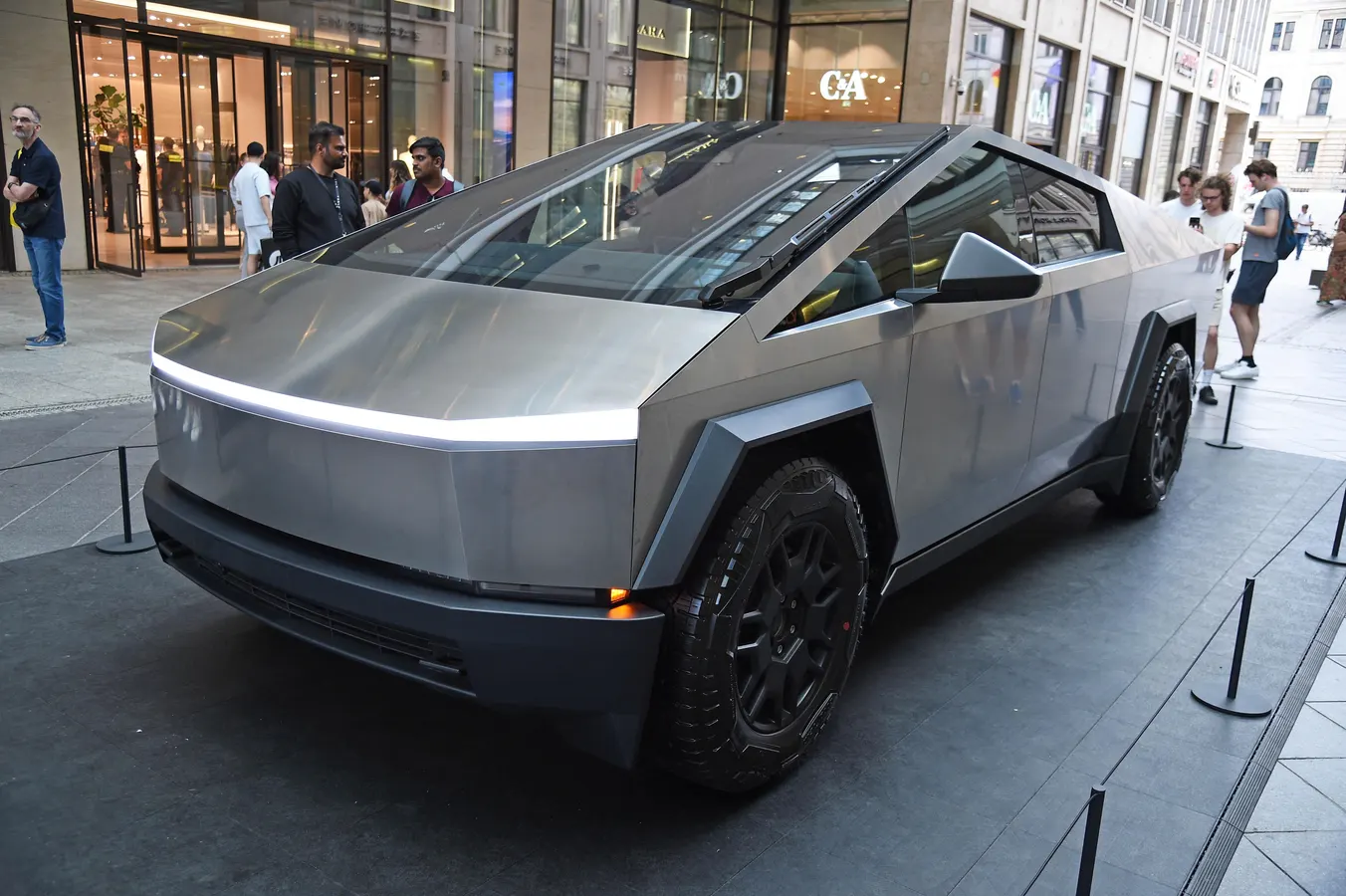
The Cybertruck's Design: It is not a "safety cell" with soft bumpers. It is a "rigid exoskeleton." The "skin" is the structure. That "ultra-hard" 30X-series cold-rolled stainless steel is, by definition, designed to not deform. It’s a vault. It is engineered to protect the occupants by being an impenetrable, unyielding object.
-
The Inherent Conflict: In a low-speed collision with a pedestrian, the Cybertruck's front end has no "give." It will not crumple. It will not absorb. It will act as a rigid steel wall. For a European regulator at Germany's KBA or the Netherlands' RDW, this is not a "design flaw"; it is an "automatic failure." It violates the entire spirit and letter of EU passive safety law, which prioritizes the "Vulnerable Road User" (VRU).
Elon Musk famously demonstrated the truck's strength by having someone hit the door with a sledgehammer, and the hammer bounced off. To an EU regulator, this isn't a feature; it's the entire problem.
2. The "Sharp Edges" Problem: A Violation of "External Projections" Law
This is the second, and just as fatal, flaw. EU law is obsessed with the shape of a car's exterior.
-
The Law (UN-R ECE R26): This is one of many "UN Regulations" that govern vehicle design, which the EU has adopted as law. This specific rule governs "external projections." It states that any part of the car's exterior that a pedestrian could strike (which is essentially everything) must be "blunted" or "rounded" to prevent "laceration and puncture" injuries.
-
The "Radius of Curvature" Rule: The law is incredibly specific. It mandates that all forward-facing edges, corners, and "styling lines" must have a "radius of curvature" of at least 2.5mm (and in some cases, 5mm or more). You must not be able to "cut" someone. Think of the front of a modern Porsche 911 or a VW Golf—every edge is soft, rounded, and smooth, even when the styling looks "sharp."
Now, look at the Cybertruck.
-
The Cybertruck's Design: It is a vehicle defined by the complete absence of "radius of curvature." The front hood is a "knife-edge." The apex of the roof is a sharp point. The wheel arches are flat, sharp-angled planes of steel.
-
The "Significant Deviation": These are not small issues. These are "significant deviations" from the law. A KBA inspector can (and will) literally take a 2.5mm radius gauge, hold it up to the Cybertruck's hood, and when it fails to make contact, they will stamp "REJECTED" on the file. There is no ambiguity here.
These two issues—the rigid body and the sharp edges—are not "features" that can be turned off with a software update. They are the Cybertruck.
3. Body Section 2: What is "Homologation" and Why Did the Cybertruck Fail?
This is the key procedural roadblock. For your American readers, the process is simple: a manufacturer "self-certifies" that its vehicle meets all federal (NHTSA) standards and puts it up for sale.
Europe operates on a completely different "gatekeeper" system called "Type Approval" or "Homologation."
-
What is Homologation? A car cannot be sold anywhere in the EU until it receives a "passport." To get this passport, the manufacturer (Tesla) must submit the car to one of the EU's national type-approval agencies (like Germany's KBA or the Netherlands' RDW).
-
The Process: That agency then conducts a brutal series of tests, checking everything against thousands of pages of EU/UN regulations. This includes:
-
Passive Safety: Pedestrian impact tests, crash tests, external projections (R26).
-
Active Safety: Braking, steering, stability control.
-
Emissions & Noise: (Easy for an EV, but still required).
-
Lighting & Visibility: The position, brightness, and angle of all lights and the driver's field of vision.
-
If the car passes every single test, it receives its "EU Type Approval," and that "passport" is valid in all 27 EU member states.
The Cybertruck failed at the first and most fundamental step: Passive Safety.
It's Not Just Pedestrian Safety (Though That's the Killer)
While the pedestrian safety rules were the "deal-breaker," homologation experts point out that the KBA and other bodies would have found dozens of other non-compliance issues.
-
1. Weight Classification (The N1 Problem): The Cybertruck's Gross Vehicle Weight Rating (GVWR) is extremely high, likely pushing it out of the M1 (passenger car) category and into the N1 (commercial vehicle / light-goods vehicle) category. While some hopefuls thought this was a "loophole" (as N1 rules can be slightly different), it's not.
-
Why it's not a fix: The core pedestrian safety rules (regarding bumpers and external projections) still apply to most N1 vehicles.
-
New Problems: Being an "N1" truck introduces new problems, like potential requirements for commercial speed limiters (e.g., 90 km/h in some countries), different driver's license requirements (a "C" license in some cases), and different tax/insurance laws. It's not a "get out of jail free" card; it's just a different, more complicated jail.
-
-
2. Lighting & Visibility:
-
Light Bar: The Cybertruck's signature, full-width front "light bar" is almost certainly illegal as a primary "headlight" in the EU, which has strict rules on the number, position, and separation of main beam headlights.
-
"Sail Pillar" Blind Spot: The massive, triangular "sail pillar" behind the cab creates a gigantic rear-quarter blind spot. EU regulations on "driver's field of vision" (both direct and indirect, via mirrors/cameras) are notoriously strict. Regulators would likely have failed the vehicle on this alone.
-
The U.S. Army Warning: The Ultimate "Proof"
This is what makes today's news so definitive. The U.S. Army Customs Agency for Europe's warning to soldiers is the "nail in the coffin."
Military personnel often have the privilege of "personally importing" their American-spec vehicles to their European duty stations. But that privilege stops if the car cannot be legally registered with the local government (e.g., the German Zulassungsstelle).
The US Army's warning confirms that their own experts, liaising with local European governments, have concluded that the Cybertruck lacks the required EU Type Approval and cannot be made to comply. They are, in effect, warning their own people: "If you bring this $100,000 vehicle here, it will be nothing more than a very expensive lawn ornament on the military base. You will not be able to drive it to the grocery store in Berlin."
4. Body Section 3: Could Tesla Make a "Euro-Spec" Cybertruck?
This is the next logical question, and the answer is almost certainly no—not without destroying the entire concept of the Cybertruck.
To make the Cybertruck compliant with EU law, Tesla would have to:
-
Change the Entire Exoskeleton: They would have to abandon the "ultra-hard" 30X stainless steel, which is the truck's entire USP (Unique Selling Proposition). They would need to replace it with a softer, deformable material.
-
Completely Redesign the Front End: The entire "knife-edge" front of the truck would have to be scrapped. It would need a new, "soft" (likely plastic-covered), energy-absorbing bumper. The hood would need to be redesigned with deformable "hinges" and materials to cushion a pedestrian's head.
-
Round Off Every Single Edge: Every sharp, flat, "cyberpunk" aesthetic line on the vehicle would have to be rounded, smoothed, and "blunted" to meet the 2.5mm radius rule.
-
Re-engineer the Lighting: The full-width light bar would be gone, replaced by two standard, EU-compliant headlamps.
-
Fix the Visibility: The "sail pillar" would likely need to be completely redesigned, perhaps with a window, to allow for legal visibility.
At the end of this process, what would you have?
You would have a soft-edged, plastic-bumpered, round-bodied, non-steel truck that looks nothing like the Cybertruck. You would have a vehicle that is a watered-down, ugly, and compromised shadow of its original self.
The Cybertruck is a product of "design absolutism." It cannot be compromised. And because it cannot be compromised, it cannot be sold in Europe.
This confirms what Elon Musk has hinted at in the past: that the Cybertruck was always designed "only for North America." He has mentioned that, in the future, Tesla might design a new, smaller, different truck that is "globally compliant" for the European and Asian markets. Today's news simply confirms that this "two-truck" approach is the only path forward.
5. Conclusion: A Tale of Two Markets – The Great Regulatory Divide
This story is the ultimate example of a deep, philosophical chasm that divides the world's two largest automotive markets.
-
The American Philosophy: Occupant Protection. The US market, and its regulations (NHTSA), are overwhelmingly focused on occupant protection. The Cybertruck is the ultimate expression of this philosophy. It's a rigid "vault" that protects the people inside from the dangers outside. The bigger, heavier, and harder the vehicle, the "safer" it is perceived to be for its driver.
-
The European Philosophy: Vulnerable Road User (VRU) Protection. The European Union market, and its regulations (UNECE), are philosophically obsessed with protecting those outside the car. Their laws are written from the perspective of the pedestrian, the cyclist, and the child. A car is judged "unsafe" if it poses an undue risk to the public. A rigid, unyielding, sharp-edged "vault" is the literal definition of an unsafe vehicle in their eyes.
The Cybertruck is the first major electric vehicle to be a casualty of this great regulatory and cultural divide. It is a uniquely American icon, built for a uniquely American set of rules and values.
What This Means for You:
-
For our European Owners: This is the definitive "no." You can stop waiting. The Cybertruck is not coming, and you can make your future vehicle plans accordingly. Any Cybertruck you see on a street in Berlin or London is a temporary "display" model on manufacturer plates, a diplomatic import, or a non-street-legal oddity—it is not, and will not be, a legally registered car.
-
For our American Owners: This cements the Cybertruck's status as a pure-bred American legend. Its non-compliance in Europe only adds to its "outlaw" mystique. It was designed for you, and for you alone.
The Cybertruck proved that Tesla could break every "rule" of automotive design. It just couldn't break the laws of European regulation.
6. Frequently Asked Questions (FAQ)
-
Q: But I saw a Cybertruck with German plates in Berlin! How is that possible?
-
A: You likely saw a car with "Manufacturer" or "Dealer" plates (which have a different format, often starting with "HH" for Hamburg or "E" for Essen). These are temporary "trade plates" used for testing, display, or transport. They are not permanent, legal registrations for a private owner. In other rare cases, a non-EU diplomat (who is not subject to local law) might import one. It is not a car a German citizen can buy and register.
-
-
Q: Can't I just import one to France/Germany myself under "Individual Vehicle Approval" (IVA)?
-
A: While an IVA process exists, it is designed for minor deviations (e.g., changing headlights on a US-spec Ford Mustang). It is not designed to bypass fundamental, non-negotiable safety laws. The Cybertruck would fail an IVA inspection instantly on the exact same grounds as the Type Approval: its rigid body and sharp external projections. It is a non-starter.
-
-
Q: This is ridiculous. Can't Tesla just put a "rubber" coating on the front edges?
-
A: This is a common "forum" suggestion, but it misunderstands the law. The law isn't just about "sharpness"; it's about energy absorption. A thin rubber "lip" glued to a rigid steel frame does nothing to solve the core problem of the non-deformable, non-crumpling body. It would be a "cosmetic" fix that would still fail the dynamic impact tests.
-
-
Q: Does this ban mean the upcoming $25,000 "Model 2" will also have trouble in the EU?
-
A: Absolutely not. This is a key distinction. The "Model 2" (or "Project Redwood") will be a global vehicle, just like the Model 3 and Model Y. It is being designed from day one with EU, US, and Chinese regulations as its core brief. It will be fully homologated, compliant, and will have all the required "soft" bumpers, crumple zones, and rounded edges. The Cybertruck was an exception; the Model 2 will be the rule.
-