
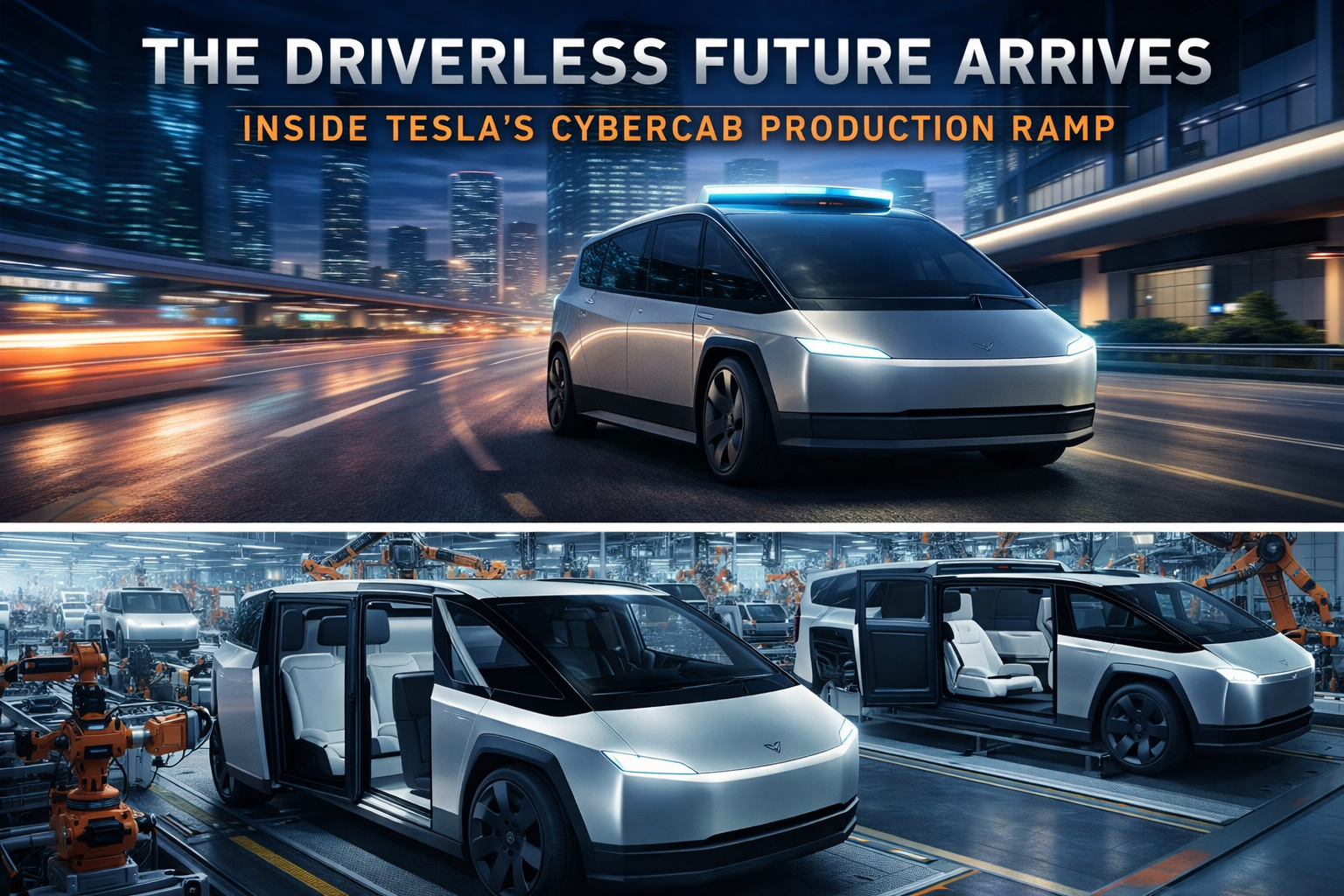
In the silence of a Texas factory, the future of transportation is being assembled without a steering wheel in sight. The promise of a ride hailed by an app, executed by an AI, and charged by the mile is no longer a concept. It's on the assembly line.
On a recent winter morning in Austin, Texas, a modified Model Y with no one in the driver's seat navigated a complex intersection, its movements guided entirely by artificial intelligence. This wasn't a one-off test but part of a quiet, expanding service that represents the vanguard of a revolution.
The culmination of this vision—the purpose-built, steering-wheel-free Tesla Cybercab—is now set to begin mass production at the company's Texas factory.
This marks the tangible start of Tesla's long-promised Robotaxi network, a move that threatens to redefine not just urban mobility, but the very economics of transportation and the concept of car ownership itself.
01 The Conveyor Belt Beckons: From Silicon Valley Vision to Texas Assembly Line
For years, the Tesla Robotaxi existed primarily in the realm of keynote presentations and Elon Musk's ambitious timelines. The narrative often outpaced the hardware. However, the landscape in early 2026 is decisively different. The company has pivoted from retrofitting existing consumer vehicles to building a machine designed from the ground up for a single task: autonomous mobility-as-a-service.
The heart of this effort is Tesla's Gigafactory Texas. Here, the core production lines dedicated to the Cybercab are reported to be "basically complete," with the company shifting its massive capital expenditure focus from factory construction to achieving "scalable mass production". This transition is critical.
It signals that the primary engineering challenges have moved from the prototype lab to the manufacturing floor, focusing on throughput, quality control, and cost reduction.
The vehicle emerging from this process is a stark departure from anything in Tesla's—or anyone else's—current fleet. Leaked images and specifications point to a compact, utilitarian pod. Its most radical feature is the complete absence of a steering wheel, brake, or accelerator pedals.
This is not an oversight but a philosophical statement: a total commitment to its Full Self-Driving (FSD) system. The interior is reconfigured around two passenger seats, maximizing cabin space within a small footprint optimized for urban navigation. Early reports suggest a distinctive "golden" exterior finish, visually setting these fleet vehicles apart from privately owned cars.
This dedicated design is the key to unlocking the economic model Musk has touted. By removing costly, human-centric components and designing for durability and ease of maintenance, Tesla aims to achieve a previously unthinkable manufacturing cost. The target is a vehicle priced under $30,000, a figure that would make large-scale fleet deployment financially plausible.
02 Engineering for Autonomy: The Hardware Behind the AI Driver
The Cybercab's minimalist passenger cabin belies a sophisticated technological core engineered for relentless, unsupervised operation. Every aspect of its design serves the goal of maximizing uptime and minimizing cost per mile.
The foundation is Tesla's controversial but unwavering "pure vision" approach. The vehicle relies on a suite of high-resolution cameras and a powerful, onboard AI computer, eschewing the laser radar (LiDAR) and detailed pre-mapped environments favored by competitors like Waymo.
Tesla's bet is that a sufficiently advanced neural network, trained on billions of miles of real-world data from its global customer fleet, can achieve superior safety and scalability at a fraction of the sensor cost.
Tesla's pure vision system relies on cameras and AI, unlike competitors' LiDAR-based approaches.
Energy efficiency is another cornerstone. Early data indicate the Cybercab is targeting a remarkable energy consumption of nearly 10 kilometers per kilowatt-hour (over 6 miles per kWh). This extreme efficiency directly attacks the largest operational expense for a fleet vehicle: energy.
Coupled with a focus on ultra-low aerodynamic drag, it enables a competitive range while keeping charging costs and downtime to a minimum.
The vehicle is also built for the realities of a commercial fleet. Features are being engineered for a "million-mile" lifecycle, with wireless charging pads and automated cleaning systems in development to allow for quick turnarounds at depots without human intervention. This focus on operational logistics highlights that Tesla is building not just a car, but an integrated service system.
03 The Business Model: A Calculus of Cents Per Mile
The true disruption of the Cybercab lies not in its engineering, but in its proposed economics. Tesla has projected an audacious goal: an operating cost of just $0.20 per mile. To appreciate the seismic shift this represents, one must dissect the cost structure of personal and commercial transportation today.
For a private car owner, the IRS mileage rate—which accounts for fuel, maintenance, insurance, and depreciation—often exceeds $0.60 per mile. For a traditional taxi or ride-hailing service with a human driver, the cost to the passenger can be $2.00 to $3.00 per mile or more, with the driver's wage constituting the largest portion.
Tesla's model dismantles this structure. At $0.20 per mile, a 10-mile urban trip would have a base cost of $2.00. Even with a markup for profit and overhead, it could be offered to consumers at a price far below current ride-hailing fares and competitive with public transit for many trips.
This creates a powerful value proposition that could rapidly drive adoption. It transforms transportation from a capital-intensive ownership model to an on-demand utility, priced like a subscription or pay-per-use service.
Tesla's strategic shift mirrors this. The company is actively moving its revenue model away from one-time car sales toward recurring software and service income. The move of FSD to a subscription-only model is a precursor; the Cybercab network is the main event.
Analysts at Goldman Sachs project the Chinese Robotaxi market alone could reach $47 billion by 2035, and Tesla's play is to capture a dominant share of a global market by being the first to achieve scale with a low-cost model.
04 The Road to Reality: Regulatory Hurdles and the Race for Approval
A flawless vehicle and a compelling business model are meaningless without regulatory permission to operate. Here, the path for Tesla's Cybercab diverges sharply between the United States and Europe, reflecting a fundamental clash of philosophies.
In the U.S., Tesla is employing a state-by-state, city-by-city strategy, leveraging relatively permissive testing regimes. It's fully driverless testing in Austin is a critical beachhead.
The approach is to demonstrate safety through accumulated, uneventful miles, building a case for expanded commercial operations. The fragmented U.S. regulatory landscape is a hurdle, but also allows for progressive expansion from friendly jurisdictions.
Europe presents a vastly more complex challenge. The regulatory framework is stricter, more centralized, and deeply cautious. Approval processes are meticulous and demand extensive validation. Tesla is reportedly targeting a key regulatory window, hoping for supervised FSD approval in Europe as soon as the coming months, with the Netherlands' RDW agency being a pivotal decision-maker.
However, European authorities are skeptical of Tesla's vision-only approach. The prevailing safety philosophy in Europe favors sensor fusion—the combination of cameras, radar, and LiDAR—as a necessary layer of redundancy.
Convincing regulators that AI and cameras alone are sufficient, especially in diverse and challenging weather conditions, remains Tesla's single greatest barrier to entry in the European market. This isn't just a technical debate; it's a regulatory and legal one that will determine the pace at which the Cybercab can roll out on the continent.
05 The Competitive Landscape: An Ecosystem in Flux
While Tesla captures headlines, it is entering a field where other players have been operating commercial services for years. The competitive dynamics reveal different strategies and stages of maturity.
Waymo, widely considered the technology leader, operates large commercial fleets in several U.S. cities. Its vehicles use a sophisticated and expensive suite of LiDAR and sensors, and rely on centimeter-accurate pre-mapped areas. This approach delivers a highly polished and safe user experience but at a high cost, making rapid geographic expansion difficult. Waymo's model is "technology-first, scale-second."
In China, companies like Baidu and Pony.ai have achieved something remarkable: the first whispers of profitability. Baidu's Apollo Go service reportedly achieved operational cost parity in certain districts.
Chinese players benefit from strong government support, coordinated "vehicle-infrastructure-cloud" ecosystems, and a pragmatic focus on optimizing operations within geofenced zones. Their strategy is "commercialization-first," proving the model can work at a city level.
Tesla's proposed third path is "scale-first, profit-later." By betting everything on low-cost manufacturing and its data-driven AI, it aims to flood cities with Cybercabs, using its cost advantage to undercut competitors and achieve dominance before turning its focus to robust profitability.
This is a capital-intensive gamble, backed by a planned 2026 expenditure of over $20 billion across its AI and robotics projects. The risk is that scaling a flawless autonomous system proves harder than anticipated, while the reward is potential market supremacy.
06 Impact on the Tesla Ecosystem and Existing Owners
For Tesla's core audience of vehicle owners, the rise of the Cybercab presents both intriguing possibilities and existential questions. The most direct impact is on the value proposition of FSD. As the AI driver is perfected for the commercial fleet, those improvements will continuously flow to consumer vehicles via over-the-air updates.
Your personal Tesla will literally become smarter by learning from the experiences of the Robotaxi fleet, enhancing the value of the FSD subscription you may already own.
More profoundly, Musk has hinted at a future where Tesla owners can enroll their own compatible vehicles into the "Tesla Network" as Robotaxis when not in use, creating a potential revenue stream from an otherwise depreciating asset. While this vision seems deferred in favor of the dedicated Cybercab, it remains a part of the long-term brand promise that adds a unique dimension to Tesla ownership.
However, the Cybercab also subtly challenges the status of car ownership. If a safe, affordable, and convenient robotaxi is always minutes away, does the significant expense of financing, insuring, and maintaining a private vehicle—which sits idle over 95% of the day—still make sense for urban dwellers?
Tesla is strategically positioning itself to win in either future: it will sell you the car you love to own, or it will sell you the ride you need, seamlessly. For the company, it's a hedge; for the auto industry, it's a disruption.
07 The Human Factor: Trust, Jobs, and the Urban Fabric
The success of the Robotaxi revolution hinges on a non-technological component: human acceptance. Will people trust a machine to navigate their children to school? Early rider feedback from Waymo and Baidu services suggests that once people experience a smooth, uneventful driverless ride, anxiety quickly turns to admiration. Tesla will need to cultivate this trust through transparent safety data and flawless early operations.
The societal implications are deep. The transportation sector is a massive employer. The displacement of professional drivers will be a significant economic and political challenge that companies and governments must manage through retraining and social policy. Conversely, it could improve road safety, as over 90% of accidents are attributed to human error.
Furthermore, the widespread adoption of Robotaxis could dramatically reshape cities. The need for vast parking lots could diminish, freeing up urban land for housing and parks. Traffic flow could improve with interconnected AI drivers, and access to affordable mobility could expand for the elderly and disabled. The Cybercab isn't just a new product; it's a catalyst for reimagining urban life.
08 The Long Road Ahead: Challenges and Strategic Risks
For all its promise, Tesla's Cybercab journey is fraught with formidable execution risks. History provides a note of caution: Musk's timelines for autonomous technology have been consistently optimistic, and projects like the Semi truck have faced significant production delays.
The Cybercab's production ramp and its AI5 chip supply are deeply intertwined, creating a complex supply chain vulnerability.
The financial commitment is staggering. The over $20 billion capital expenditure for 2026 is a bet that presupposes Tesla can achieve scale before its capital runway or investor patience runs thin. The company itself has acknowledged that the Cybercab may not be immediately profitable, framing early losses as "strategic" investments in future market dominance. This is a high-stakes gamble.
Finally, the "vision-only" technological bet, while potentially a masterstroke of cost reduction, remains unproven at the required scale and safety level. A high-profile incident, or a persistent inability to convince European regulators, could severely dent public confidence and slow adoption, handing an advantage to competitors with more conventional—and regulator-friendly—sensor stacks.
The coming 12-18 months will be a continuous live-fire test of Tesla's execution capability, technological prowess, and financial endurance.
The steering wheel, that century-old symbol of human control and automotive freedom, is being retired from the front lines of transportation.
The hum of the Texas assembly line is the sound of a calculated bet being placed—not just on a vehicle, but on a future where mobility is consumed, not owned. The success of the Cybercab won't be measured merely in units sold, but in the silent, driverless journeys that begin to rewrite the map of our cities and the economics of getting from A to B.