
1. Introduction: The Tweet That Killed the Perpetual License
The era of the "software-defined vehicle" has officially entered its most controversial phase. In a post on X (formerly Twitter) earlier today, January 14, 2026, Elon Musk confirmed what industry analysts have suspected for months: the option to purchase Full Self-Driving (FSD) capability for a one-time fee is ending.
For the past decade, the FSD package—priced anywhere from $5,000 in the early days to a peak of $15,000 in 2023, before settling recently at $8,000—was marketed as an investment. It was sold on the premise that the car would one day become an appreciating asset, a robotaxi that could earn income for its owner. That narrative effectively ended today.
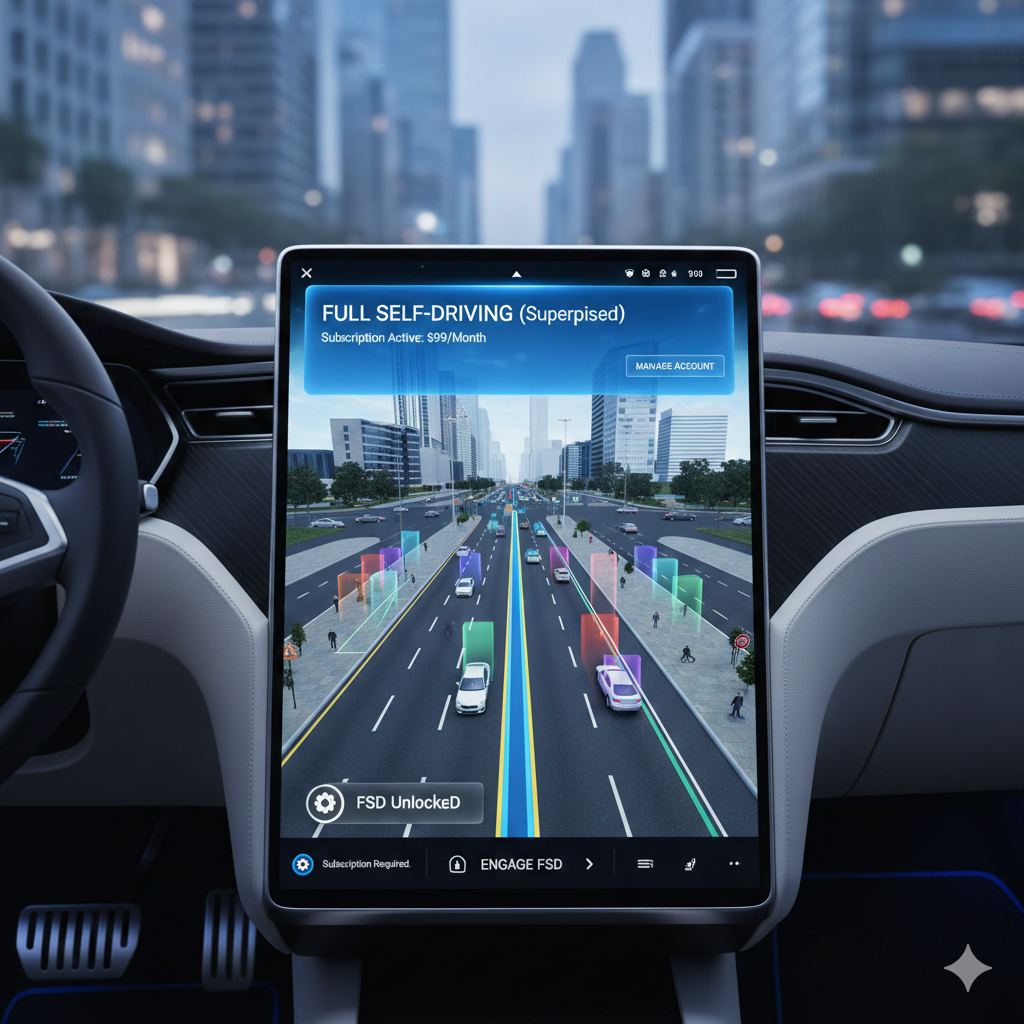
Effective February 14, 2026, new Tesla buyers will no longer have the option to add FSD as an upfront capital cost. Instead, accessing Tesla’s suite of autonomous driving features will require a non-negotiable monthly subscription, standardized at $99 (or €99 in Europe).
This move represents a seismic shift in Tesla’s relationship with its customers. It transforms the vehicle from a product you own into a platform you rent. For the tech-savvy demographics in Silicon Valley or the sustainability-focused drivers in Oslo, this change fundamentally alters the calculus of buying a Tesla. It is no longer just about range and charging infrastructure; it is now about the long-term economics of software dependency. As we dissect this announcement, we must look past the initial sticker shock and understand the corporate, economic, and technological gears turning behind the scenes.
2. The Financial Strategy: Why Wall Street Demands a SaaS Model
To understand why Tesla is making this move now, in early 2026, one must look at the company not as an automaker, but as a publicly traded tech giant facing a maturity crisis.
The Problem with Hardware Cyclicality
By the end of 2025, Tesla’s vehicle delivery growth had slowed to single digits. The explosive growth of the Model 3 and Model Y era has saturated the early-adopter and early-majority markets. In the automotive world, hardware sales are cyclical; they boom during economic upturns and crash during recessions. Wall Street hates cyclicality.
Software, however, is linear and cumulative. By switching FSD to a subscription-only model, Tesla is pivoting to a "Software as a Service" (SaaS) valuation. In the SaaS world, the holy grail is Annual Recurring Revenue (ARR). A one-time sale of $8,000 is great for a single quarter’s balance sheet, but a $99/month subscription from millions of users creates a predictable, high-margin revenue stream that lasts for the life of the vehicle—and crucially, the life of the next owner of that vehicle.
The "Take Rate" Math
Historically, the "take rate" (the percentage of buyers who purchased FSD upfront) was relatively low—estimated to be between 10% and 15% globally. The $8,000 barrier was simply too high for the average consumer, especially with high interest rates on auto loans.
By lowering the entry barrier to $99/month, Tesla bets that the take rate will triple or quadruple.
-
Old Model: 100 cars sold. 10 people buy FSD at $8,000. Total Revenue: $80,000.
-
New Model: 100 cars sold. 40 people subscribe at $99/month for 5 years. Total Revenue: $237,600.
The math is undeniable. Over the lifecycle of a fleet, the subscription model extracts significantly more value per VIN (Vehicle Identification Number) than the upfront purchase model, especially since the subscription revenue continues when the car is sold to a second or third owner.
Stabilizing the Stock Price
With Tesla’s market cap hovering around $1.5 trillion, the company needs to justify a Price-to-Earnings (P/E) ratio that dwarfs Toyota or Volkswagen. That justification comes from AI and software margins. Hardware margins are shrinking due to competition from Chinese heavyweights like BYD and Xiaomi. Software margins remains above 70%. This pivot is a defensive maneuver to protect Tesla’s stock valuation in a year where vehicle hardware profits are under attack.
3. Consumer Impact: The Break-Even Calculation (US vs. Europe)
For the consumer, the immediate reaction is often negative. "I hate subscriptions" is a common sentiment in an era of "subscription fatigue." However, when we run the numbers, the reality is nuanced, and the impact differs significantly between the US and European markets.
The American Driver: A Lease-Friendly Shift
In the United States, the average length of new car ownership is approximately 6 years. However, a significant portion of luxury EV buyers lease their vehicles for 36 months (3 years).
Under the old model, leasing a Tesla with FSD was financially painful. The $8,000 cost was residualized, meaning you paid a massive chunk of it during the lease, but walked away with nothing.
-
The Math: To equal the $8,000 upfront cost at $99/month, a driver would need to subscribe for roughly 80 months (6.7 years).
For anyone leasing a Tesla, or anyone who plans to trade in their car within 6 years, the subscription model is objectively cheaper. It lowers the barrier to entry, allowing drivers to turn FSD on for road trips and off for daily city commuting, offering flexibility that the "permanent license" never did.
The European Driver: The "Beta" Tax
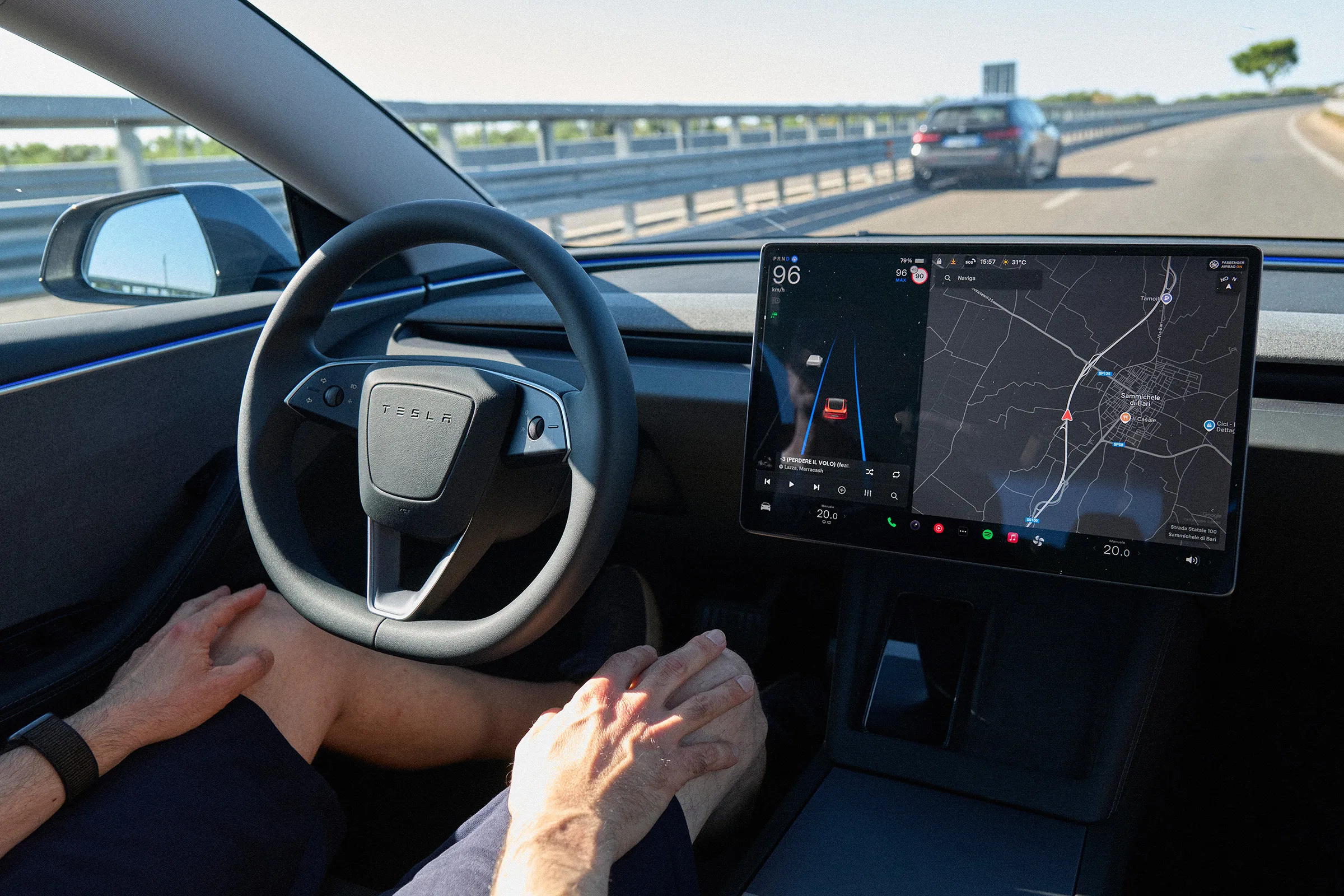
For European drivers, the calculation is far more bitter. In the US, FSD (Supervised) V13 is a capable, albeit imperfect, system that can navigate city streets. In Europe, due to UNECE regulations and the RDW’s strict oversight, FSD is severely neutered. It cannot perform sharp maneuvers, has limited torque application on the steering wheel, and often requires more driver intervention than its US counterpart.
Asking a German or French customer to pay €99/month for a system that is still functionally "Enhanced Autopilot" feels like a tax on hope. European customers are effectively funding the neural network training that primarily benefits US drivers. Until the EU regulatory framework changes (hopefully later in 2026), the value proposition for the European subscriber is incredibly low compared to the American subscriber.
The "Lock-In" Effect
The danger for consumers lies in price elasticity. Once the upfront option is gone, Tesla has a monopoly on the software for your car. While the price is $99 today, there is no guarantee it won't rise to $149 or $199 in 2028 as the software improves. Without the anchor of a "lifetime purchase price," the ceiling for monthly fees is theoretically unlimited.
4. Hardware Longevity: The HW3 vs. HW4 Divergence
One of the most critical aspects of this announcement is how it interacts with the hardware fragmentation in the current fleet. We are currently seeing a divergence between Hardware 3 (HW3) and Hardware 4 (AI4).
The Fairness of Flat-Rate Subscriptions
If you own a 2020 Model 3 with HW3, your cameras are lower resolution (1.2 megapixels) compared to the 2026 Model Y with AI4 (5 megapixels). We are already seeing evidence that V13 software runs smoother and more confidently on the newer hardware.
Yet, the subscription price is uniform: $99. This creates a disparity in value. An HW4 owner is paying $99 for a high-fidelity experience. An HW3 owner is paying $99 for a system that is pushing the limits of its compute buffer. As time goes on, and the neural nets become more complex, the "legacy" fleet may see performance stagnation.
The Subscription as a Shield?
Conversely, the subscription model protects the consumer from "hardware regret." In the old days, if you paid $15,000 for FSD on a car that became hardware-obsolete three years later, you lost that investment. With a subscription, if your car’s hardware can no longer run the latest FSD build effectively, you simply cancel the subscription. In this sense, the SaaS model aligns the incentives: Tesla must keep the software working well on older hardware, or they will see a mass wave of cancellations (churn) from HW3 owners.
5. Market Reaction: The "Grandfathered" Fleet and Resale Value
Perhaps the most fascinating secondary effect of this announcement will be on the used car market.
The Rise of the "Unicorn" Tesla
Cars purchased before February 14, 2026, with the FSD package fully paid for, are now "Grandfathered." They possess a perpetual license that travels with the VIN (assuming Tesla does not strip it upon trade-in, which they have historically done intermittently but recently stopped).
These cars will likely command a premium on the private party market. A 2024 Model Y with "Permanent FSD" will be highly attractive to high-mileage drivers or those who plan to keep the car for 10+ years. It creates a split in the used market:
-
Subscription Cars: Lower resale value, as the second owner inherits a monthly bill.
-
Perpetual Cars: Higher resale value, as the second owner inherits a "free" autonomous capability.
The Dealer Dilemma
For third-party dealers, valuing a Tesla just got harder. They must now verify if a specific VIN has the permanent license or if it was just on a subscription that expired the moment the previous owner stopped paying. This adds friction to the trade-in process and may lead to undervalued trade-in offers from dealers who don't understand the nuance.
6. Conclusion: From Automaker to Utility Provider
The discontinuation of the FSD perpetual license is not just a pricing update; it is an identity shift. Tesla is signaling that Autonomous Driving is not a feature of the car, like leather seats or alloy wheels. It is a utility, like electricity or data, that flows into the car.
For the shareholder, this is a brilliant move to secure the company's future revenue in a slowing hardware market. For the lessee and the casual user, it lowers the barrier to entry and reduces risk. But for the hardcore Tesla loyalist—the person who believed in buying the "future" upfront—today marks a melancholy end to the era of ownership. The car in your driveway is no longer fully yours; its brain is now a service you rent, $99 at a time.
As we look toward the February 14th cutoff, we expect a surge in FSD purchases as buyers rush to lock in the permanent license one last time. After that, the subscription era begins, and Tesla will have to earn your $99 every single month by delivering value, not just promises.
7. FAQ (Frequently Asked Questions)
Q1: I already paid $8,000 (or $12k/$15k) for FSD. Do I have to start paying the subscription? No. Your vehicle is "grandfathered" in. You own the perpetual license for the life of that specific vehicle. You will not be charged the monthly fee.
Q2: If I buy a used Tesla that has FSD, will I lose it and have to subscribe? If you buy from a private party, the FSD license generally transfers with the VIN, so you keep it. If you buy from a third-party dealer, it usually transfers. However, if you buy a used Tesla directly from Tesla inventory, they often strip the FSD software to resell it or force you to subscribe. Always check the specific configuration of the VIN before buying.
Q3: Can I transfer my current permanent FSD to a new car after Feb 14, 2026? Tesla has not announced a permanent transfer policy. Historically, they have only allowed FSD transfers during limited-time end-of-quarter promotion windows. Without a specific active promotion, you cannot transfer your license; you would have to subscribe on the new car.
Q4: Will the subscription price increase? While the price is currently fixed at $99/month, there is no contract guaranteeing this price forever. As Tesla adds features (like Unsupervised City Driving), it is highly likely the subscription tier could split or increase in price in future years.
Q5: Does this affect EAP (Enhanced Autopilot) in Europe? Tesla has not explicitly clarified the fate of the standalone EAP package in Europe. However, typically, EAP features are subsumed into the FSD subscription. It is likely EAP as a purchase option will also be phased out in favor of the single FSD subscription tier.
Q6: I have a lease ending soon. Should I buy out the car to keep FSD? If you have a low residual value on your lease and you have the "old" FSD locked in, buying out the lease might be financially wise, as you would own a car with a software package that can no longer be bought permanently.