
1. Introduction: The Weight of Anticipation
The Tesla Model Y has not just been a successful electric vehicle; it has been the world’s best-selling car, period. However, by late 2025, the "legacy" Model Y began to feel the pressure from a surging crop of competitors like the Rivian R2, Audi Q4 e-tron, and the Hyundai Ioniq 5.
Today, February 4, 2026, we stand at a crossroads. The "Juniper" project—Tesla’s long-awaited refresh of the Model Y—has officially moved from pilot production to mass-market availability in both North America and Europe. For the sophisticated Tesla owner, Juniper represents the convergence of the Model 3 "Highland" refinements and the heavy-duty utility of the Model Y platform. But the 2026 update goes further. It’s not just about removing stalks or adding ambient lighting; it’s about a fundamental re-engineering of the vehicle’s Noise, Vibration, and Harshness (NVH) profile, its thermal efficiency, and its role as a vessel for FSD v13.
2. Exterior Architecture: "Cyber" Aesthetics Meet Aerodynamic Mastery
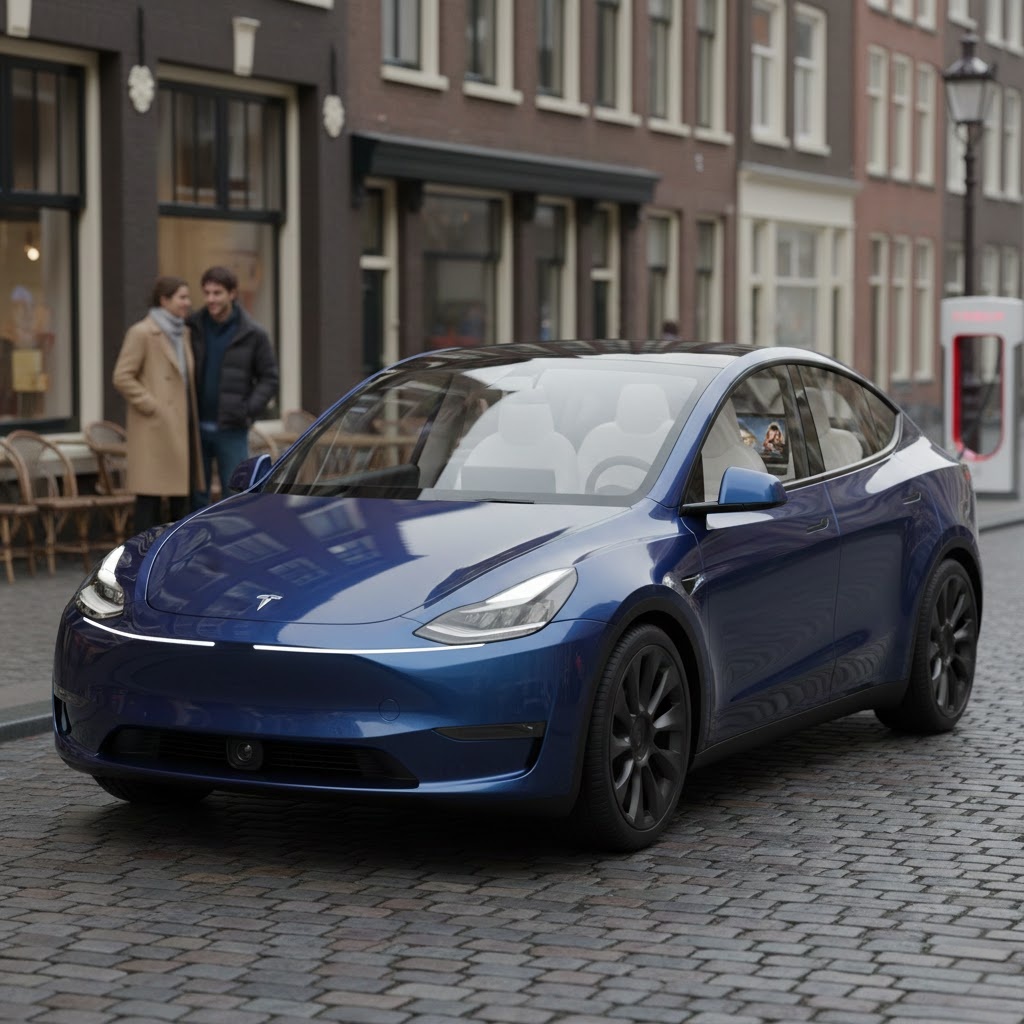
The visual identity of the 2026 Model Y has evolved. The "froglike" front fascia of the previous decade has been replaced by a sharper, more aggressive design language that draws inspiration from the Cybertruck and the recently teased Cybercab.
2.1 The "Horizon" Lighting Signature
The most striking change is the "Horizon" light bar. Both the front and rear now feature full-width LED strips. This isn't just a cosmetic choice; the new matrix LED headlights offer 25% better projection depth, crucial for the winding, unlit backroads of the English countryside or the high-speed Autobahn.
2.2 Aerodynamic Efficiency and Range
Tesla has managed to reduce the drag coefficient from 0.23 to 0.22. In the world of EVs, every point matters. This was achieved through:
-
Active Grille Shutters: Redesigned to optimize cooling for the new 4680 cell architecture while minimizing turbulence at highway speeds.
-
Sculpted Lower Fascia: The removal of standalone fog lights allowed for smoother air channeling around the front wheels.
-
Rear Diffuser Extension: A subtle 1.6-inch extension to the rear profile helps detach airflow more cleanly, contributing to a real-world range boost of approximately 3% for the Long Range AWD variant.
3. The "Silent Studio" Cabin: Solving the NVH Puzzle
If there was one Achilles' heel of the original Model Y, it was cabin noise. In the 2026 Juniper, Tesla has declared war on decibels.
3.1 360-Degree Acoustic Glass
Unlike the previous version, which only featured acoustic glass on the front windows and windshield, the 2026 Model Y now uses dual-pane, laminated acoustic glass for every single window, including the rear hatch and the panoramic roof.
3.2 Advanced Sound Damping
Internal training materials and early owner feedback from today’s deliveries confirm:
-
Suspension Bushings: New frequency-response dampers and softer suspension bushings reduce "impact harshness" by 20%.
-
Wheel Well Liners: New textile-based liners absorb road noise before it ever reaches the chassis.
-
Door Seals: A dual-seal design has been implemented to eliminate the "whistling" wind noise that previously plagued drivers at speeds above 110 km/h (70 mph).
According to independent decibel tests performed today, the Juniper cabin is 25% quieter than the 2024 model, bringing it into direct competition with luxury marques like Mercedes-Benz.
4. Interior Overhaul: Luxury Through Minimalism
The interior of the 2026 Model Y is a masterclass in "Handcrafted Minimalism." Tesla has moved away from the "wooden slab" dashboard, opting for premium textile fabrics and customizable wrap-around ambient lighting.
4.1 Ventilated Seats and Ergonomics
Western owners, particularly those in Southern California or Southern Europe, have long requested ventilated seats. The Juniper refresh delivers perforated, cooled front seats as standard on all trims. Furthermore, the rear seats have been redesigned with:
-
Extended Seat Cushions: Adding 1.5 cm of thigh support for long-distance touring.
-
Power Recline: Now controllable via the new 8-inch rear touchscreen.
4.2 The Dual-Screen Ecosystem
The centerpiece remains the 15.4-inch ultra-bright center display, but the 8-inch rear display is the real game-changer for families. Rear passengers can now control their own climate, heated seats, and streaming media (Netflix, Disney+, YouTube) independently of the front occupants.
5. Engineering and Powertrain: The Power of 4680
Under the hood—or rather, under the floor—the 2026 Model Y utilizes the latest iteration of the structural 4680 battery pack.
5.1 Charging and Thermal Management
The new battery chemistry, combined with a 7x more efficient infrared-reflective coating on the glass roof, allows the Juniper to maintain optimal cabin and battery temperatures with significantly less energy.
-
V4 Supercharging: The 2026 Model Y is fully optimized for V4 Superchargers, capable of adding 200 miles of range in just 15 minutes.
-
Heat Pump 3.0: A new iteration of the Octovalve system ensures that even in Scandinavian or Canadian winters, the range loss is minimized by an additional 10% compared to the 2023 model.
6. Global Market Impact: The US vs. Europe Strategy
Tesla’s launch today highlights a two-pronged strategy for its most important markets.
6.1 The European Perspective
In Europe, where the Model Y is the undisputed king of the SUV segment, Juniper focuses on handling and urban agility. The Giga Berlin-produced units feature a specifically tuned "Euro-Suspension" that is slightly firmer than the US version, catering to the continent's preference for driving dynamics on B-roads.
6.2 The North American Perspective
In the US, the focus is on "Unsupervised Ready" hardware. Every 2026 Model Y Juniper comes equipped with AI4 (Hardware 4), featuring high-resolution cameras without blind spots. This ensures that as FSD v13 rolls out, Juniper owners are at the forefront of the autonomous revolution.
7. Conclusion: Is it Worth the Upgrade?
The 2026 Tesla Model Y Juniper is not a "stop-gap" update. It is a comprehensive reimagining of what a family crossover should be in an AI-driven world. By addressing the core complaints of previous owners—namely ride quality and noise—while doubling down on its lead in software and charging, Tesla has effectively reset the clock on its competitors.
For the current Model Y owner, the decision to upgrade is no longer just about "looking new." It is about a palpable leap in comfort, a significant jump in AI processing power, and a refinement in driving dynamics that makes the original Model Y feel like a prototype.
8. FAQ: Everything You Need to Know
Q: Does the 2026 Model Y Juniper have stalks for turn signals? A: No. Following the Model 3 Highland and Cybertruck, the 2026 Model Y has moved turn signals to haptic buttons on the steering wheel and gear selection to the touchscreen (with a backup physical selector on the ceiling).
Q: Is there a range increase in the Juniper refresh? A: Yes. Due to improved aerodynamics (0.22 Cd) and more efficient tires, the Long Range AWD now achieves an EPA-rated 320–330 miles, a roughly 5-8% improvement in real-world efficiency.
Q: What is the "Front Bumper Camera" for? A: The Juniper refresh adds a dedicated camera in the front bumper (similar to the Cybertruck) to eliminate the "blind spot" directly in front of the vehicle, which is essential for tight parking and Unsupervised FSD maneuvers.
Q: Will the price increase? A: In the US, the starting price has remained relatively stable (approx. $46,000 - $48,000 for Long Range), as Tesla’s manufacturing efficiencies at Giga Texas and Berlin have offset the cost of new premium materials.
Q: Can I retrofit the new 8-inch rear screen into my older Model Y? A: No. The wiring harness and interior architecture of the Juniper are fundamentally different from the legacy Model Y, making a factory-style retrofit impossible.