
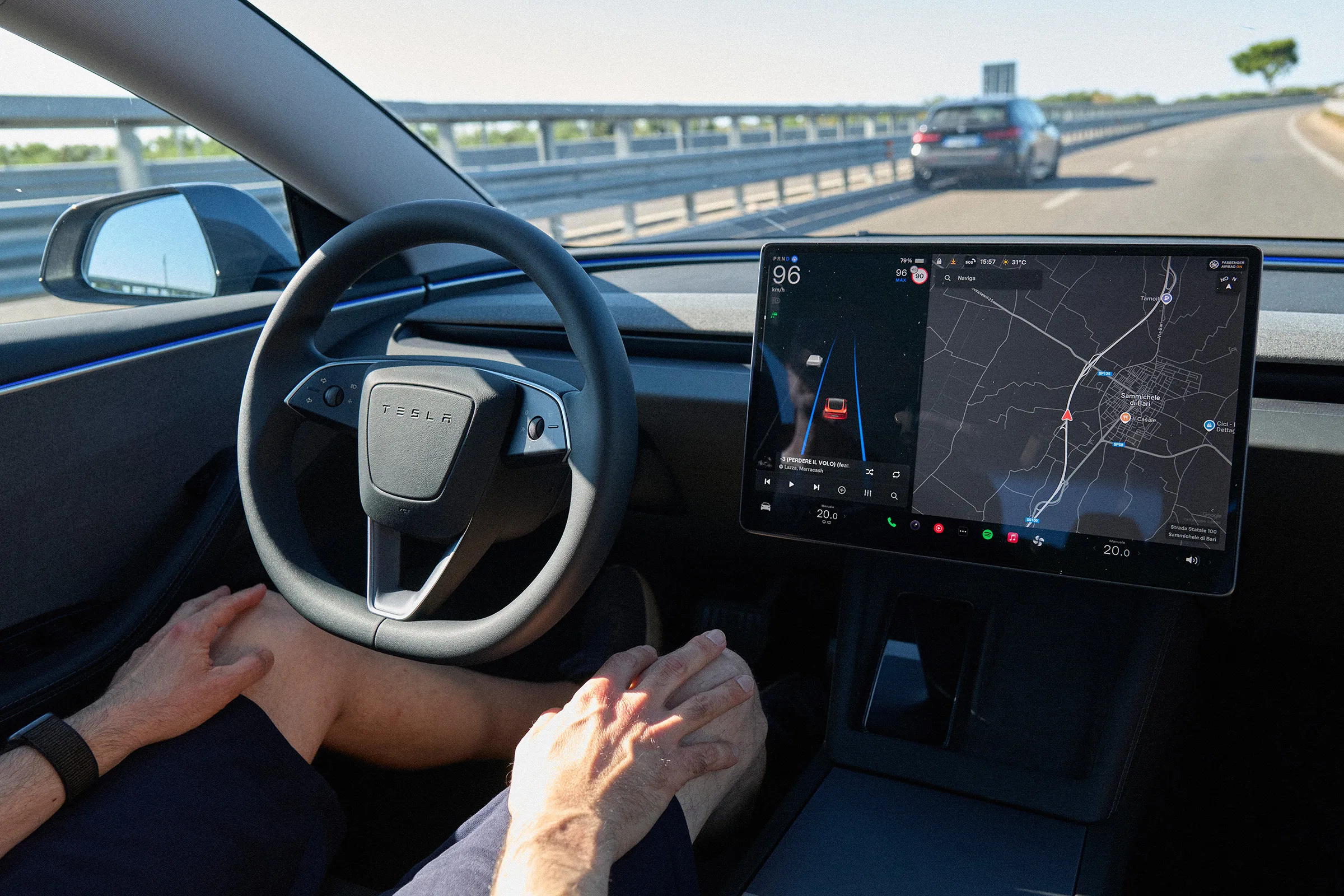
Introduction: A Tale of Two Continents
"Full Self-Driving (Supervised)" is Tesla's "moonshot." It is the technological quest that underpins the company's narrative, its mission to "accelerate the world's transition to sustainable energy," and, according to analysts at firms like Stifel and Cantor Fitzgerald, the core justification for its $1.5 to $2 trillion valuation. It is the company's single biggest promise.
But in late 2025, FSD is living a fractured, double life. It is a tale of two continents.
In the United States, owners are on the front lines of an AI revolution. They are active participants in the development of FSD v12 and its recent iterations (like v12.5.6 and v12.6.4), experiencing the "end-to-end AI" that navigates complex city streets with a "human-like" fluidity that is, by turns, breathtaking and terrifying. The progress is tangible, rapid, and visible with almost every new monthly software push.
In Europe, owners are stuck in regulatory purgatory. They have paid for a promise that remains tantalizingly out of reach. The "FSD" they experience is a feature in name only, a heavily restricted, "nerfed" shadow of its American counterpart. It is bound by aggressive "nags," crippled by limited functionality, and fundamentally incapable of the very "city streets" driving that defines the modern FSD stack.
This "Great Divide" is not a simple software deployment lag. As one European EV journalist recently called it, it is a "regulatory chasm," and it appears to be widening. This chasm is built on fundamentally different philosophies of safety, data privacy, and corporate liability. And as Tesla makes its first tentative efforts to bridge this gap—such as new reports this week of proposed FSD tests in a new Swedish city—it is finding the climb more treacherous than ever. This divide is now the single greatest threat to Tesla's global Robotaxi ambitions.
Chapter 1: The US Trajectory: The "End-to-End AI" Revolution
To understand the chasm, we must first appreciate the mountain Tesla is climbing in its home market. The leap from FSD v11 to FSD v12 was the most significant in the company's history.
What is FSD v12+ (v12.5, v12.6, etc.)?
Before v12, FSD was a marvel of traditional, rule-based software. Tesla engineers had written over 300,000 lines of explicit C++ code. This was a "heuristics" model: "IF a red light is detected, THEN apply brake," "IF a lane line is solid, THEN do not cross." While smart, it was brittle. It failed when it encountered a situation the engineers hadn't explicitly programmed for—a "long-tail" event.
FSD v12 threw that all away.
It is a true "end-to-end AI" or "single-stack" system. Instead of code, the car's driving decisions are governed by a massive neural network. The system learns to drive simply by watching petabytes of video data from the Tesla fleet. It is not programmed with rules; it is trained on outcomes. It learns what a "good" driver does (e.g., "creeping" forward at a blind intersection) by observing millions of human drivers doing it successfully. The neural net outputs steering, braking, and acceleration commands directly.
The Owner Experience in the US (Late 2025)
This new architecture is what is thrilling US owners. After a slow rollout, the iterations are coming fast.
-
True "City Streets" Autonomy (Supervised): This is the game-changer. US owners are now experiencing a system that can, with supervision, navigate their entire commute. It handles "naked" unprotected left turns, navigates complex roundabouts, and responds to construction zones and pedestrians with a new, less-robotic "assertiveness."
-
AI "Personalities": Iterations like v12.5.6 introduced new driving profiles: "Chill," "Standard," and "Hurry" (later renamed "Assertive"). This isn't just changing follow-distance; it's a setting for the AI's personality. "Hurry" mode will make more aggressive lane changes to get to a destination faster, mimicking a human driver in a rush.
-
Rapid, Visible Iteration: US owners feel like they are part of the development process. They are, in effect, the world's largest R&D fleet. New software versions (like the 2025.32.x.x builds) drop, and suddenly the car handles a previously difficult intersection near their home perfectly. The "end-to-end" model means improvements are holistic, not just small patches.
The US Regulatory "Green Light"
How is this allowed? Because the United States operates on a "self-certification" model for L2 systems. There is no "EU-style" pre-approval body that must test and validate FSD before deployment.
Tesla is free to push any software it wants, as long as it does two things:
-
Self-Certify: Tesla tells the National Highway Traffic Safety Administration (NHTSA) that its system is safe and meets all federal motor vehicle safety standards.
-
Ensure Driver Supervision: The system must be "Level 2" (SAE J3016). This means that despite the "Full Self-Driving" name, the human is legally the driver at all times. The "nag" (the torque sensor on the steering wheel) is Tesla's mechanism for enforcing this.
This regulatory environment allows for maximum-speed innovation. The "Supervised" moniker, heavily pushed by Tesla since 2024, is its key legal and marketing shield. It places all liability on the driver, allowing the software to learn in the real world.
Chapter 2: The European "Regulatory Chasm": Why Europe is Stuck
The European Union and the United Kingdom (which largely mirrors EU rules) operate on a completely opposite philosophical framework. Where the US says, "Innovate, but be liable," Europe says, "Prove to us you are safe before you innovate."
The "Mother, May I?" Philosophy: Type Approval
An automaker cannot sell a car in Europe until it has received "type approval." This means every system—from the headlights to the engine and, yes, the driver-assist software—has been tested and certified by a national regulatory body (like Germany's KBA) to meet a specific, harmonized set of rules.
This is where Tesla's FSD hits a brick wall. There is no rule for a "Level 2" system that can drive on city streets. The existing rules actively prevent it.
The UNECE Regulations: The Legal Cage
The rules governing all of Europe (including the UK, post-Brexit) come from the United Nations Economic Commission for Europe (UNECE). Two regulations, in particular, are the bars of Tesla's cage.
-
UNECE R79 (Steering Equipment): This is the "original sin" of European Autopilot restrictions. R79 was an old rule designed for simple lane-keeping. It places strict limits on how much and how fast an automated system can turn the steering wheel. This is why European Autopilot has always felt "nerfed" on highways, disengaging on curves that the US version handles with ease. It also, by its very nature, makes sharp, 90-degree city-street turns (the core of FSD v12) legally impossible.
-
UNECE R157 (Automated Lane Keeping Systems - ALKS): This is the EU's big, new, "world-first" law for "Level 3" automation. This is the law that allows a driver to be "hands-off" and "eyes-off." Mercedes-Benz and BMW have used it for their "Drive Pilot" systems. However, R157 is incredibly restrictive:
-
It only works on divided highways (motorways).
-
It only works under 60 km/h (37 mph) (though a new revision is pushing this to 130 km/h, the process is slow).
-
It requires a "black box" recorder.
-
The manufacturer (not the driver) is liable during operation.
-
Tesla's FSD (Supervised) fits in neither of these boxes. It's far more capable than R79 allows, but it's not a true "Level 3" system that Tesla is willing to accept liability for, as required by R157. It is, in regulatory terms, a "Level 2" system with "Level 4" ambitions, and the EU has no category for that.
Data Privacy (GDPR): The Sleeper Issue
The "regulatory chasm" isn't just about driving rules. It's about data. FSD v12's "end-to-end" AI model is fed by a voracious appetite for video data. It learns by watching. This is the "fleet learning" and "shadow mode" operation.
In Europe, the General Data Protection Regulation (GDPR) places severe restrictions on this. A car's external cameras capturing video of public streets, other cars (with readable license plates), and pedestrians is a GDPR nightmare. Collecting this data, and especially exporting it to the US for Tesla's "Dojo" supercomputer to process, is legally fraught.
While Tesla has European data centers and data-anonymization techniques, it is undeniable that GDPR starves the FSD AI of the very high-quality, European-specific data (e.g., complex multi-lane roundabouts in Paris, narrow village streets in Italy) that it needs to learn and improve.
Chapter 3: The European FSD "Experience" Today: A Gilded Cage
So, what does a European owner who paid ~€7,500 for the "Full Self-Driving" package actually get in October 2025? They get a feature set that is, for the most part, identical to "Enhanced Autopilot" (EAP).
-
"Navigate on Autopilot" (Highway): This is the core feature. The car can suggest and (with driver confirmation) execute lane changes on the motorway. It can take on-ramps and off-ramps. But it is a shadow of its US self. The lane changes are slow and timid. It disengages on curves US drivers find trivial. And the "nag" (the steering wheel torque sensor) is hyper-aggressive, demanding input far more frequently.
-
"Autopark" and "Summon": These features are so restricted by EU rules that they are borderline useless. "Smart Summon," for example, which allows a US owner to summon their car from across a parking lot, is limited in Europe to a "line of sight" or "proximity" rule (often ~6 meters). It's a "party trick," not the "valet" it's sold as.
-
NO City Streets: This is the most painful divide. The entire FSD v12 revolution—navigating roundabouts, stopping at traffic lights, taking 90-degree turns in a city—is completely, 100% disabled. The software stack is not just "limited"; it is a fundamentally different and older branch of code. A European owner trying to activate "Autosteer" on a city street gets an immediate "unavailable" error.
They are, in effect, driving a Ferrari that is legally speed-locked to 30 mph.
Chapter 4: Bridging the Gap: Tesla's Charm Offensive
Tesla is not blind to this problem. It is the single biggest barrier to its global growth story. And we are now seeing the first, tentative steps of a new "charm offensive" to try and bridge this chasm.
The News: New FSD Tests in Sweden
According to a report from Teslarati today, Tesla is in the process of applying for, or has been received positively by, officials in a new Swedish city to conduct FSD tests on public roads.
This is significant. This is not a public rollout. This is Tesla approaching a national regulator (not the EU) and, likely, offering to provide a geofenced, firewalled "beta" of its FSD v12 stack for testing. The goal is to build a "safety case." Tesla needs to prove to European regulators that its end-to-end AI is safe, and it can only do that by collecting local data and running local tests.
Why Sweden? Sweden is a perfect testbed. It has a mature Tesla market, complex driving scenarios (different road markings, priority-to-the-right intersections), and, critically, adverse weather (snow and ice) that AI systems find notoriously difficult. If Tesla can prove FSD works safely in a Swedish winter, it's a powerful argument.
The Uphill Battle: A Multi-Front War
This "charm offensive" is facing a multi-front war.
-
The Labor Dispute (The Political Front): As detailed extensively in our other article today, Tesla is in open conflict with Sweden's entire union system. The political timing could not be worse. Swedish regulators and politicians are under immense public pressure not to grant any special favors—like pioneering FSD test permits—to a company that is seen as attacking the "Swedish Model."
-
The UNECE Framework (The Legal Front): Even if the Swedish test is 100% successful, it doesn't change UNECE R79. Tesla would still be legally barred from deploying the feature. The goal of the Swedish test is to create a body of evidence that Tesla can take to Brussels and Berlin to lobby for a change in the law or the creation of a new category for "Level 2+" systems. This is a slow, bureaucratic process that can take years.
-
The Trust Deficit (The PR Front): Tesla's "Full Self-Driving" branding has done it no favors in Europe. Cautious EU regulators see the name as inherently misleading and dangerous. Tesla has to overcome years of skepticism and prove it is a serious, safety-first partner, not a reckless Silicon Valley "move fast and break things" company.
Chapter 5: The Two-Track Robotaxi Dream
This regulatory chasm has profound implications for Tesla's real endgame: the Robotaxi network.
The US Robotaxi Goal Tesla's plan in the US is clear (if ambitious). It aims to achieve "unsupervised" FSD in the next 1-2 years. Once it believes the system is "safer than a human," it will turn it on and then begin the process of getting "driverless" (Level 4/5) approval from individual states, much as Waymo and Cruise have done in cities like San Francisco and Phoenix. The regulatory path, while difficult, is at least visible.
The European Robotaxi Goal The regulatory chasm makes the European Robotaxi dream look nearly impossible in the medium term (i.e., this decade). There is no existing legal framework for a driverless car on all roads, and the process to create one will be painfully slow.
This leaves Tesla with two deeply unsatisfying possibilities:
-
A "Bifurcated" FSD Stack: Tesla is forced to maintain two completely separate FSD software stacks indefinitely: the cutting-edge, end-to-end AI stack for the US and other "permissive" markets, and a separate, "dumbed-down," rule-based stack that complies with UNECE regulations for Europe. This would be incredibly costly, complex, and inefficient.
-
The "Geofenced Level 3" Concession: Tesla's only other path in Europe is to abandon its "anywhere, anytime" FSD (L2) dream and instead concede to the EU's vision. This would mean re-engineering FSD to be a "Level 3" system that complies with R157. It would be "hands-off" (like Mercedes Drive Pilot), but only on geofenced motorways, and Tesla would have to accept full legal liability when it's active. This would be a massive philosophical and engineering concession.
Conclusion: The Most Important Chasm Tesla Faces
The Great Divide in FSD is not a simple software update that European owners are waiting for. It is a deep, fundamental conflict between two opposing engineering and legal philosophies.
The US path is fast, data-rich, and high-risk, embracing a "beta-test-in-public" model where the driver is liable. The European path is slow, cautious, and bureaucratic, demanding "provable safety" before deployment, with liability shifting to the manufacturer.
Tesla's newly reported test in Sweden is a hopeful, if small, first step. It shows the company is finally willing to engage with European regulators on their own turf. But it is the beginning of a very long, very cold journey.
For the foreseeable future, European owners must accept a hard truth: they have bought the hardware for a "Level 4" car but are trapped by "Level 2" laws. They are passengers in a "Tale of Two Continents." How Tesla navigates this chasm—whether it can bridge it with data and diplomacy, or whether it's forced to concede—will determine not only the future of FSD in Europe but the long-term technological and financial future of the company itself.
Frequently Asked Questions (FAQ)
Q1: Why can't I just "jailbreak" my European Tesla to get the US FSD software? A1: You cannot. A Tesla is not like an iPhone. The software it runs is geographically locked and controlled by Tesla's mothership. The car's configuration is tied to its VIN (Vehicle Identification Number) and the market it was sold in. The European version has the "city streets" code (FSD v12) completely disabled at a fundamental level. There is no "hidden menu" to unlock it, as doing so would make the car illegal to operate on European roads and would be a massive liability for Tesla.
Q2: Is there any sign that the EU regulations (UNECE) will change soon? A2: Yes, but very slowly. The UNECE is actively working on revisions. For example, the R157 (Level 3) regulation is being amended to raise the speed limit from 60 km/h to 130 km/h, which makes it far more useful. There is also discussion about allowing "automated lane changes." However, these changes are still within the "Level 3, motorway-only" framework. There is very little movement on creating a new category for a "Level 2+" system like Tesla's FSD (Supervised) that works on all roads. This is the change Tesla needs, and it is the one that is furthest away.
Q3: What is Mercedes-Benz doing with Level 3, and why is that different from Tesla? A3: This is the key difference. Mercedes-Benz designed its "Drive Pilot" specifically to comply with the EU's R157 "Level 3" law.
-
It's "Hands-off" AND "Eyes-off": When active, the driver can legally watch a movie or check email.
-
It's Highly Restricted: It only works on divided highways, only below 60 km/h (in the first version), and only in good weather.
-
Mercedes is Liable: This is the most important part. If the car crashes while Drive Pilot is active, Mercedes is legally liable, not the driver. Tesla's FSD (Supervised) is the opposite:
-
It's "Hands-on" AND "Eyes-on": The driver is always liable.
-
It's Designed for "Anywhere": It's designed to work on all roads, at all speeds. Mercedes built a limited system that fits the law. Tesla built an ambitious system and is waiting for the law to change.