
Introduction: The Quiet Evolution of the Electric Vanguard
In the rapidly evolving landscape of electric vehicles, Tesla has consistently distinguished itself not merely as an automaker but as a technology company on wheels. This identity is perhaps most vividly demonstrated through its over-the-air (OTA) software update capability, a feature that transforms the ownership experience by continuously refining and enhancing vehicles long after they have left the showroom floor. In late January 2026, Tesla began the global rollout of software update version 2026.2.3, a release that, while not carrying the fanfare of a major holiday update, represents a significant leap in functionality, safety, and user experience for the Tesla fleet .
According to data aggregated from Tessie.com and TeslaFi.com, the update has rapidly permeated the global fleet, with approximately 62% of vehicles having received it as of mid-February 2026 . This rapid deployment underscores the efficiency of Tesla‘s connected vehicle infrastructure. While the official release notes highlighted marquee features such as easier charge cable unlatching and child left-alone detection, the true depth of this update lies in a series of “hidden” improvements that cater to the tech-savvy owner and address nuanced pain points specific to different global markets .
For the discerning Tesla owner in the United States and Europe, 2026.2.3 is not just a routine patch; it is a carefully calibrated suite of upgrades that enhance daily practicality, bolster safety protocols with a keen eye on privacy, and refine the autonomous driving backbone that promises to define the future of mobility. This article provides a comprehensive, technical, and experiential deep dive into the 2026.2.3 update, exploring the features you might have missed and what they signal about Tesla‘s strategic direction on both sides of the Atlantic.
Section 1: Redefining the Charging Ritual – The New Charge Cable Unlatch Feature
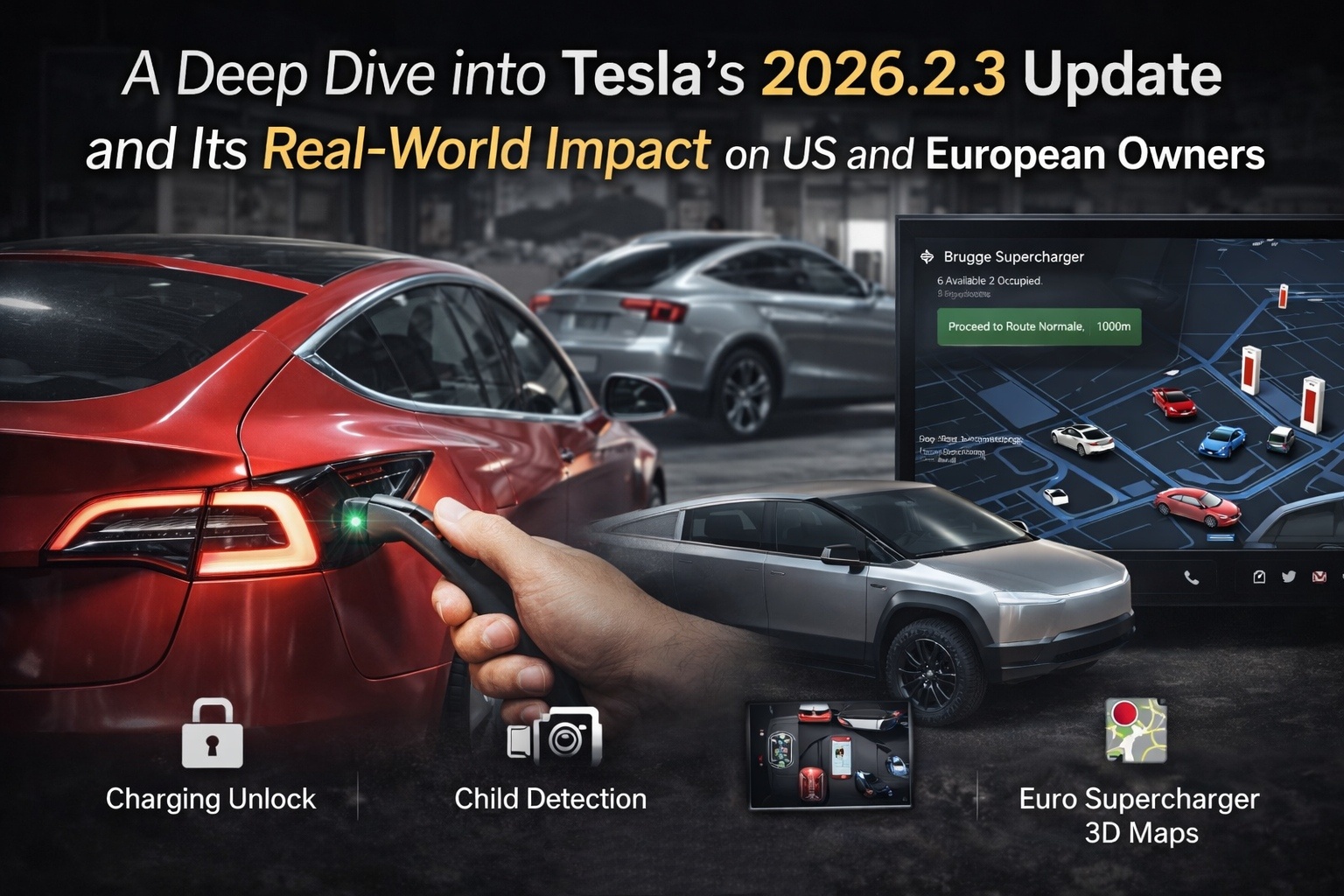
One of the most immediately tangible updates in version 2026.2.3 is the introduction of a new method for stopping a charging session and releasing the charging cable. Dubbed the “charge cable unlatch” or “charging unlock” feature, it is available for Model 3 and Model Y vehicles . The functionality is elegantly simple: when the vehicle is unlocked or an authenticated key fob or phone key is detected nearby, a user can pull and hold the left rear door handle for three seconds. This action commands the vehicle to cease charging and unlock the charging connector, allowing it to be removed .
The European Context: Solving a Ubiquitous Pain Point
To fully appreciate the significance of this feature, one must understand the charging landscape in Europe, where Tesla owners frequently interact with a diverse ecosystem of public charging infrastructure. Unlike the dedicated Tesla Supercharger network, where the connector and vehicle communicate seamlessly, many third-party AC and DC public chargers feature standard Type 2 or CCS2 connectors without an integrated button to release the cable lock. Previously, a driver faced with this situation had to resort to either fumbling with a mobile app—which could be slow and reliant on cellular connectivity—or climbing back into the vehicle to tap through the center touchscreen’s charging menu to stop the session and unlock the port .
This workaround, while functional, disrupted the flow of a charging stop. The 2026.2.3 update eliminates this friction entirely. By simply interacting with a physical point on the car—the rear door handle—the driver can complete the charging process without re-entering the vehicle or waiting for an app to connect. This is a quintessential example of Tesla‘s commitment to refining the user experience by identifying and solving a common, yet previously unaddressed, point of friction. As one analyst noted, this update “precisely targets the high-frequency pain points of overseas users” . For European owners navigating a mixed network of chargers, this seemingly small change transforms the charging ritual into a more seamless and intuitive process.
The Technology and Safety Redundancy
The feature is not merely a convenience; it is also a testament to the robust and secure architecture of Tesla‘s vehicle control systems. The activation requires a triple condition: the vehicle must be in a state where it recognizes an authorized user (unlocked or key detected), the user must intentionally perform a sustained pull on the specific handle, and the vehicle must be actively charging. This multi-factor approach ensures that the action is deliberate and authorized, preventing accidental disconnections . The system relies on the vehicle’s controller area network (CAN) bus and body control modules to interpret the door handle input and relay the command to the charge port ECU (Electronic Control Unit). The decision to process this locally, rather than via a cloud-based command, ensures reliability even in areas with poor internet connectivity, further enhancing its utility. For owners, the familiar fallback options—using the touchscreen or the Tesla app—remain fully available, providing redundancy without complexity .
Section 2: A Guardian in the Cabin – Child Presence Detection and the Privacy Paradigm
Perhaps the most significant feature from a safety and ethical standpoint is the introduction of Child Presence Detection. This functionality, initially introduced in Europe with a previous update, is now being rolled out more broadly, including to vehicles in North America with the 2026.2.3 release . The system is designed to prevent a tragedy that occurs with alarming frequency: the accidental leaving of a child or pet in a closed vehicle, which can lead to heatstroke or hyperthermia.
How It Works: A Symphony of Sensors
The feature leverages the vehicle‘s cabin camera, located above the rearview mirror, to monitor the interior for the presence of a child after the driver has exited and locked the car . If the system detects a child left alone, it initiates a multi-stage alert protocol to draw attention and notify the owner. First, the vehicle’s hazard lights begin to flash, and the horn sounds in a distinctive pattern designed to attract the attention of passersby. Simultaneously, the Tesla mobile app sends a push notification to the owner‘s smartphone, warning them of the situation . The alert is not a one-time event; it repeats at set intervals until the owner returns to the vehicle, ensuring the warning cannot be easily missed or dismissed.
The Cornerstone: Privacy by Design
In an era where in-car monitoring systems often raise significant privacy concerns, Tesla has taken a notably thoughtful approach. A critical detail buried in the feature‘s implementation is that all data processing for Child Presence Detection occurs locally on the vehicle’s hardware. According to Tesla‘s official notes, “All cabin detection data is processed locally and is not uploaded to Tesla servers” . This is a crucial distinction.
For privacy-conscious consumers, particularly in Europe where regulations like GDPR set a high bar for data protection, this “edge processing” approach is immensely reassuring. It means that while the car is intelligent enough to act as a guardian, it does not do so at the cost of broadcasting potentially sensitive imagery from the interior of one‘s home-on-wheels. The feature is enabled by default, reflecting Tesla’s prioritization of safety, but can be manually disabled by the owner via the path Controls > Safety > Child Left Detection on the touchscreen . This combination of default-on safety with a clear, easy opt-out path represents a mature and respectful approach to feature deployment.
Section 3: Visualizing the Grid – The Expansion of 3D Supercharger Maps
Another update that enriches the ownership experience, particularly for those planning longer journeys, is the significant expansion of the 3D Supercharger map feature. This capability, first introduced in the 2025 holiday update, was initially limited to just 18 Supercharger sites in the United States . With the 2026.2.3 update, Tesla is not only enhancing the feature but also expanding its geographic footprint to include European sites.
From Dots to Details: The Power of Contextual Awareness
Traditional navigation systems represent points of interest, like charging stations, as simple dots or icons on a 2D map. While functional, this approach provides limited information. The 3D Supercharger map, available on vehicles equipped with the AMD Ryzen infotainment system, transforms this experience by rendering a detailed, bird‘s-eye view of the actual Supercharger location . When a user searches for a compatible Supercharger, the map display shifts to show a photorealistic layout of the site, complete with the precise position of each individual charging stall.
The true power of this visualization lies in its integration with real-time data. The 3D map doesn‘t just show the site layout; it overlays live occupancy information. It can display which stalls are available and, perhaps more impressively, which stalls are occupied and by what specific Tesla model. The system renders a 3D model of the vehicle currently charging—be it a Model 3, Model Y, Model S, or Cybertruck—in its appropriate stall . For non-Tesla electric vehicles using a Supercharger, a generic vehicle model is displayed. This granular level of detail allows a driver approaching a busy site to make strategic decisions at a glance. They can see not only that a stall is free, but also identify which stall is accessible for a vehicle towing a trailer, or which stall offers the best path for their particular car, all before they arrive. This transforms the charging stop from a moment of uncertainty into a planned, efficient maneuver.
The European Rollout: A Focus on Key Hubs
The initial European expansion of the 3D Supercharger map, confirmed with this update, includes at least two sites: Bruges and Heusden-Zolder in Belgium . The selection of these locations is strategic. Bruges is a major tourist destination, where clear and intuitive navigation is paramount for visitors unfamiliar with the area. Heusden-Zolder is home to a famous racetrack, suggesting Tesla is also considering sites that may experience high traffic during events. This targeted rollout in Europe signals Tesla‘s intent to eventually bring this premium visualization feature to all major Supercharger hubs across the continent, further cementing its charging network as a key competitive advantage.
Section 4: Empowering the Enthusiast – Service Mode, ECU Updates, and Hidden Gems
Beyond the headline-grabbing features, the 2026.2.3 update is laden with enhancements for the technically inclined owner—the very audience that forms the bedrock of the Tesla community. These updates, often undocumented or only briefly mentioned, provide deeper insight into the vehicle‘s operation and future capabilities.
The Democratization of Service Data
One of the most intriguing undocumented changes is the expansion of Service Mode capabilities. Previously a tool reserved primarily for Tesla service technicians, the 2026.2.3 update has unlocked new data for owners to access. Specifically, a new section for “Autopilot Trip Weights” has appeared within Service Mode for Hardware 3 (HW3) vehicles . This feature indicates that the vehicle is actively gathering and preparing to upload FSD (Full Self-Driving) AI data in “shadow mode.” This means that while the owner drives normally, the car‘s FSD computer is silently running its neural networks in the background, comparing its decisions to the driver’s real-world actions. By allowing owners to see that this data collection is happening, Tesla is providing a rare glimpse into the process that fuels the improvement of its autonomous driving technology. It transforms the owner from a passive user into an active, albeit indirect, contributor to the development of the world‘s most advanced production ADAS (Advanced Driver-Assistance System).
ECU Update Visibility and System Health
Another backend improvement is the enhancement of the ECU update status panel. With this update, the panel now displays the update status for a wider range of Electronic Control Units, including those not on the traditional Controller Area Network (CAN) bus. This now includes processors critical to the vehicle‘s core intelligence, such as the self-driving computer and the Telematics Control Unit (TCU), which manages cellular and Wi-Fi connectivity . For owners who like to keep their vehicle in peak condition, this expanded visibility allows for a more comprehensive check of the car’s software integrity.
Furthermore, reports from owners indicate that the update includes an automatic battery recalibration routine . This background process can, in some cases, restore a small amount of previously “lost” gross battery capacity, a welcome side effect that can alleviate concerns about long-term battery degradation. For owners of vehicles with LFP (Lithium Iron Phosphate) battery packs, particularly the Model Y RWD, this recalibration has been noted to bring the displayed range back in line with expected levels . Improvements to the behavior of matrix headlights, which now sense and react to ambient light and reflections more effectively, round out the list of subtle but meaningful enhancements .
Conclusion: The Cumulative Power of Continuous Improvement
Tesla‘s 2026.2.3 software update is a masterclass in the philosophy of continuous improvement. It lacks a single, flashy, world-changing feature, yet its aggregate impact on the ownership experience is profound. For the European owner, the charge cable unlatch feature dismantles a daily frustration associated with public charging. For families on both continents, the privacy-first Child Presence Detection offers a layer of protection that is both advanced and respectful. For the road-tripper, the 3D Supercharger maps transform the charging stop into a predictable part of the journey. And for the dedicated enthusiast, the glimpses into Service Mode and ECU health provide a satisfying connection to the car‘s inner workings and its role in the future of autonomy.
This update reaffirms that Tesla’s product is not a static object but a living, evolving platform. It listens to its fleet, identifies points of friction, and deploys solutions over the air with a speed and scale that traditional automakers can only envy. By focusing on both high-impact safety features and subtle quality-of-life refinements, Tesla continues to strengthen the bond with its owners, ensuring that a Tesla improves with age. As the company navigates a complex regulatory and competitive landscape, updates like 2026.2.3 serve as a quiet reminder of its core strength: an unwavering commitment to using software to make its cars safer, more convenient, and more delightful to own, mile after mile.