
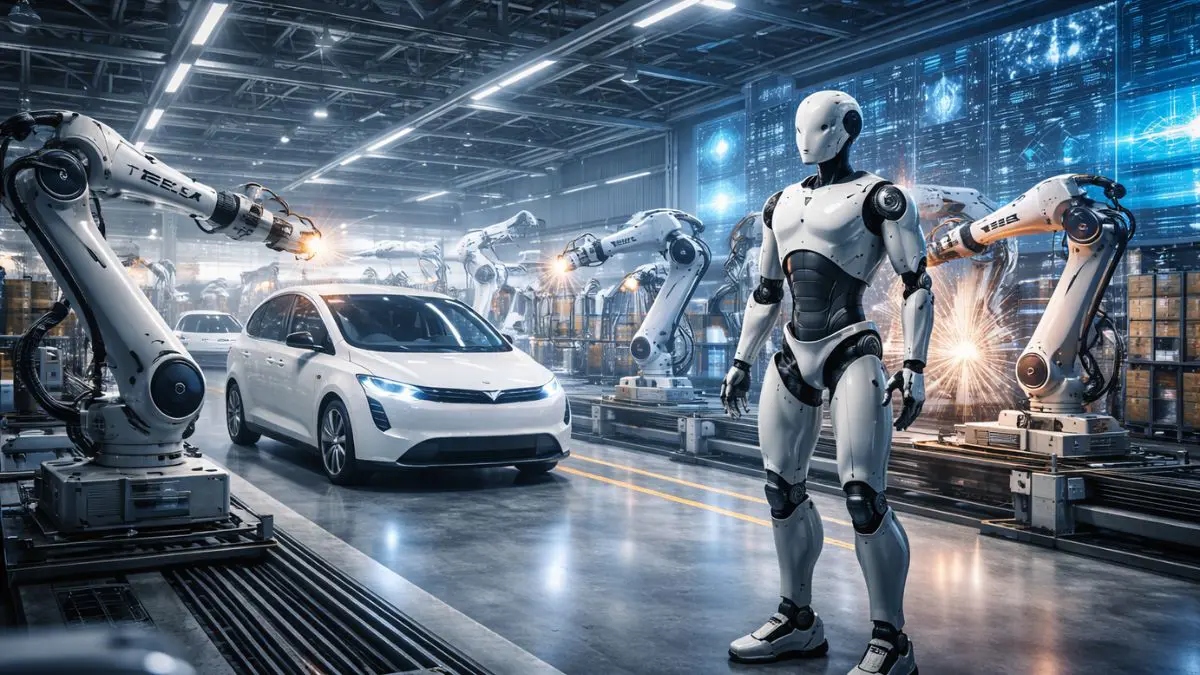
Introduction: The End of an Era — and the Beginning of the Next
In 2025 and 2026, Tesla — long synonymous with electric vehicles (EVs) — is undergoing the most significant strategic transformation in its history. For the first time, Tesla posted an annual revenue decline, stirring alarm among traditional automotive investors. Rather than retreating, the company is doubling down on a bold strategic pivot: moving away from being merely a car manufacturer toward becoming a technology and AI‑driven enterprise with recurring revenue at its core.
This comprehensive article explores that strategic pivot in detail — what it means, why it matters, how it changes Tesla’s revenue model, and what it implies for the broader EV market and for Tesla owners in the U.S. and Europe.
I. From Electric Cars to Physical AI: Defining the New Tesla
A. The Shift from Automotive to Technology First
Historically, Tesla built its reputation — and market value — as a pioneer in zero‑emissions vehicles. However, as revenues and deliveries stagnate globally, Tesla is consciously reinventing itself:
-
Sales of the flagship Model S and Model X are being discontinued to free up production resources.
-
Manufacturing capacity is being redirected toward robots (Optimus) and autonomous robotaxis (Cybercab).
-
Capital expenditures are projected to more than double to over $20 billion in 2026 to support AI and robotics infrastructure.
This transition mirrors tech giants that increasingly monetize software, data, and services — a move that many investors believe could redefine Tesla’s value proposition.
B. What Tesla Means by “Physical AI”
Unlike typical tech companies that sell software or cloud services, Tesla’s version of “physical AI” emphasizes AI integrated into physical platforms — from self‑driving cars to humanoid robots. Tesla’s ambition is not just to create software that powers machines but to produce AI‑enabled physical systems capable of real‑world autonomy.
This includes:
-
Autonomous Driving (FSD)
-
Robotaxi Networks (Cybercab)
-
Humanoid Robots (Optimus)
These aren’t supplements to the car business — they are central to Tesla’s long‑term strategy.
II. The Full Self‑Driving (FSD) Subscription Model: A Paradigm Shift
A. Moving from One‑Time Sales to Recurring Revenue
One of Tesla’s most transformative revenue pivots is the shift from selling the Full Self‑Driving (FSD) software as a one‑time purchase (often around $8,000) to a pure subscription model. As of February 14, 2026, all new buyers can only access FSD via subscriptions (~$99/month or $999/year).
This change is far more than a pricing adjustment; it represents a strategic realignment towards:
-
Recurring revenue streams
-
Enhanced lifetime customer value
-
Better alignment with software update cycles
-
Increased data capture for AI training
B. The Strategic Logic of Subscription Monetization
Why subscription?
-
Predictable Cash Flow: Recurring revenue smooths cyclical automotive sales volatility.
-
Engagement & Feedback Loops: Monthly users generate ongoing driving data, which is crucial for AI training.
-
Business Valuation: Tech companies with recurring revenue often justify higher valuations due to anticipated future cash flows.
These reasons place Tesla on firmer ground if it wishes to be viewed more as a software and services company than a vehicle producer.
C. FSD Adoption and Financial Implications
Tesla recently disclosed 1.1 million FSD users globally, though most were from previous one‑time purchase models. While subscription adoption is still emerging, it’s a strategic foundation for future services like robotaxi integration.
Increasing adoption of subscriptions, rather than individual purchases, could significantly transform Tesla’s revenue mix:
-
From episodic vehicle purchases
-
To the ongoing software revenue
-
Eventually clustered with AI and autonomous service monetization
III. Robotaxis: Transforming Mobility into Service
A. Beyond Ownership — Toward Mobility-as‑a‑Service
The robotaxi initiative represents perhaps Tesla’s most ambitious monetization shift. Instead of selling cars once, Tesla aims to transform every autonomous‑ready vehicle into a potential revenue generator:
-
Robotaxis can generate recurring fare revenue rather than one‑time sales profits.
-
This model resembles cloud services — recurring revenue with scale.
-
Tesla may allow owners to place their autonomous vehicles into a shared network that produces passive income — effectively turning vehicles into income assets.
This isn’t hypothetical — Tesla is preparing production of the Cybercab robotaxi in 2026, signaling tangible execution on this vision.
B. How Robotaxis Will Integrate with FSD Subscriptions
The long‑term strategy envisions a seamless integration between the FSD subscription model and the robotaxi service:
-
Subscribed vehicles provide continuous data streams.
-
Those vehicles could eventually earn shared revenue in an autonomous network.
-
Tesla’s valuation narrative shifts from a one‑time EV sale to a recurring service revenue model.
If successful, this could be one of the most disruptive business models in mobility history.
IV. Robotics: From Optimus to Industrial Scale
A. Optimus — The Humanoid Robot Vision
Tesla’s humanoid robot, Optimus, is a centerpiece of its AI‑driven vision. Designed to perform general physical tasks, Optimus represents:
-
A future revenue stream independent of vehicle sales
-
A physical platform for AI beyond transportation
-
Potential enterprise and consumer robotics markets
Tesla’s commitment includes using former EV production capacity to scale robot manufacturing — a bold move indicating long‑term prioritization of robotics over legacy vehicles.
B. Impact on Production and Talent Allocation
Redirecting engineering, manufacturing, and R&D investment toward robotics signals a clear break from a pure auto focus — the company is recruiting AI engineers, robotics designers, and machine learning researchers at a rate that matches tech industry standards.
This investment is expected to underpin Tesla’s new identity as a technology innovator rather than primarily an automaker.
V. Financial Realities: Transition Costs vs Future Value
A. Revenue Headwinds and Profit Pressures
Tesla’s reported annual revenue decline in 2025 was historic. Its automotive business faced:
-
Volume declines in key markets
-
Tough competition from other EV manufacturers
-
Reduced regulatory credit income
Yet, Tesla’s energy and software segments provided offsets, and the broader AI narrative buoyed investor sentiment.
B. Capital Expenditure Strategy
Tesla’s CapEx for 2026 is expected to exceed $20 billion, a significant increase compared to 2025. The majority will be directed toward:
-
AI compute infrastructure
-
Factory retooling for robotics and autonomous vehicles
-
Supply chain scaling for new product platforms
Short‑term costs are high, but they reflect a long‑range investment horizon aligned with AI and robotics product cycles.
VI. Strategic Impacts on Tesla Owners
A. Changing Value Proposition for Owners
As Tesla transitions, owners in the U.S. and Europe will experience:
-
Evolving software services (e.g., continuous FSD updates)
-
New options for service revenue via robotaxi networks
-
Software‑driven vehicle enhancements rather than hardware upgrades
Ownership is becoming a platform engagement experience, not just vehicle possession.
B. Consumer Considerations with Subscription Services
FSD subscriptions mean:
-
Lower initial costs for autonomous features
-
Ongoing payments instead of ownership
-
Potential integration with future autonomous revenue
This shift could reshape vehicle value retention and resale dynamics.
VII. Broader Industry Implications
Tesla’s strategic pivot has ripple effects:
-
Competitors may accelerate software‑centric revenue models
-
Legacy automakers could revisit how they engage in autonomous ecosystems
-
The definition of a car manufacturer may evolve toward a mobility‑services provider
Tesla’s move toward service revenue mirrors broader tech industry trends where recurring models deliver stronger long‑term valuations.
Conclusion: Tesla’s Strategic Transformation Is Not Just About Cars
Tesla’s newest evolution — from an electric vehicle company to a physical AI and recurring revenue enterprise — is the defining narrative of 2026. With shifts in revenue structure, autonomous and robotics focus, and fundamental changes to how customers engage with products like FSD, Tesla is transforming not just its business model but its identity.
This transition — though risky and costly — could redefine what it means to be a mobility and technology company in the 21st century.
FAQ
1. Why is Tesla ditching one‑time FSD purchases for subscriptions?
Tesla views subscription revenue as a more reliable, ongoing cash‑flow source and a way to scale its autonomous data collection and AI training ecosystem.
2. Will Tesla still sell cars in the future?
Yes, but vehicles are increasingly seen as intelligent platforms rather than standalone products.
3. How do robotaxis generate revenue?
Robotaxis operate as on‑demand autonomous mobility services, generating fare revenue continuously rather than one‑time sales.
4. What role does Optimus play in Tesla’s strategy?
Optimus represents Tesla’s push into general robotics, offering new AI‑driven revenue avenues beyond transportation.
5. How will this shift affect Tesla’s stock and valuation?
Investors often assign higher valuations to companies with recurring revenue and scalable tech services — aligning with Tesla’s strategic direction.