
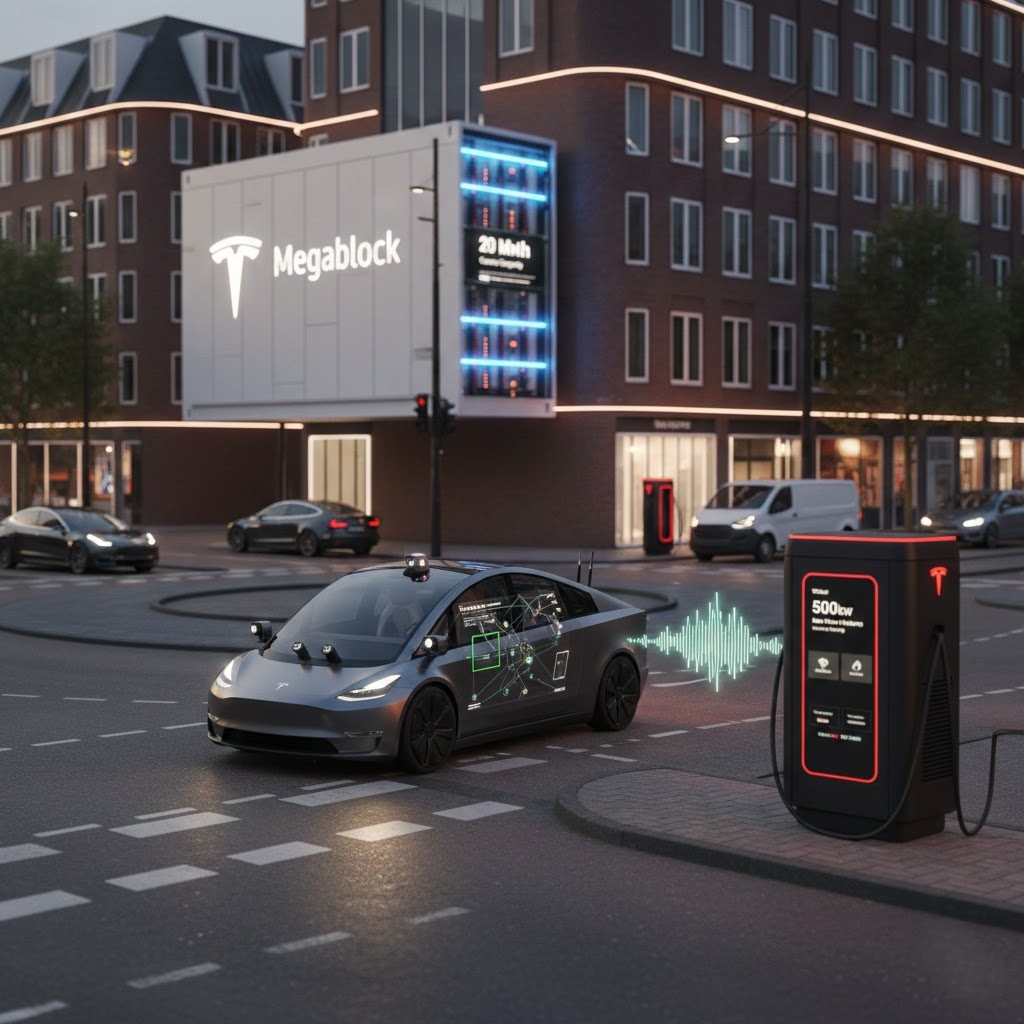
The year 2026 has officially marked the dawn of the "Cortex Era" for Tesla. For nearly a decade, the promise of Full Self-Driving (FSD) has hovered on the horizon—a tantalizing "coming soon" that often felt like a moving target. However, as of February 2026, the release of FSD v13.3 has fundamentally shifted the conversation. We are no longer discussing "beta" experiments; we are witnessing the emergence of a unified, high-intelligence driving agent that behaves with a level of environmental awareness previously reserved for biological entities.
This article provides an in-depth technical and operational analysis of the FSD v13.3 stack, the massive compute power of the Cortex supercluster that birthed it, and what this means for owners in the North American and European markets.
Chapter 1: The Death of the "Highway Stack" and the Birth of Unified Intelligence
Historically, Tesla’s software architecture was a tale of two cities. One "stack" (v11 and earlier) handled highway driving using legacy heuristic code and older neural networks, while another "stack" (v12) introduced the end-to-end neural network for city streets. This duality often led to a "handshake" problem—a noticeable shift in driving personality when transitioning from a suburban road to an interstate on-ramp.
The End-to-End Revolution
FSD v13.3 represents the full maturation of End-to-End Neural Networks. In this version, the "highway stack" has been completely retired. The vehicle now operates on a single, continuous brain from the moment it leaves your driveway to the moment it arrives at your destination.
-
Unified Logic: By removing the C++ "if-then" code that previously governed highway lane changes, v13.3 handles high-speed merges with the same fluid, predictive logic it uses for urban roundabouts.
-
Contextual Fluidity: The car no longer views an "on-ramp" as a special geometric zone. Instead, it perceives the flow of traffic as a unified vector field, allowing for smoother gaps and less aggressive "jerk" movements when joining 75 mph traffic.
36Hz Full-Resolution Vision
Under the v13.3 architecture, Hardware 4 (AI4) and the newly rolling out AI5 vehicles have seen a significant jump in perception frequency. The system now processes full-resolution video at 36Hz (36 frames per second). For the driver, this translates to a 2x reduction in "latency-to-action." When a vehicle in the adjacent lane begins to drift, v13.3 reacts in roughly 28 milliseconds—faster than human visual processing speed.
Chapter 2: The Cortex Cluster – The 500MW Heart of Tesla AI
The intelligence of v13.3 didn't happen by accident. It is the direct result of the Cortex supercomputing cluster at Giga Texas reaching its first major operational milestone in early 2026.
Scaling Compute by 5x
While previous versions of FSD were trained on localized clusters or limited Dojo partitions, v13.3 is the first major branch trained entirely on the expanded Cortex cluster.
-
Hardware Scale: Cortex now utilizes over 100,000 NVIDIA H100 chips, providing a 5-fold increase in training compute compared to the environment that produced v12.
-
Energy Consumption: The cluster's power demand has scaled to an instantaneous maximum of 130MW, with projections to hit 500MW by the end of this year. This massive energy draw is supported by a dedicated Tesla Megapack installation, ensuring 24/7 uptime for the neural networks to "dream" through billions of miles of fleet data.
3x Model Scaling and "World Models"
The extra compute has allowed Tesla’s AI team to increase the neural network parameter count by 3x. Why does this matter?
-
Nuance Perception: The model can now distinguish between a "distracted pedestrian" (looking at a phone) and an "attentive pedestrian" (making eye contact with the car), adjusting its yielding behavior accordingly.
-
Object Permanence: If a ball rolls into the street, v13.3’s "World Model" predicts that a child may follow, even before the child is visible. This "predictive imagination" is a direct benefit of the larger model size enabled by Cortex.
Chapter 3: Unpark-to-Park – The Final Integration of ASS
For years, "Summon" and "FSD" were separate apps within the car’s OS. You used FSD to drive, and you used Actually Smart Summon (ASS) to move the car in a parking lot. In v13.3, these have merged into a single "Unpark-to-Park" suite.
The Seamless Journey
With v13.3, the vehicle can now:
-
Self-Extract: Back out of a tight home garage or driveway autonomously.
-
Navigate Private Roads: Transition from a private driveway to a public street without requiring the driver to take over.
-
End-of-Trip Autopark: Once you reach your destination, the car doesn't just "stop" on the street; it identifies a valid parking spot, executes the maneuver, and shifts into Park.
For US owners, this means the car can handle the entire journey "curb-to-curb." For European owners, who often deal with underground car parks and narrow "pavement" parking, the improved Ultra-Wideband (UWB) integration with the Tesla Phone Key allows the car to navigate these complex geometries with centimeter-level precision.
Chapter 4: Audio Fusion – Giving the Car "Ears"
Perhaps the most significant safety breakthrough in v13.3 is the activation of Audio-Visual Fusion. Tesla has finally enabled the use of internal and external acoustic sensors (and the microphone array in the cabin) to identify emergency vehicles.
Hearing the Invisible
Visual-only systems have a weakness: they cannot see around corners. In dense urban environments like London, Paris, or New York, an ambulance's siren is often heard long before its lights are seen.
-
Siren Recognition: v13.3 can categorize different siren types (police, fire, ambulance) and determine their approximate vector based on Doppler effect processing.
-
Proactive Yielding: When the system "hears" an approaching emergency vehicle, it will proactively move to the side of the lane or slow down, even if the vehicle is still two blocks away and out of the camera’s line of sight.
-
Media Ducking: To ensure the human "supervisor" is aware, the car will automatically lower the volume of the music and display a blue "Emergency Vehicle Detected" notification on the center display.
Chapter 5: Regional Nuance – The European DCAS Breakthrough
While US owners have enjoyed "Supervised" FSD for years, 2026 is the year Europe finally catches up. Tesla’s collaboration with the Dutch regulator (RDW) has reached a milestone with the UN ECE R171 (DCAS) regulation.
February 2026: The European Demonstation
Tesla is currently conducting high-stakes demonstrations in 17 European countries. FSD v13.3 has been specifically tuned for European road signs, "shark's teeth" markings, and the high density of cyclists in cities like Amsterdam and Copenhagen.
-
Cyclist Intent: Using the increased compute from Cortex, the car now predicts "cyclist intent" by analyzing subtle body leans and head movements, allowing for safer overtakes on narrow European B-roads.
-
Exemptions for Lane Changes: Tesla is seeking national approval in the Netherlands to allow system-initiated lane changes without driver confirmation—a move that would pave the way for an EU-wide rollout by mid-2026.
Conclusion: The Road to Unsupervised
FSD v13.3 is more than a point release; it is the definitive proof that Tesla’s "compute-first" strategy is working. By investing $20 billion into the Cortex cluster and AI5 hardware, Tesla has moved beyond simple pattern matching. The car now possesses a primitive form of "reasoning" about the physical world.
As we move through 2026, the gap between "Supervised" and "Unsupervised" is narrowing. With every mile driven on v13.3, the Cortex cluster refines the model, moving us closer to the day when the steering wheel becomes an optional relic of the past.
FAQ: Everything You Need to Know About FSD v13.3
Q: Is FSD v13.3 coming to Hardware 3 (HW3) vehicles? A: While Tesla continues to support HW3, v13.3 is optimized for the memory and throughput of AI4 (HW4) and AI5. HW3 vehicles will receive a "distilled" version of the model, but they may lack certain features like high-resolution 36Hz vision and advanced audio fusion due to processing constraints.
Q: Does the "Audio Recognition" feature record my conversations? A: No. The system processes audio data locally on the vehicle’s AI chip to identify siren frequencies. The audio is not uploaded to Tesla's servers or stored, ensuring user privacy in compliance with GDPR (Europe) and CCPA (California).
Q: How does the "Unpark-to-Park" feature handle private gates? A: If your gate is integrated via HomeLink or MyQ, v13.3 can trigger the gate to open as it approaches and close it once it has "unparked" onto the street.
Q: When will European owners get the full v13.3 feature set? A: Pending RDW approval in February 2026, a "Pilot Release" is expected in the Netherlands and Germany by March, with a wider EU rollout following as local regulators adopt the R171 framework.