
Introduction
On March 2, 2026, Tesla's official safety page updated a number that few owners fully understand but every FSD user has contributed to: 84 billion miles. That's the cumulative distance driven with Full Self-Driving (Supervised) engaged across Tesla's global fleet. To put that in perspective, it's equivalent to driving to the Sun and back 450 times. It's 84 billion miles of real-world data, fed continuously into the neural networks that tell your car where to steer, when to brake, and how to navigate the chaos of human-driven traffic.
But here's the question that rarely gets answered in layman's terms: what actually happens to all that data? How does a random Tuesday afternoon drive in suburban Frankfurt or a chaotic intersection in Los Angeles translate into a software update that makes your car smarter?
The Data Tsunami: Why 84 Billion Miles Changes Everything
The raw numbers tell a story of exponential acceleration. According to data compiled by Tesla observer Sawyer Merritt, FSD mileage has grown at a rate that few predicted: from approximately 6 million miles in 2021, to 80 million in 2022, 670 million in 2023, 2.25 billion in 2024, and 4.25 billion in 2025. In just the first 50 days of 2026, owners have already added another 1 billion miles.
At this pace, Tesla is on track to approach 10 billion miles in 2026 alone. But why does this matter? Elon Musk has previously stated that achieving on a large scale, safe unsupervised autonomy may require approximately 100 billion miles of training data to cover the "long tail" of rare but critical driving scenarios. At 84 billion miles, Tesla is now at 84% of that theoretical target.
However, the headline number obscures a more important truth: not all miles are created equal. A highway commute in perfect weather teaches the neural network far less than a complex urban interaction with pedestrians, cyclists, and unpredictable drivers. The value lies in what Tesla engineers call "edge cases"—the scenarios that happen rarely but demand correct responses.
The Architecture of Learning: From Raw Video to Steering Commands
Shadow Mode: The Silent Teacher
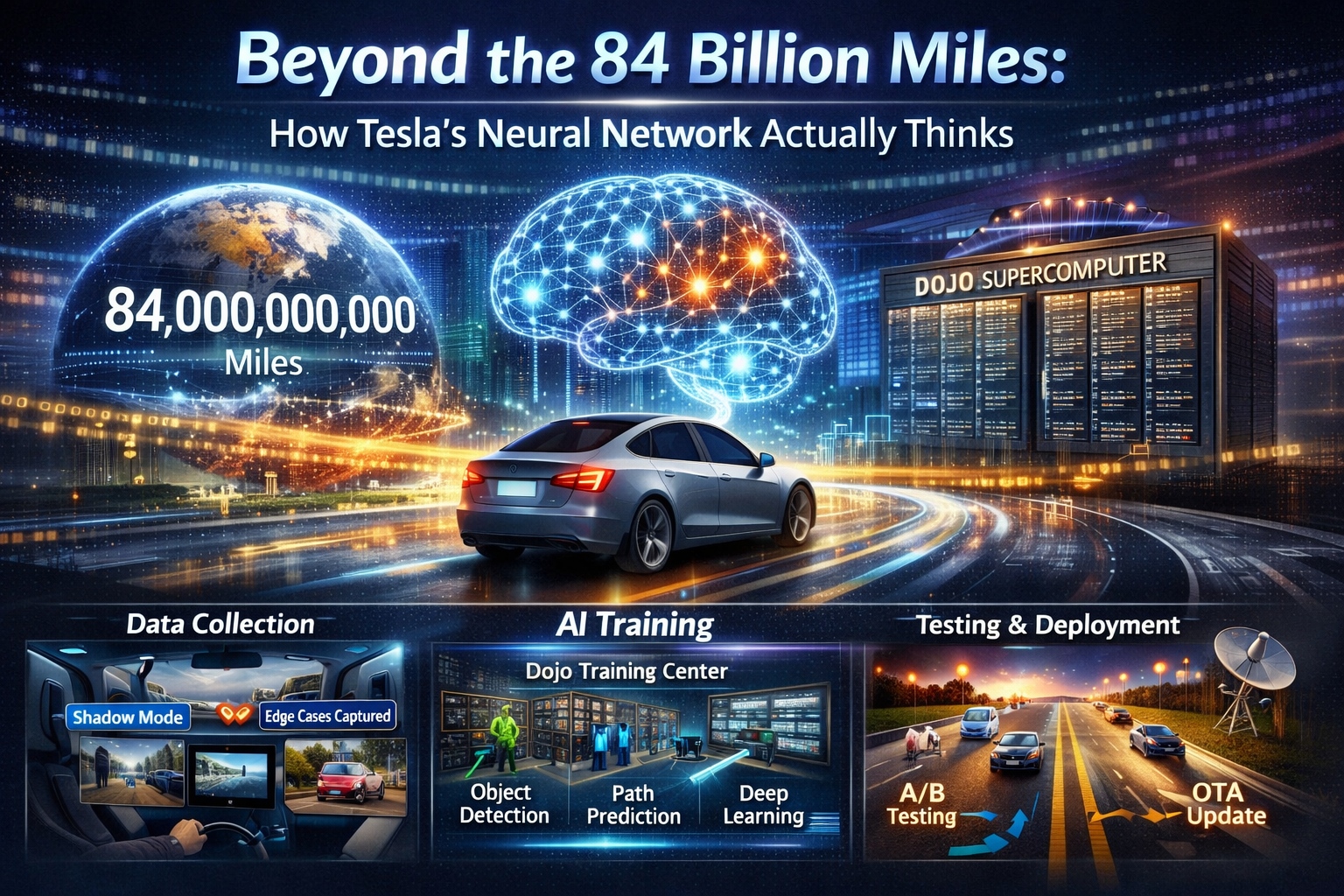
When you drive your Tesla without FSD engaged, something remarkable is happening in the background. The car is running its neural network in parallel with your human inputs, constantly asking itself: "What would I do here?" When your action differs from the network's prediction, that moment is flagged. If the difference is significant—if you take a tighter line through a curve, or yield differently at a four-way stop—the vehicle may save that segment and upload it to Tesla's training cluster.
This is "shadow mode," and it's why every Tesla on the road is effectively a data collection vehicle. The 84 billion miles figure only counts miles driven with FSD actively engaged, but the total dataset informing Tesla's neural networks is vastly larger when including shadow mode operations.
The Training Pipeline: How Raw Data Becomes Intelligence
Once a driving segment is uploaded, it enters a pipeline that would be recognizable to any machine learning engineer, but the scale is what distinguishes Tesla. The company operates one of the largest supercomputing clusters in the world, including its custom-designed Dojo hardware, specifically optimized for the type of matrix mathematics that neural network training requires.
The process follows several distinct stages:
Data Curation: Raw video from eight cameras, plus vehicle telemetry, must be cleaned and labeled. Tesla has increasingly automated this process, using what engineers call "automatic labeling"—where one neural network helps label data for another. When the system detects a pedestrian, for example, it doesn't just note that a person was present; it tracks joint positions, movement vectors, and predicted paths.
Training: The curated data is fed into the neural network, which adjusts millions of internal parameters to better predict the correct driving behavior. This is where Dojo excels. Traditional GPU clusters can train networks, but Tesla's custom silicon is designed specifically for the video-based, spatiotemporal reasoning that autonomous driving requires.
Validation: Before any new model is pushed to the fleet, it must prove itself against a validation set—billions of miles of held-back data that the network hasn't seen during training. If the new version performs worse on key metrics, it never reaches your car.
Simulation: For scenarios that are too rare or too dangerous to capture in real data—a child chasing a ball into the street, for example—Tesla uses simulation to generate synthetic training examples. These simulations are themselves informed by real-world data, creating a feedback loop between actual and synthetic experience.
The Neural Network's View of the World
To understand how your Tesla "sees," forget everything you know about traditional programming. There are no lines of code that say "if traffic light is red, then stop." Instead, the network has learned, from exposure to millions of examples, that certain patterns of pixels correlate with the concept of "stopping required."
Tesla's vision system processes eight camera feeds simultaneously, at multiple frames per second. Each camera captures different perspectives: the narrow forward camera for distant objects, the wide forward for intersections, the B-pillars for cross traffic, the rear for following vehicles. These feeds are fused into a single representation of the world that includes:
-
Semantic segmentation: Every pixel is classified as road, vehicle, pedestrian, building, sky, etc.
-
Object detection: Specific entities are identified and tracked—cars, trucks, cyclists, pedestrians, animals.
-
Depth estimation: Unlike systems that use LiDAR, Tesla's vision must infer distance from parallax between cameras and from learned size cues.
-
Motion prediction: Based on past frames, the network predicts where each object will be in the next 1, 5, and 10 seconds.
-
Path planning: The network proposes a trajectory that is safe, comfortable, and compliant with traffic rules.
All of this happens in milliseconds, on the vehicle's onboard computer, using neural networks that have been compressed and optimized from the massive models trained in the data center.
The European Challenge: When Neural Networks Meet Regulation
For European Tesla owners, the 84 billion mile milestone carries an additional layer of significance. While North American owners have enjoyed increasingly capable FSD releases, European customers have watched from the sidelines, limited by a regulatory framework that was never designed for neural network-based driving systems .
The Regulatory Landscape
The gap isn't about technology; it's about philosophy. In the United States, regulators have given automakers more latitude to deploy driver-assist systems as long as crash reporting and defect investigations remain active. Europe, by contrast, operates under UNECE regulations that define in detail what driver assistance systems are allowed to do and how they must behave.
The key regulation is UN-R-171, which governs driver control assistance systems (DCAS). It was written with lane-keeping assist and adaptive cruise control in mind—features that supplement but don't replace human control. The regulation expects clear, rule-based behaviors: defined operating speed ranges, explicit driver monitoring requirements, and limited lateral acceleration in curves.
FSD Supervised sits in an uncomfortable middle ground. Tesla insists it remains a Level 2 system where the human driver is responsible, but in practice it performs tasks that look to regulators like early Level 3 or beyond: navigating complex intersections, managing roundabouts, making discretionary lane changes without explicit driver input . Some of these behaviors simply don't appear in UN-R-171's language.
The Dutch Path Forward
Tesla has adapted its strategy. Rather than seeking immediate EU-wide approval, the company is pursuing a Netherlands National Approval first, working with the Dutch vehicle authority RDW . Under EU Article 39, member states can grant exemptions for technologies that don't fit existing regulations but can be shown to be safe .
Tesla's public statements acknowledge that some current rules are "outdated and rules-based," and that forcing FSD to strictly conform would make it "unsafe and unusable" in many scenarios . The plan with RDW involves demonstrating that FSD meets all logical safety aspects of UN-R-171, then requesting Article 39 exemptions for behaviors that don't fit the existing rulebook.
The timeline has been moving. In late 2025, Tesla stated that RDW had committed to a February 2026 demonstration target, with approval potentially coming even sooner. More recently, indications suggest a decision could land as early as March 20, 2026.
If approved, the Netherlands would become the first European market to formally green-light FSD Supervised under an updated regulatory framework. Other EU members could then recognize the Dutch exemption, though the process would be staggered rather than instantaneous.
What This Means for Training
Crucially, European roads present challenges that the North American-centric training data may not fully cover. Roundabouts, narrow historic city centers, different traffic sign designs, and varying driving cultures all represent edge cases that the neural network must learn. This is why Tesla has been conducting FSD ride-along programs in German cities including Stuttgart, Frankfurt, and Düsseldorf .
The 84 billion mile global dataset includes European contributions, but the distribution remains skewed toward North America. As European approval progresses, the proportion of European training data will grow, creating a virtuous cycle: more European miles enable better European performance, which encourages more European usage, generating more data.
The 100 Billion Mile Question
Musk's 100 billion mile target for unsupervised FSD is often quoted but rarely examined. Is 100 billion truly a threshold, or is it an aspirational milestone?
The "long tail" problem in autonomous driving suggests that the relationship between data and capability is logarithmic, not linear. The first billion miles teach the system how to handle 90% of scenarios. The next 10 billion cover 9% of the remaining edge cases. The next 100 billion handle 0.9% of what's left. Each additional mile delivers diminishing returns, but the cumulative effect is that the system encounters and learns from scenarios that might otherwise cause failures.
At 84 billion miles, Tesla's neural networks have likely encountered more real-world driving situations than any human could experience in multiple lifetimes. But the gap between "supervised" and "unsupervised" isn't just about data volume. It's about confidence—the statistical certainty that when the system encounters a novel situation, it will respond safely.
Regulators in both the US and Europe will require evidence, not just of average performance, but of performance in the tails of the distribution. How does FSD handle a construction zone with ambiguous signage? How does it respond when a pedestrian makes eye contact and gestures? How does it manage when snow partially obscures lane markings?
These questions can't be answered by total mileage alone. They require targeted testing of specific scenarios, which is why Tesla's combination of real-world data and simulation is so powerful.
What Owners Should Expect
For Tesla owners in 2026, the practical implications of the 84 billion mile milestone are already visible. FSD (Supervised) releases have become more capable and more consistent. The system handles a wider range of scenarios with less need for intervention. The dreaded "phantom braking" that plagued earlier versions has been dramatically reduced as the network has learned to distinguish between genuine hazards and false positives.
In Europe, the next 12 months could be transformative. If Dutch approval materializes in March 2026, followed by broader EU recognition, European owners may finally gain access to the full FSD experience that North Americans have been enjoying. The system won't be perfect—no neural network-based system ever is—but it will be continuously improving, fed by the growing stream of European driving data.
The 84 billion mile figure is more than a milestone. It's evidence that Tesla's data flywheel is spinning faster than ever. Every mile driven makes the next mile safer. Every intervention teaches the network something new. And every owner, whether in California or Cologne, is part of that learning process.
Conclusion
When you engage FSD on your morning commute, you're not just using a feature. You're participating in the largest real-world machine learning project in history. The 84 billion miles accumulated so far represent an unprecedented dataset—a digital record of how humans drive, how traffic flows, and how the world looks from a Tesla's cameras.
The neural networks that process this data don't "think" the way humans do. They don't have intentions or understandings. But they have learned, from exposure to billions of miles, to recognize patterns and predict outcomes with a reliability that increasingly approaches—and in some ways exceeds—human capability.
The path to unsupervised driving isn't a straight line, and 100 billion miles isn't a magic number. But with each passing day, with each new mile driven, Tesla's neural networks get a little bit smarter. And for owners who have been waiting for the autonomous future, that's the most important number of all.
Frequently Asked Questions (FAQ)
Q: Does my car collect data even when I'm not using FSD?
A: Yes. Your Tesla operates in "shadow mode" during manual driving, comparing its decisions to yours and uploading segments where significant differences occur. This shadow mode data is a crucial part of Tesla's training pipeline, even though it doesn't count toward the official 84 billion FSD mileage figure.
Q: Will my HW3 car need an upgrade to achieve unsupervised FSD?
A: Tesla has not made a final determination. The company has stated that HW3 was designed to be capable of full autonomy, but as neural networks grow more complex, the computational demands increase. If HW3 proves insufficient, Tesla has historically offered upgrade paths for early adopters, though no specific program has been announced for a potential HW3-to-HW4 transition.
Q: When will European owners get the same FSD capabilities as North America?
A: The most realistic timeline centers on Dutch approval, potentially as early as March 20, 2026. If RDW grants Netherlands National Approval under Article 39, other EU countries may recognize it, though the process will be staggered. Some markets may impose local conditions or require additional reviews before full deployment.
Q: How does Tesla ensure privacy with all this data collection?
A: Tesla states that uploaded data is anonymized and associated with vehicle identifiers rather than personal information. Owners can adjust their data sharing settings in the vehicle's privacy menu, though reducing data sharing may limit participation in certain beta programs.
Q: Does highway driving count the same as city driving in the 84 billion mile total?
A: Yes, the total includes all miles driven with FSD engaged, regardless of road type. However, Tesla's training pipeline weights different scenarios based on their information value. A complex city interaction may be more valuable for training than a mile of straight highway driving, even though both contribute equally to the headline number.