
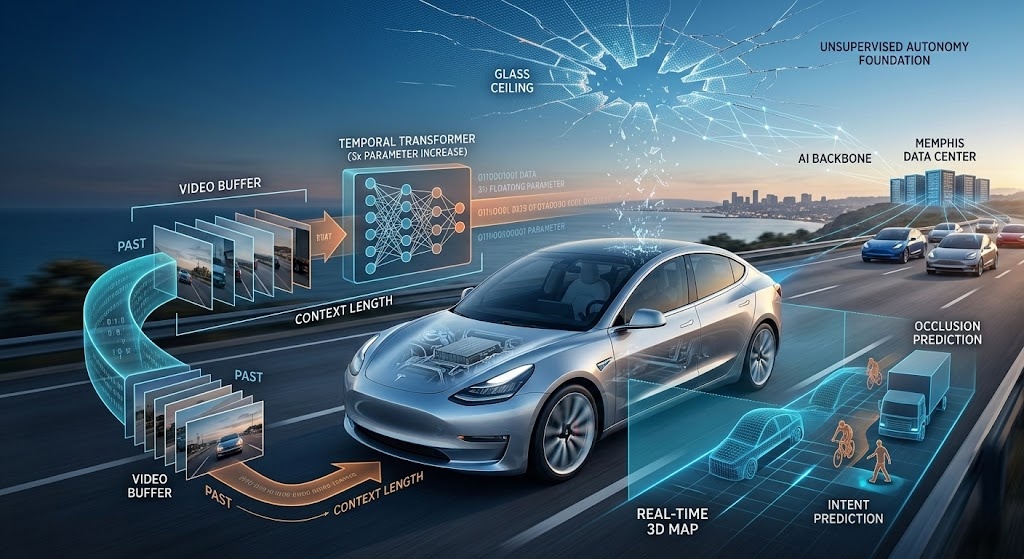
1. Introduction: The Arrival of the "Final Boss"
For nearly a decade, the promise of "Full Self-Driving" (FSD) has been a horizon that receded as quickly as Tesla approached it. However, the release of FSD v13 (Firmware 2026.2.3) represents more than just a version increment; it is the realization of a radical architectural pivot. In the industry, we often refer to "the glass ceiling of autonomy"—the point where manual coding and simple spatial recognition can no longer handle the chaotic entropy of the real world.
With v13, Tesla has officially transitioned from a system that sees to a system that understands time. This article explores the "End-to-End Temporal Transformer" architecture, the diverging paths of Hardware 3 (HW3) and AI4 (Hardware 4), and why this specific update is the foundational layer for the unsupervised Robotaxi network slated for broad 2027 deployment.
2. The Temporal Revolution: Understanding the "Time" Dimension
Prior to version 12, Tesla used a "C++ heuristic" approach—thousands of lines of human-written code telling the car how to behave. Version 12 introduced "End-to-End Neural Networks," where the car learned by mimicking human video data. However, even v12 struggled with "object permanence"—the ability to remember that a cyclist who disappeared behind a parked van is still there.
2.1 What are Temporal Transformers?
The "Transformer" is the same AI architecture that powers Large Language Models (LLMs) like ChatGPT. While a standard spatial transformer looks at all eight cameras simultaneously to understand the space around the car, a Temporal Transformer looks at a "buffer" of past video frames to understand change over time.
In v13, the model doesn't just process a snapshot; it processes a sequence. This allows the car to:
-
Predict Intent: Recognize that a pedestrian looking over their shoulder is likely about to cross the street.
-
Handle Occlusions: Maintain a "mental map" of a vehicle hidden behind a semi-truck, predicting its speed and trajectory based on where it was three seconds ago.
-
Smooth Decision Making: Eliminate the "jerky" micro-braking seen in earlier versions by understanding that a shadow on the road is static and poses no threat.
2.2 The 3x Scaling Milestone
According to internal Tesla AI telemetry, v13 features a 3x increase in model parameter count and a 3x increase in context length. This means the "brain" of the car is three times larger and can "remember" three times more data from the immediate past to inform its next move.
3. HW3 vs. AI4: The Great Hardware Schism
As of March 2026, we are witnessing the first significant performance divergence between legacy Hardware 3 (AI3) and the newer AI4 (Hardware 4) suites.
3.1 The Resolution Gap
AI4 vehicles now utilize their full 5.44-megapixel camera resolution at a native 36 frames per second (fps). In contrast, HW3 remains capped at 1.2 megapixels. While v13 has been remarkably optimized for HW3, the "vision fidelity" on AI4 allows the neural net to identify lane markings and small debris (like a stray nail or a pothole) at twice the distance of HW3 cars.
3.2 Latency: "Photon to Control"
The most critical metric in autonomy is "Photon to Control"—the time it takes from light hitting the camera lens to the car executing a steering or braking command.
-
AI4 Performance: v13 has halved this latency on AI4 hardware, achieving a response time that is now faster than human neurological reflexes.
-
HW3 Constraint: While still safe, HW3 is beginning to show "compute bottlenecks" when running the full temporal transformer stack, leading to slightly more cautious driving in dense urban environments.
4. Safety Metrics: Quantifying the Leap
The data from the North American fleet as of this week shows a staggering improvement in reliability.
| Version | Miles Per Critical Disengagement (MPCD) | Improvement (%) |
| FSD v11.4 | ~150 Miles | Baseline |
| FSD v12.5 | ~1,200 Miles | 700% |
| FSD v13.2 (Current) | ~7,500+ Miles | 525% vs v12 |
This 95% reduction in interventions means that for the average commuter, a "zero-intervention drive" is no longer a lucky occurrence—it is the expected standard. In Europe, where v13 is currently in "Shadow Mode" testing, the data suggests that the system is already outperforming the average European driver in highway lane-keeping and roundabout navigation.
5. From Park-to-Park: The Integrated Feature Set
FSD v13 isn't just about the drive; it's about the entire journey. This update finally integrates:
-
Unpark & Reverse: The car can now autonomously back out of a driveway or a complex parking spot to begin the route.
-
Dynamic Routing: If the vision system detects a road closure or "Road Work" signs that aren't yet on the GPS map, v13 will automatically recalculate a detour without driver input.
-
Audio Recognition: Using the external pedestrian speaker as a microphone, the car can now "hear" sirens and pull over for emergency vehicles—a long-awaited safety feature.
6. Conclusion: The Foundation for the Robotaxi
The technical sophistication of v13 confirms Tesla’s 2026 strategy: the car is no longer an "EV with driver aids"; it is a mobile AI terminal. By solving the temporal dimension, Tesla has removed the primary hurdle to unsupervised operation. As volume production of the steering-wheel-less "Cybercab" begins next month (April 2026), the v13 software stack will be the ghost in the machine that determines if Tesla becomes a $5 trillion transportation utility.
For owners in the US and Europe, v13 is the moment the "Beta" feel finally disappears, replaced by a confident, human-like pilot that doesn't just see the road—it understands the flow of time upon it.
FAQ: Frequently Asked Questions
Q: Can I upgrade my HW3 Tesla to AI4 to get the better v13 performance?
A: No. Tesla has confirmed that the wiring harness and power requirements for AI4 are fundamentally different. However, Tesla continues to release "pruned" versions of the v13 models specifically optimized for HW3 to ensure safety parity.
Q: Does v13 work in the rain and snow?
A: v13 features "Improved Camera Cleaning" logic and "Occupancy Network 3.0," which significantly improves performance in low-visibility conditions. However, "Supervised" status still requires the driver to be ready to take over if cameras become physically blocked by mud or heavy snow.
Q: When will v13 be "Unsupervised" in Europe?
A: While the software is capable, European regulatory bodies (UNECE) are still reviewing the "Direct Photons to Control" architecture. We expect "Supervised" v13 to roll out in the UK and Germany by late Q3 2026, with unsupervised pilots likely delayed until 2027.