
Introduction
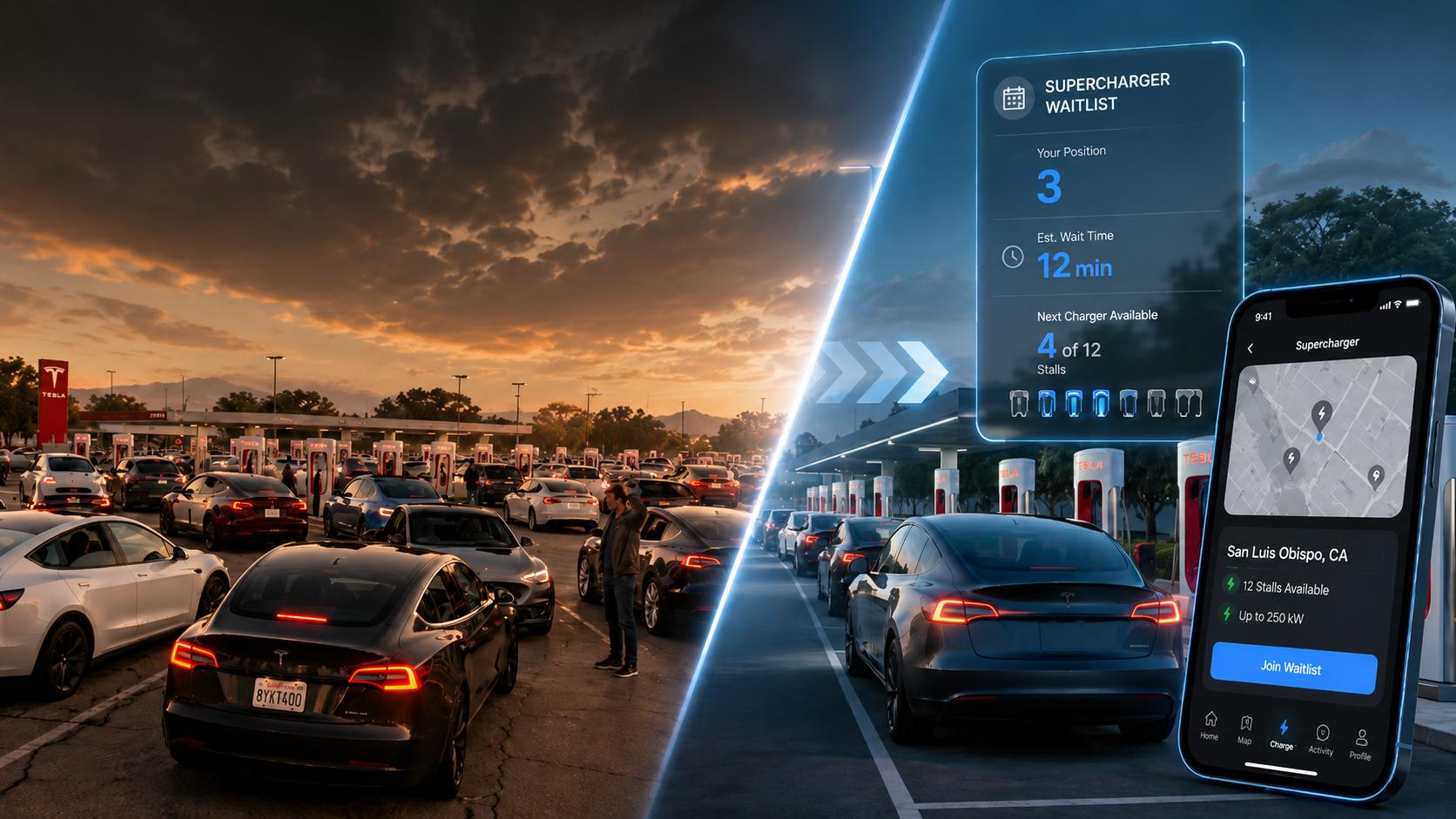
There is a particular kind of frustration that EV drivers know intimately, one that has nothing to do with range anxiety or charging speeds. It is the frustration of arriving at a charging station to find every stall occupied, then realizing there is no system — none at all — for determining who gets the next available plug. Cars hover at odd angles. Drivers make uneasy eye contact. Someone inches forward, and someone else gestures angrily. What should be a routine stop becomes a tense, unstructured negotiation among strangers.
For years, Tesla owners navigated this ambiguity with a mix of patience and unwritten etiquette. Most of the time, it worked. But occasionally — and memorably — it did not. In early 2025, a video surfaced online of two Tesla owners physically fighting at a crowded Supercharger station over who was next in line. The footage circulated widely, becoming a symbol of what happens when a charging network's success outpaces its queue management tools. Tesla acknowledged at the time that wait times occur about one percent of the time across its network, but conceded the experience needed improvement.
That improvement has finally arrived — more than a year later than promised, and with notable limitations. On May 11, 2026, Tesla's official charging account on X announced the pilot launch of a "Waitlist" feature at five high-traffic Supercharger locations. The system lets drivers join a virtual queue through the Tesla app rather than forming physical lines, displaying their position and estimated wait time. It is, in concept, the software solution to a hardware-proximate social problem. But the year-long delay, the reliance on an honor system, and the questions that remain unanswered raise an important question: is this a genuine fix, or a half-measure dressed in a clean user interface?
Chapter 1: The Anatomy of a Supercharger Queue — Why This Problem Exists
When Success Creates Congestion
Tesla's Supercharger network is, by any measure, the most successful DC fast-charging deployment in the world. As of early 2026, the network operates more than 2,500 station locations with approximately 30,000 individual stalls in the United States alone, representing the single largest fast-charging footprint by stall count with a significant density advantage over competing networks on major highway corridors. Reliability rates hover above ninety-nine percent, a figure that competitors like Electrify America and EVgo have struggled to match.
This success creates its own problem. The very qualities that make the Supercharger network attractive — reliability, density, integration with vehicle navigation — also make it the default choice for millions of Tesla drivers. When those drivers converge on the same stations during peak travel periods, the result is predictable: queues form. During holiday weekends, the end of a workday in dense urban centers, or major travel events, a once-serene charging oasis can transform into a source of anxiety, confusion, and, in rare but significant cases, open conflict.
The Scale of the Congestion Problem
Tesla has disclosed that congestion occurs approximately one percent of the time across the network. That sounds negligible until you run the math. In the first quarter of 2026 alone, Tesla reported 53 million Supercharger sessions. One percent of 53 million is 530,000 sessions per quarter — more than 5,800 per day, on average — where a driver encountered a fully utilized station. Over a full year, that translates to more than two million instances where drivers arrived to find no available stall and no organized way to wait for one.
It is important to understand what that one percent figure actually represents. It is not that one percent of stations are congested at any given moment; congestion is concentrated at specific locations during specific time windows — Friday evenings on Interstate 5, Sunday afternoons on the California coast, holiday corridors in the Northeast. For drivers who frequent these routes, the congestion rate is not one percent. It is far higher, and the experience of arriving at a full station with no clear queuing mechanism is not a statistical abstraction. It is a recurring frustration.
Why Physical Queues Break Down
The informal, often unspoken rules of queuing at Superchargers have always been fragile. Unlike a gas station, where refueling takes minutes and the line of cars is visible and unambiguous, a Supercharger station presents multiple complications. Stalls are often arranged in parking-lot configurations that do not lend themselves to orderly lines. Some drivers wait in their vehicles near the stalls; others park across the lot. Some leave to grab coffee, raising the question of whether they have forfeited their spot. A driver who arrives after someone else may position their vehicle closer to a stall that is about to open, creating ambiguity about who has the legitimate claim. As one report notes, these situations have occasionally escalated into physical altercations, turning a simple wait for a charging stall into a genuinely distressing event.
The problem has been amplified by Tesla's decision to open its Supercharger network to non-Tesla electric vehicles. Between May 2023 and late 2024, Tesla reached interoperability agreements with effectively every major EV automaker: Ford, GM, Rivian, Volvo, Polestar, Mercedes-Benz, Nissan, Lucid, Hyundai, Kia, BMW, Acura, Audi, Lexus, and others. Roughly 70 percent of Tesla's 80,000-plus Supercharging stalls are now open to other automakers' vehicles, contributing to increased station utilization. A system that relied on informal etiquette among a smaller community of Tesla enthusiasts is no longer sufficient for a continental network serving millions of diverse users.
The Viral Moment That Forced Action
Sometimes, a problem needs a symbol. The early 2025 video of two Tesla owners physically fighting at a crowded Supercharger station became that symbol. The footage showed an argument — then shoving, then full-blown fisticuffs — as two drivers contested their place in an invisible queue. The video spread rapidly across social media and was covered by major outlets, transforming what had been a niche frustration into a widely recognized failure of user experience design.
In February 2025, approximately two weeks after the video circulated, Tesla announced that it would launch virtual queue pilots "in Q2 at select sites" — meaning the second quarter of 2025. The company acknowledged the problem and promised a software solution. That solution is now launching in Q2 2026 — a full year behind schedule.
Chapter 2: The Waitlist — What It Is and How It Works
The User Experience
Joe Klender of Teslarati published one of the earliest detailed looks at the Waitlist feature on May 12, 2026, describing a system that "will solve sequencing confusion when there is a line to charge at one of the company's locations". The mechanism is straightforward: when a driver approaches a Supercharger that has reached capacity, their vehicle automatically joins a virtual queue. The driver does not need to press a button or navigate menus; the system activates based on proximity to the station and the station's occupancy status.
Once in the queue, the driver receives several pieces of information through both the vehicle's infotainment screen and the Tesla mobile app. They can see their position in line — for example, "2 cars ahead" — and an estimated wait time. A promotional video released by Tesla shows a driver being informed of a wait time of "less than 5 minutes" with two cars ahead. This information, while simple, is transformative. It eliminates the ambiguity that causes conflict: everyone knows exactly where they stand and approximately how long they will wait.
The feature also integrates with Apple's Live Activity system on iPhones, letting drivers see their queue position and estimated wait time even when the Tesla app is closed. According to the app's permissions, "While the app is closed, Tesla uses your location to notify you of accurate wait times at Superchargers when you arrive". This means a driver can park, walk into a nearby establishment, and monitor their position without staring at their phone.
The Five Pilot Locations
Tesla announced the pilot through its official Tesla Charging account on X on May 11, 2026. The five test sites are:
-
Los Gatos, California — Los Gatos Boulevard
-
Mountain View, California — El Monte Avenue
-
San Francisco, California — Lombard Street
-
San Jose, California — Saratoga Avenue
-
Bronx, New York — East Gun Hill Road
The location selection is revealing. Four of the five sites are in the San Francisco Bay Area — arguably the highest-density Tesla market in the world and a logical stress-test environment for any congestion-management feature. The Bay Area has more Teslas per capita than any other metropolitan region in the United States, and its Superchargers are among the most heavily utilized in the network.
The fifth location, in the Bronx, is a notable addition. New York City Superchargers have been overwhelmed by ride-hailing drivers in the past, making the Bronx station a real-world congestion hotspot. By including it in the pilot, Tesla is testing the Waitlist under conditions that are meaningfully different from the Bay Area — a denser urban environment where a higher proportion of users charge away from home and ride-hailing adds another layer of demand variability.
Non-Tesla EV Support
One of the most significant aspects of the Waitlist pilot is that it supports non-Tesla EVs through the Tesla app. This is more important than it might initially appear. When Tesla opened its Supercharger network to vehicles from Ford, Rivian, General Motors, Hyundai, Kia, and others, it introduced a new category of user: drivers who are not part of the Tesla ecosystem, who may not be familiar with Supercharger etiquette, and whose vehicles may not have the same level of navigation integration that Tesla vehicles enjoy.
The inclusion of non-Tesla EVs in the Waitlist system acknowledges that congestion is a network-level problem, not a Tesla-only problem. If non-Tesla drivers were excluded from the queue, they would have every incentive to ignore it — plugging in as soon as they see an open stall, regardless of who was waiting. By bringing them into the system, Tesla creates a single queue that applies to all users at a given station.
Chapter 3: The Honor System Problem — What the Waitlist Does Not Do
No Technical Enforcement
The most consequential detail about the Waitlist pilot is what it does not do: it does not prevent a driver from plugging in out of turn. According to multiple reports, including Electrek's coverage on May 12, 2026, Tesla "doesn't appear to be able to block a driver from plugging in out of turn" and instead relies on a software prompt asking the driver to confirm their action.
Not a Tesla App, which decompiled a recent version of the Tesla app to examine the feature's code, confirmed this limitation. "Based on a recent Tesla app we decompiled, it does not appear Tesla will limit charging to the next person in the queue, and anyone would technically be able to pull into the open stall and charge". In other words, the Waitlist is a coordination tool, not an enforcement mechanism. The system asks drivers, "There is a waitlist to charge. Are you sure you want to start a charging session now?" — but if the driver answers yes, the session proceeds normally.
The Social Dynamics of an Unenforced Queue
Anyone who has waited at a busy Supercharger understands the fragility of an honor system. In most situations, most people will respect the queue. But it takes only one person to cut the line for the entire system to break down. If drivers believe that queue-jumpers face no consequences, the incentive to respect the waitlist diminishes. Why wait your turn if someone else will take the stall the moment it opens?
The risk is especially acute for non-Tesla EV owners, who may arrive at a station without receiving the same built-in notifications that Tesla drivers see in their vehicles. Drive Tesla Canada noted this gap in their coverage: "Another missing piece is that Tesla also did not clarify how the system handles queue-jumpers. That question is especially important for non-Tesla EV owners, who may arrive at a station without receiving the same built-in notifications that Tesla drivers see in their vehicles".
Tesla has previously indicated that "there will be some kind of enforcement mechanism in place", but as of the pilot launch, no such mechanism has been activated. The most likely enforcement approach — and one that would be technically straightforward for Tesla to implement — would be preventing a vehicle from starting a charging session unless it has reached the front of the virtual queue. The Supercharger network already authenticates every vehicle that plugs in; adding a queue-position check to that authentication process would not require new hardware. But Tesla has chosen not to implement it, at least for now.
Why the Soft Launch?
There are several plausible explanations for Tesla's decision to launch the Waitlist as a coordination tool rather than an enforced queue. The first is data collection: by observing how drivers interact with the system voluntarily, Tesla can gather information about queue behavior, wait times, and compliance rates before deciding whether enforcement is necessary. The second is user experience: an enforced queue that blocks charging could cause significant frustration if it malfunctions, and Tesla may prefer to validate the system's reliability in a low-stakes mode before adding the high-stakes element of access control. The third is legal and regulatory: blocking access to a public charging station based on software-determined queue position raises questions about fairness and potential liability that Tesla may want to address before implementing full enforcement.
Whatever the reason, the result is a system that represents genuine improvement over the status quo — organized information is better than no information — but that stops short of solving the core problem. The Waitlist tells you where you are in line. It does not guarantee that your place in line will be respected.
Chapter 4: The Year-Long Delay — Why Tesla's Software Fix Took 12 Extra Months
From Promise to Product
Tesla first announced virtual queue pilots in February 2025, saying they would begin "in Q2 at select sites" — meaning the second quarter of 2025. The pilot is now launching in Q2 2026, a full year behind the original schedule. For a feature that is, at its core, a relatively straightforward software implementation — identify which vehicles are near a full station, order them by arrival time, and display their position — the delay requires explanation.
The Code Was There, the Deployment Was Not
Part of the puzzle is that the code for the virtual queue was visible in Tesla app updates months before the feature launched. Drive Tesla Canada reported that code discoveries in the mobile app had been "hinting at the feature's development" for more than a year before the official activation. The software was being built. It just was not being deployed.
This pattern — building software and then sitting on it — is not unique to the Waitlist feature. Tesla has a documented history of developing capabilities that take months or years to reach customer-facing deployment. The reasons can include internal testing requirements, regulatory considerations, resource allocation decisions, and the company's characteristic unpredictability around product timelines. In this case, the feature required coordination between the vehicle firmware, the mobile app, the back-end Supercharger management system, and the charging hardware itself — a cross-functional integration that is more complex than it appears from the outside.
Competing Priorities
The year between the Waitlist's announcement and its launch was not a quiet period for Tesla's charging division. During that time, the company completed its transition from V3 to V4 Supercharger cabinets, with Gigafactory New York producing its last V3 cabinet in March 2026 after more than 15,000 units over seven years. The V4 ramp, which delivers up to 500 kW per stall for passenger vehicles and supports 1.2 MW for the Tesla Semi, represented a significant engineering and manufacturing effort.
Simultaneously, Tesla was executing the largest expansion of third-party Supercharger access in the network's history. By early 2026, effectively every major automaker had gained access to the network, requiring Tesla to manage compatibility testing, adapter distribution, billing integration, and user education at a scale it had never previously attempted. The company was also beginning to deploy "folding V4 Superchargers" — a new pre-fabricated design that allows 33 percent more units to fit on a single delivery truck, cuts deployment time in half, and reduces installation cost by roughly 20 percent. A 400-stall site in Yermo, California, described as potentially the world's largest Supercharger location, was announced in March 2026 with construction expected to begin in phases.
In this context, the Waitlist — which addresses a problem that affects one percent of charging sessions — may simply not have been the highest priority, however frustrating that may have been for the drivers who experienced those sessions.
The Infrastructure Response
It is also worth noting that Tesla's primary strategy for addressing congestion has been, and remains, expansion. Max de Zegher, Tesla's Senior Director of Charging, has articulated the engineering philosophy behind the approach: the goal is to eliminate wait times entirely through network expansion and smarter routing algorithms that direct vehicles to less congested stations, with the Waitlist serving as a backup for unexpected surge events that expansion cannot prevent.
Under this philosophy, the Waitlist is not the solution to congestion; it is the safety net for moments when the real solution — more stalls, better routing — falls short. De Zegher noted that "while larger sites and advanced trip planning algorithms have drastically reduced overall network congestion, physical lines still occasionally form during peak travel periods. When these surges happen, charging stations can become chaotic as vehicles form a physical line, causing some confusion. In some extreme cases, drivers have even resorted to passing around a clipboard to help organize the queue".
The fact that drivers have resorted to clipboards — a 20th-century solution to a 21st-century congestion problem — underscores how urgently the Waitlist was needed, even if Tesla's infrastructure-first strategy made it a second-tier priority.
Chapter 5: The Charging Ecosystem — Where the Waitlist Fits in Tesla's Broader Strategy
A Multi-Layered Approach to Congestion
The Waitlist is the newest layer in a multi-layered congestion management strategy that Tesla has built over several years. Understanding how these layers fit together is essential to understanding why the Waitlist took the form it did.
The first layer is capacity expansion. Tesla continues to build new Supercharger stations at a rate unmatched by any competitor, with a growing emphasis on larger sites. The 400-stall Yermo project, the 168-stall station opened in July 2025 with a solar farm and Megapack batteries, and the deployment of folding V4 units that reduce installation time and cost all represent capacity-side interventions designed to make congestion less frequent.
The second layer is dynamic routing. Tesla vehicles do not simply navigate to the nearest Supercharger; the in-vehicle trip planner considers station occupancy, charging speeds, and the vehicle's state of charge to route drivers to stations with available capacity. This layer operates invisibly to the driver, but it is arguably the most important congestion-management tool Tesla has, because it prevents queues from forming in the first place.
The third layer is behavioral. In 2023, Tesla launched a congestion fee of $1 per minute for drivers who continue charging past 90 percent at busy stations. This fee addresses a different aspect of the congestion problem: not the number of cars waiting, but the duration for which each car occupies a stall. By incentivizing drivers to unplug when their battery reaches a high state of charge, Tesla increases stall turnover and reduces wait times for arriving vehicles.
The Waitlist is the fourth layer. It does not prevent congestion; it manages the experience of congestion when prevention fails. And it does so not by adding hardware or changing behavior, but by providing information — position in line, estimated wait time, and a clear sequence that eliminates the ambiguity that causes conflict.
The Software Advantage
The Waitlist also exemplifies what is arguably Tesla's most durable competitive advantage in the charging space: vertical integration of hardware, software, and vehicle. When a Tesla driver approaches a congested station, their vehicle knows where they are, knows the station's occupancy in real time, and can add them to a queue automatically without the driver needing to open an app or press a button. This is possible because Tesla controls the vehicle firmware, the mobile app, the Supercharger back-end, and the charging hardware — four systems that in any other automaker's ecosystem would be controlled by three or four different entities.
For non-Tesla EV drivers using the Supercharger network, the experience is necessarily less seamless. They must use the Tesla app to join the queue, and they may not receive in-vehicle notifications. But even this less integrated experience is better than what competing networks offer. Electrify America and EVgo — the two largest non-Tesla fast-charging networks in the United States — have implemented various congestion-management measures of their own. Electrify America has experimented with strict time limits at its busiest California stations, but neither network has deployed a virtual queuing system comparable to Tesla's Waitlist. The competitive gap in software-driven infrastructure management remains wide.
Chapter 6: What This Means for Tesla Owners — Today and Tomorrow
The Immediate Benefit: Certainty
For Tesla owners who charge at the five pilot locations, the Waitlist provides something that has been conspicuously absent from the Supercharger experience during peak periods: certainty. Knowing that you are third in line with an estimated wait of less than ten minutes transforms the psychology of the charging stop. You can stay in your car and watch something on the infotainment screen. You can walk into a nearby coffee shop without worrying about losing your spot. You can make an informed decision about whether to wait or navigate to a different station.
This psychological benefit — the reduction of uncertainty — is not a trivial feature. Research on queuing behavior consistently shows that people tolerate waits far better when they know how long the wait will be and feel confident that the queue is fair. The Waitlist addresses both dimensions: it provides an estimated wait time and it establishes a transparent, first-come-first-served order.
The Unresolved Questions
Despite the genuine improvement the Waitlist represents, several important questions remain unanswered as of the pilot launch.
First, what happens when a stall becomes available? Tesla's promotional video shows a driver joining the queue, but "the video stopped short of showing what happens next. Tesla did not show how drivers are notified when a stall becomes available, whether they must confirm their spot, or how much time they have to plug in before losing their place in line". These details will determine whether the Waitlist functions smoothly in practice or introduces new forms of frustration.
Second, how will the system handle edge cases? What happens if a driver's vehicle leaves the geofence around the Supercharger while they are in the queue? According to Not a Tesla App, "if the vehicle goes too far outside the Supercharger waitlist geofence, it will automatically leave the queue". But the size of that geofence, and whether it accommodates nearby businesses where drivers might wait, has not been specified.
Third, will enforcement be added? Tesla has indicated that enforcement is being considered but has not committed to a timeline. Without enforcement, the Waitlist is a coordination tool that relies on social cooperation. With enforcement, it would become an actual queue management system. The difference between these two states is substantial.
The Expansion Timeline
Tesla has stated that it will expand the Waitlist if the pilot proves successful. The company is "asking drivers who use the feature at these specific stations to provide feedback via the Tesla app to improve the experience". A broader rollout "to hundreds of other congested Supercharger sites globally" is described as the long-term goal.
The pace of expansion will likely depend on several factors: the feedback Tesla receives during the pilot, the compliance rate with the honor system, the technical performance of the queue management algorithm, and — as always — Tesla's internal prioritization among competing charging initiatives. Given the year-long delay between announcement and pilot, any expansion timeline should be treated as provisional until the feature actually appears at additional stations.
Chapter 7: The Bigger Picture — Queuing as a Chapter in the EV Maturation Story
From Early Adopter to Mass Market
The Supercharger Waitlist is not just a feature update. It is a marker of where the electric vehicle market stands in its evolution from early adoption to mass market. In the early years of Tesla ownership, Supercharger congestion was rare not because the system was well-managed but because the fleet was small. Enthusiasts who charged at the same stations regularly developed informal norms. Queuing problems were exceptional.
That era is over. With millions of Tesla vehicles on the road and effectively every major automaker's EVs gaining Supercharger access, the network serves a user base that is orders of magnitude larger and dramatically more diverse than the community of early adopters who created its informal norms. The shift from unwritten etiquette to software-enforced queue management is a shift from community governance to institutional governance — from the norms of a club to the rules of a public utility.
This transition is happening across every dimension of the EV experience, not just charging. As EVs move from niche to mainstream, the infrastructure, software, and customer experience tools that served the early market must be rebuilt for scale. The Waitlist is one small piece of that larger transformation, but it is a revealing one: it shows what happens when a company that built its charging network for enthusiasts must now build it for everyone.
The Competitive Context
Tesla is not the only company grappling with charging congestion. Every major fast-charging network in the United States faces similar challenges, though their approaches differ. Electrify America has experimented with strict session time limits at busiest stations. EVgo has focused on station siting and capacity planning to minimize congestion before it occurs. But neither has deployed a virtual queuing system — a testament to the difficulty of the software integration required and to Tesla's unique position as a company that controls both the vehicles and the chargers.
The Waitlist also has implications for Tesla's future ambitions. The company has announced plans for a dedicated Robotaxi fleet, which will require its own charging infrastructure. In April 2026, reports emerged that Tesla is building Superchargers that will be reserved exclusively for the Robotaxi fleet. If Tesla can successfully manage queuing for human drivers, it may apply the same algorithmic approach to autonomous vehicles — scheduling charging sessions, routing vehicles to available stalls, and optimizing network utilization in ways that would be impossible with manual management.
Conclusion
The Supercharger Waitlist that Tesla began testing on May 11, 2026 is, in one sense, a small feature: a software update that lets drivers see their place in line at five charging stations. But in another sense, it is a significant milestone in the maturation of public EV charging infrastructure. It represents the moment when Tesla acknowledged that its network had grown too large and too diverse for informal queuing to work, and that software — not etiquette — would have to fill the gap.
The feature is not without limitations. The year-long delay from the original Q2 2025 target is a reminder that Tesla's product timelines remain aspirational rather than reliable. The reliance on an honor system rather than technical enforcement means the Waitlist is a coordination tool, not a queue management system. And the unanswered questions — about notifications when stalls open, about geofence boundaries, about enforcement mechanisms — mean the pilot is precisely that: a test, not a finished product.
Yet the Waitlist represents genuine progress. For drivers at the five pilot stations, it replaces ambiguity with information, tension with structure, and the risk of conflict with the certainty of a defined place in line. It leverages Tesla's unique vertical integration — vehicle, app, charger, back end — to deliver an experience that no competing charging network currently matches. And it signals that Tesla, for all its focus on autonomy, robotics, and energy, has not forgotten the mundane but meaningful work of making the existing charging experience better.
The clipboards that Tesla drivers passed around at crowded stations — a 20th-century solution to a problem created by 21st-century success — may finally be headed for obsolescence. The Waitlist is not the end of Supercharger congestion. But it is the beginning of the end of Supercharger chaos.
Frequently Asked Questions
Q: How do I join the virtual queue at a Supercharger?
When you navigate to a participating Supercharger that is at capacity, your vehicle will automatically join the virtual queue. You do not need to press any buttons or navigate menus. The system activates based on your vehicle's proximity to the station and displays your position in line and estimated wait time. You can also join the queue through the Tesla mobile app, which supports both Tesla vehicles and non-Tesla EVs.
Q: Which Supercharger locations currently have the virtual queue?
The pilot program is active at five locations: Los Gatos, California (Los Gatos Boulevard); Mountain View, California (El Monte Avenue); San Francisco, California (Lombard Street); San Jose, California (Saratoga Avenue); and Bronx, New York (East Gun Hill Road). Tesla is asking drivers who use the feature at these stations to submit feedback through the Tesla app to help refine the system before a potential broader rollout.
Q: Can non-Tesla EVs use the virtual queue?
Yes. Tesla has confirmed that the Waitlist feature supports non-Tesla EVs through the Tesla app. This is particularly important given that roughly 70 percent of Tesla's Supercharging stalls are now open to vehicles from other automakers. Non-Tesla drivers can join the queue using the Tesla app, though their experience may not include the same in-vehicle notifications that Tesla drivers receive.
Q: What prevents someone from cutting the line?
Currently, the system relies primarily on an honor system. When a driver who is not at the front of the queue attempts to start a charging session, the Tesla app displays a message asking, "There is a waitlist to charge. Are you sure you want to start a charging session now?" However, the system does not technically block the charging session from proceeding. Tesla has indicated that enforcement mechanisms are being considered but has not announced a timeline for implementation.
Q: Why did the virtual queue take so long to launch?
Tesla first announced virtual queue pilots in February 2025, saying they would begin in Q2 2025. The pilot launched in Q2 2026, a full year behind schedule. The delay likely reflects several factors: the cross-functional complexity of integrating the feature across vehicle firmware, mobile app, back-end systems, and charging hardware; competing priorities within Tesla's charging division, including the V4 cabinet transition and the massive expansion of third-party network access; and Tesla's characteristic unpredictability around product timelines.
Q: Will the virtual queue expand to more locations?
Tesla has indicated that it will expand the Waitlist feature if the pilot proves successful. The company is collecting feedback from drivers at the five pilot locations and will use that data to refine the system. A broader rollout — potentially to hundreds of congested Supercharger sites globally — is described as the long-term goal, though no specific expansion timeline has been announced.
Q: How does the Waitlist differ from Tesla's other congestion-management measures?
The Waitlist is one layer in Tesla's multi-layered approach to congestion management. Other measures include capacity expansion (building more and larger Supercharger stations), dynamic routing (directing vehicles to less congested stations through the in-vehicle trip planner), and behavioral incentives (the $1-per-minute congestion fee for charging past 90 percent at busy stations). The Waitlist does not prevent congestion; it manages the experience of congestion when prevention measures fall short by providing organized queuing and real-time wait information.