
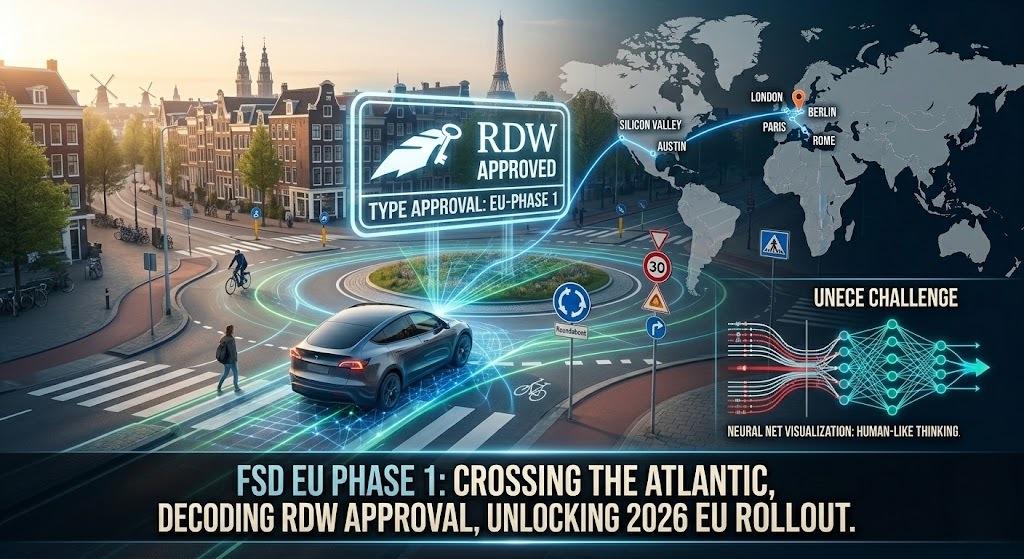
Chapter 1: The Zero-Hour of Autonomous Driving in Europe
Today, March 4, 2026, a single administrative approval from the Netherlands is resonating with the force of a sonic boom across the European automotive landscape. The RDW (Rijksdienst voor het Wegverkeer), the Dutch Vehicle Authority, has officially granted Tesla Extended Type Approval for the initial rollout of its "FSD Supervised" (Full Self-Driving Supervised) software across all of Europe. This is the official "Zero-Hour" that European Tesla owners have been anticipating since the first hardware-capable Model S rolled off the assembly line in 2016.
For the American observer, accustomed to the permissive regulatory environment of the US, the gravity of this moment may be difficult to grasp. FSD v12 has been a common sight on California’s roads for nearly two years. However, for Europe, a continent where "driver control" is etched into centuries of legal and cultural precedent, and where regulatory bodies move with glacier-like deliberation, this approval is a paradigm shift.
It is no coincidence that the RDW is the gateway. This same Dutch authority was the first to approve Tesla’s Model S for European sales and the first to approve its Supercharger network for third-party access. In 2026, the RDW remains the most pragmatic and forward-thinking regulator in the European Union, balancing public safety with the need for technological progress.
This approval does not mean FSD is suddenly unsupervised across the whole continent. Instead, it signifies that Tesla’s End-to-End Neural Net architecture, known to the public as FSD Supervised v13.x, has met the stringent standards of UNECE (United Nations Economic Commission for Europe) for specific pre-approved Operational Design Domains (ODDs). This initial phase is the key to unlocking the mass-scale validation data needed to convince more conservative nations like Germany and France to approve the next, more autonomous tiers. For the European Tesla owner, the question is no longer "if" but "when" and, critically, "which features."
Chapter 2: The UNECE Challenge: How Europe Differed from the USA
To understand why FSD Supervised v13 is making its debut only now, we must deconstruct the regulatory chasm between North America and Europe. The core conflict lies in the philosophy of software development and validation.
The US Model: Flexibility and Post-Hoc Correction In the United States, regulators like NHTSA (National Highway Traffic Safety Administration) have historically adopted a performance-based approach. Tesla has been free to push OTA (Over-the-Air) updates and even beta-test advanced features on public roads, provided they do not cause a recognizable pattern of "unreasonable risk to safety." NHTSA corrects post-hoc through recalls and safety investigations. This flexibility is what allowed Tesla to jump straight from classic Autopilot to FSD without an intermediate phase.
The UNECE Model: Pre-Approval and Rigid Standards Europe operates under the UNECE framework, which is built on the principle of Type Approval. Before a vehicle can be sold or a significant new driving feature can be enabled via OTA, it must be proved to meet a very narrow, rigid, and pre-defined set of criteria. This validation is done by an independent technical service and approved by a national authority, like the RDW.
For years, Tesla’s End-to-End Neural Net, which "thinks" rather than follows rigid IF-THEN code, was incompatible with UNECE’s demands for "explainability." How do you write a mathematical formula to prove why a neural net decides to yield to a pedestrian 100 meters away instead of 50? This was the "black box" problem.
The 2026 Solution: Extended Type Approval and ODD Constraints The breakthrough for FSD Supervised v13 in Europe did not come from a change in the neural net itself, but from a novel validation methodology. Tesla, working with RDW’s technical partners, created a new validation protocol that treats the entire system as a "cognitive unit," evaluating its outputs in millions of standardized scenarios.
The RDW approval relies on two key constraints. First, the Operational Design Domain (ODD) is restricted. FSD Supervised v13 will initially operate only on pre-validated road networks (all major highways and select inter-city routes) and during predefined conditions (no heavy fog, no heavy snow). Second, the user interface enforces "Supervision" with unprecedented strictness. European drivers will see a more aggressive cabin camera monitoring system and shorter steering wheel torque-nag intervals, designed to meet the strict interpretation of "Hands-on, Eyes-on" required by UNECE.
Chapter 3: The Demo Drive Program: Translating American Code for European Roads
While the regulatory work was massive, the engineering challenge was equally formidable. The FSD code, primarily trained on the grid-like, wide-laned, and well-marked streets of Palo Alto and Austin, faced an initial failure when confronted with the chaos of Rome, the roundabouts of Paris, and the unmarked village lanes of the Cotswolds.
The FSD European Integration Initiative (EII) Throughout 2024 and 2025, Tesla’s Autopilot team embarked on an unprecedented "data-collection expedition" in Europe. They used special validation fleets and extended the "Request for Intervention" (RFI) data gathering from the existing Autopilot base. In early 2026, this culminated in the multi-city "Demo Drive" program that just concluded last month.
Key Learnings from the 2026 Demo Drive Data from the demo drives in Paris, Berlin, Rome, and London (in partnership with RDW’s observers) highlighted specific deficiencies:
-
Roundabout Mastery: FSD v12 struggled with the non-sequential lanes and non-verbal communication of chaotic places like the Arc de Triomphe. FSD Supervised v13 includes specific neural net layers for "Roundabout Intent Prediction," allowing it to identify which lane is entering and which is exiting based on micromovements, a critical skill in Europe.
-
Narrow Lanes and "Giving Way": The US grid system does not prepare FSD for a medieval Italian village street where only one car can pass. V13 now includes a "Give Way Protocol," training the vehicle to identify oncoming traffic at a distance and slow down to the nearest pull-in spot, rather than charging ahead and creating a deadlock.
-
Vulnerable Road Users (VRUs): Bicycles are ubiquitous in Dutch and Danish cities. FSD Supervised v13 includes a specialized "Dutch Reach" neural module, trained primarily with data from Amsterdam, which monitors a bicycle's vector and potential interactions with parked car doors or cross-traffic far more aggressively than the North American version.
Chapter 4: The Software Delta: What Features European Owners Will Get (And What They Must Wait For)
This is the chapter every European owner needs to read carefully. The RDW approval does not grant feature-parity with the US. Instead, it unlocks a specific, UNECE-compliant subset of FSD capabilities, which Tesla is labeling "FSD Supervised EU-Phase 1."
What’s Included: FSD Supervised EU-Phase 1
-
End-to-End Highway: The neural net controls steering, lane changes (always initiated with full human logic-check), merging, and exit-ramp navigation on all major European motorways.
-
Neural-Based Autosteer on Urban Arterials: In pre-validated, well-marked city streets, the vehicle can handle complex intersections and traffic lights, but the driver must keep hands on the wheel and monitor every movement.
-
Advanced Junction Navigation: The vehicle can handle standard traffic lights and yields, and, critically, it can make left and right turns at intersections that do not feature complex, non-obvious rules.
-
The Dutch Roundabout Protocol: The first implementation of the v13 specialized roundabout handling.
What’s Excluded (For Now): The Wait for "Phase 2"
-
Unsupervised City Streets: The "Supervised" part of the name is critical. There is no timeline for Level 3 unsupervised urban driving in the initial RDW approval.
-
Complex, Unmarked Urban "Edge Cases": Navigating an unmarked village square or a shared-use zone in Barcelona is not currently validated.
-
Full Neural Smart Summon: Summon will be heavily restricted, requiring a much closer, active user engagement (like continuous phone-app touch) and a very defined ODD.
This phased approach is a strategic masterstroke. By launching a limited but highly functional "Phase 1," Tesla can gathering millions of hours of real-world European validation data, which will be essential for creating the safety-case arguments needed to unlock "Phase 2" and "Phase 3" (Unsupervised) in subsequent years.
Chapter 5: Infrastructure Readiness: The Road Signage Puzzle and End-to-End Solutions
The success of FSD Supervised v13 relies on one final, and often overlooked, element: European infrastructure. The End-to-End Neural Nets are designed to "read the road" like a human, not follow a GPS map. This makes FSD far less susceptible to map errors than Lidar-based competitors like Waymo, but far more dependent on the predictability of the visual world.
The Chaos of European Standardization While the UNECE standards provide a high-level framework for signage, the local implementation is chaotic. A "speed limit" sign in Spain might be a different color and size than one in France, and it might be placed higher or lower. Temporary yellow construction lines in Germany might contradict permanent white lines, and the vehicle must instantly prioritize the yellow, as a human would.
Solving with End-to-End Neural Nets A classical computer vision system, using explicit coding, would struggle to identify all these variations. However, a neural net trained on hundreds of thousands of varied European examples is designed to internalize these patterns. The 2026 Giga Berlin software team, which leads this localization, has spent 18 months training specific modules on "National Road Rule Deviations." This allows FSD Supervised v13 to understand, for instance, that a certain yellow sign in Croatia is a regulatory warning, while a similar sign in Sweden is merely an advisory one.
The Final Frontier: Lane Markings The most critical part of the RDW’s ODD constraints is lane markings. The first update will only function on roads with clear, verifiable boundaries. The End-to-End network is trained to project "virtual lane lines" based on the vector of surrounding traffic and pavement wear-patterns, but for the initial "Supervised Phase 1," RDW is demanding visual confirmation as a fallback, which is why rural roads remain off-limits.
Chapter 6: Conclusion: The Old World at the Dawn of a New Era
Today, March 4, 2026, will be remembered as the day the regulatory fortress of Europe finally opened its gates to the artificial intelligence revolution on its roads. The Dutch RDW approval is more than just a piece of paper; it is a validation of Tesla’s End-to-End Neural Net philosophy, the very concept of data-driven safety, and the pragmatism of Dutch regulation.
For the American owner, this is a validation of the features they have helped train. For the European owner, it is a reward for years of patience. The arrival of FSD Supervised v13 is the moment Tesla transitions in Europe from "the car that is fun to drive" to "the car that drives you." It is the first step in a multi-year journey, and while it is not the destination, it is the most crucial milestone yet. The "Old World" is about to find out just how fresh the future can be.
FAQ: Your Guide to FSD Supervised EU-Phase 1
Q1: What exactly did the Dutch RDW approve today? Answer: The RDW approved an Extended Type Approval for Tesla’s "FSD Supervised EU-Phase 1" software package. This allows it to be downloaded OTA to all capable vehicles across the European Union, the United Kingdom, and the EEA (European Economic Area), operating within specific, pre-approved road and condition constraints (ODDs).
Q2: Does my specific car support FSD Supervised EU-Phase 1? Answer: Generally, any Model S, 3, X, Y, or Cybertruck equipped with Hardware 3 (HW3) or Hardware 4 (HW4) and that has the "Full Self-Driving Capability" package purchased is eligible. Older, 2017-2018 vehicles may require a cabin camera upgrade or a computer upgrade from HW2.5 to HW3, which is sometimes offered by Tesla. Vehicles with HW4 will see slightly enhanced performance in complex junctions.
Q3: Does this mean I can take my hands off the wheel? Answer: Absolutely not. FSD Supervised v13.x in Europe, like the initial version in the US, is a Level 2 driver assistance system. The driver must remain focused on the road, keep hands on the wheel, and be prepared to take immediate control at any moment. The RDW approval mandating a more aggressive monitoring system (including the cabin camera) to ensure this.
Q4: When can I download the update and what is the cost? Answer: Tesla is beginning a phased OTA rollout this week, with priority given to vehicles in the Netherlands and those belonging to early-adopter profiles (like FSD subscription-holders). Most eligible owners should see the update within 4-6 weeks. The FSD package must be purchased (check current prices on the app) or subscribed to on a monthly basis.
Q5: What are the road and condition constraints (ODD)? Answer: "Phase 1" functions only on highways, major inter-city arteries, and pre-validated multi-lane urban roads. It will not activate on most rural "B-roads," unmarked single-lane paths, or in zones of heavy construction. It will automatically disengage if it detects heavy fog, heavy rain, or snow that visually obstructs sensors.