
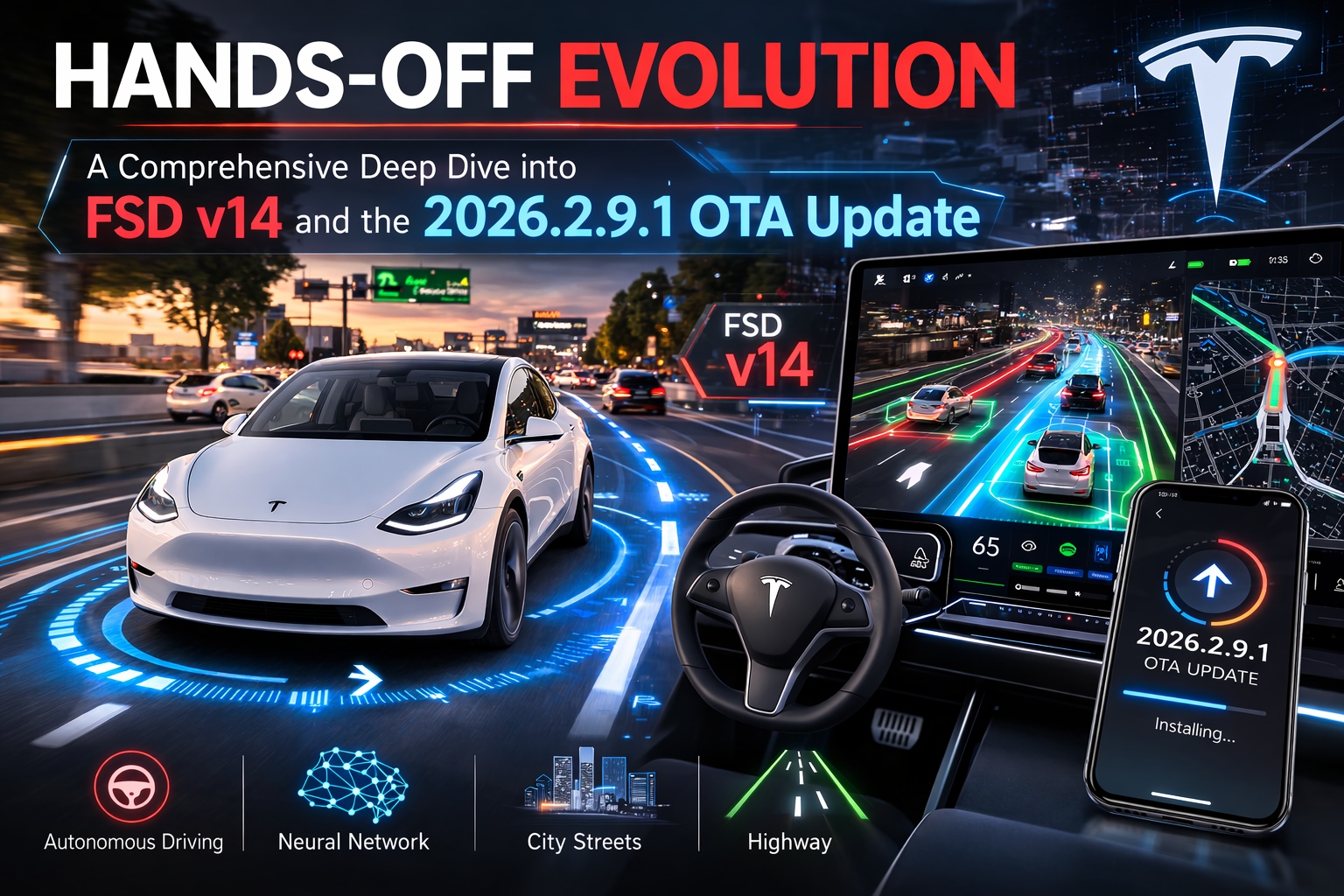
Introduction: The Most Important OTA of 2026
Software-defined vehicles are Tesla's foundational advantage. While traditional automakers treat software as an afterthought—something to be developed, locked down, and never touched again—Tesla treats it as the vehicle's beating heart, continuously improved, continuously expanded, continuously reimagined. Over-the-air updates aren't a convenience feature; they're the entire point of the Tesla ownership experience.
The 2026.2.9.1 update, now rolling out to vehicles across North America and Europe, exemplifies this philosophy . It's not a minor bug-fix release or a collection of incremental improvements. It's a comprehensive overhaul of the assisted driving system, a rebranding of core Tesla terminology, and the introduction of features that fundamentally change how the vehicle interacts with its environment.
At its heart is FSD v14, the latest iteration of Tesla's full self-driving software. But v14 isn't simply v13 with some polish; it represents a shift in how the system processes information and makes decisions. Tesla has moved toward what it calls "reasoning models"—AI systems that don't just recognize objects but understand context, predict behavior, and make human-like decisions about what comes next .
The timing is strategic. With the Cybercab program advancing toward production and regulatory approvals beginning to align, Tesla needs its assisted driving software to be ready for prime time. Unsupervised FSD—where the vehicle can operate without a human ready to take over—requires not just competence but confidence. It requires the system to handle edge cases with the same calm competence that a human driver would bring. FSD v14 is the most significant step yet toward that goal.
But for owners who couldn't care less about robotaxis and just want their daily commute to be easier, v14 delivers immediate practical benefits. The system is smoother, more predictable, and more capable in complex urban environments. It handles intersections with greater confidence, merges onto highways with less hesitation, and navigates construction zones with improved awareness. The improvements are tangible from the first drive.
Section 1: Version 2026.2.9.1 – What's Actually in the Update
Before diving into the features, it's worth understanding what the 2026.2.9.1 update actually contains. Based on release notes and early adopter reports, this is a substantial download—several hundred megabytes—that touches multiple vehicle systems.
The core of the update is FSD v14, but the version number itself reveals something important about Tesla's development process. Tesla uses a versioning scheme that encodes information about the update's timing and content. "2026" indicates the year, "2" indicates the month (February), and "9.1" indicates the specific build iteration. This is a major update, not a hotfix—the kind of release that would have required a dealership visit in the old world of automotive software.
Vehicles receiving the update must meet certain hardware requirements. FSD v14 is designed primarily for Hardware 4 (HW4) vehicles, which include all Model S, X, 3, and Y vehicles built since early 2024. Hardware 3 (HW3) vehicles—those built between 2019 and early 2024—will receive a subset of the features, with some of the more computationally intensive capabilities reserved for the newer hardware . Tesla has not yet announced a retrofit path for HW3 owners who want full v14 capability, though the company has historically offered upgrade paths for owners willing to pay.
The update is being delivered in phases, with Tesla's typical "safety first" approach. Initial recipients are employees and early access program members, followed by high-safety-score owners, followed by general release. If you haven't received the update notification yet, you will—assuming your vehicle is compatible and you're willing to accept the terms, which include acknowledging that FSD remains a supervised system requiring your constant attention.
Installation takes approximately 45 minutes, during which the vehicle cannot be driven. Tesla recommends installing overnight or during a period when you won't need the car, which is sound advice for any major update.
Section 2: The Rebranding – Why Words Matter
One of the most curious aspects of the 2026.2.9.1 update is what it changes in Tesla's terminology. Navigate on Autopilot, the feature that has guided Tesla vehicles on highways for years, is now called Navigate on Autosteer . The FSD Computer, the hardware brain that runs Tesla's assisted driving software, is now called the AI Computer .
On the surface, this seems like semantics—a rebranding exercise that changes nothing about how the vehicle actually operates. But Tesla's choice of words reveals something important about the company's strategic direction.
"Navigate on Autopilot" always carried a certain ambiguity. Autopilot is an aviation term that refers to systems capable of flying an aircraft without constant human intervention—but always under human supervision. The term worked well enough in the early years of Tesla's assisted driving development, but as the systems have grown more capable, the limitations of the analogy have become apparent. An aircraft's autopilot doesn't navigate; it maintains heading and altitude. It doesn't make routing decisions; it follows a programmed flight plan. It doesn't respond to dynamic conditions; it requires human intervention for anything unexpected.
"Navigate on Autosteer" is both more accurate and more modest. It describes what the system actually does: it steers the vehicle along a programmed route, maintaining lane position and speed, while the human remains responsible for overall supervision. The term doesn't overpromise, and in the current regulatory environment, that's important.
The shift from "FSD Computer" to "AI Computer" is even more revealing. "Full Self-Driving" is the goal, but it's also a loaded term—one that regulators in multiple jurisdictions have scrutinized. By rebranding the hardware as an AI Computer, Tesla shifts the focus from the feature to the technology. This isn't just a computer that runs self-driving software; it's a computer designed for artificial intelligence applications broadly, with self-driving being one of many possible uses.
This rebranding also aligns with Tesla's broader narrative about being an AI company rather than a car company. The AI Computer isn't just for driving; it's the platform that will eventually power Tesla's humanoid robot, its robotaxi fleet, and whatever other AI applications emerge from the company's development pipeline. By calling it what it is, Tesla prepares customers for a future where the car's intelligence extends far beyond the driving task.
For owners, the practical implications are minimal. The features work the same way they always have, just with different names in the menus. But for investors, regulators, and anyone tracking Tesla's strategic direction, the rebranding signals a shift in how the company wants to be understood.
Section 3: Arrival Options – The Feature That Changes Everything
If there's one feature in the 2026.2.9.1 update that deserves special attention, it's Arrival Options. This seemingly simple addition fundamentally changes how FSD handles the end of a journey, and it provides the clearest window yet into Tesla's vision for unsupervised driving.
Here's how it works: when you navigate to a destination, the system now presents you with options for how you want to arrive. You can choose Parking Lot, Street, Driveway, Parking Garage, or Curbside . Based on your selection, the vehicle will adjust its behavior in the final moments of the journey.
If you select Parking Lot, the system will look for an appropriate parking space, navigate through the lot at reduced speed, and attempt to park in a spot that's convenient to your destination. If you select Street, it will pull to the side of the road near your destination and stop, as if picking up or dropping off. Driveway tells the system to enter the driveway if one exists and stop at an appropriate point. Parking Garage initiates a search for garage entry and appropriate parking within. Curbside is similar to Street but with more emphasis on finding a legal curbside spot.
The system doesn't just blindly follow your instruction; it applies what Tesla calls "reasoning models" to assess the destination and suggest the most appropriate arrival mode . If you're navigating to a shopping mall, it might default to Parking Lot. If you're going to a friend's house in a residential neighborhood, it might default to Driveway or Street. If you're heading to an airport, Parking Garage becomes the likely default.
This intelligence is what makes Arrival Options more than just a menu selection. The system is learning to understand destinations not just as coordinates but as places with context, with typical uses, with expected behaviors. It's learning to think like a human driver who knows that you park in the lot at the grocery store but pull into the driveway at home.
For current FSD users, Arrival Options eliminates one of the most common sources of last-minute disengagement. Previously, the system would often reach the destination and then seem uncertain what to do next—stop in the middle of the road, perhaps, or attempt to park in an inappropriate location. The driver would have to take over for the final moments, which broke the flow of the otherwise autonomous journey. With Arrival Options, the system knows what's expected and executes accordingly.
For the robotaxi future, Arrival Options is essential. A driverless vehicle needs to know whether it's dropping off a passenger at the curb, parking in a garage, or waiting in a lot for the next fare. It needs to make these decisions autonomously, without human input, based on the context of the trip. Arrival Options provides the framework for that decision-making.
Section 4: Safety and Emergency Response
The 2026.2.9.1 update includes significant improvements to how FSD handles emergency vehicles—a critical safety capability that has challenged every autonomous driving system on the market.
The new emergency vehicle response system is designed to detect police cars, fire trucks, and ambulances, assess their behavior, and respond appropriately . If an emergency vehicle is approaching from behind with lights flashing, the system will pull over to the right and stop, clearing the path. If an emergency vehicle is stopped on the shoulder with lights active, the system will move over to provide space, just as human drivers are taught to do. If an emergency vehicle is approaching an intersection from a cross street, the system will yield appropriately.
This isn't simple object recognition; it's behavior prediction. The system must distinguish between an emergency vehicle that's responding to a call (and thus needs right-of-way) and one that's simply parked (and thus doesn't). It must assess the urgency of the situation based on light patterns, siren sounds, and vehicle movement. It must make split-second decisions that balance safety, legality, and social expectations.
The underlying technology is a "upgraded neural network vision encoder" that improves the system's ability to recognize not just vehicles but their state and intent . The same encoder also improves recognition of human gestures—a police officer directing traffic, a pedestrian waving to cross, a cyclist signaling a turn. These are the subtle cues that human drivers process automatically but that have challenged autonomous systems.
Also new is an automatic narrow-field camera washing system . Tesla's camera-based system depends on clear vision, and dirty cameras have been a known limitation. The new system can detect when a narrow-field camera (the ones used for distance vision) is obscured and activate washers to clean them. This happens automatically, without driver intervention, ensuring that the vision system remains operational in adverse conditions.
For owners, these improvements translate directly to safer, more confident driving. The system is less likely to be confused by emergency scenes, less likely to miss critical visual cues, and better equipped to handle the unpredictable situations that arise on real roads.
Section 5: User Experience Improvements
Beyond the headline features, the 2026.2.9.1 update includes a range of smaller improvements that collectively enhance the ownership experience.
The dashcam viewer has been significantly upgraded. When reviewing footage, you can now see data overlays showing speed, steering wheel angle, and self-driving state at the time of recording . This transforms the dashcam from a simple recording device into a forensic tool—useful for analyzing incidents, understanding system behavior, or simply reliving interesting drives. If you've ever wondered exactly what the vehicle was doing at a particular moment, now you can see.
For iOS users, Dog Mode gains a clever new feature: Live Activity on the iPhone's lock screen and Dynamic Island . When you leave your dog in the vehicle with Dog Mode active, your iPhone will display the current cabin temperature without requiring you to open the Tesla app. A quick glance at your lock screen tells you that your pet is safe and comfortable. It's a small convenience, but it's the kind of thoughtful detail that distinguishes Tesla's software approach.
The update also changes how Autopilot engages. Previously, engaging Autopilot required a brake confirmation—you had to tap the brake pedal to confirm that you were ready for the system to take over. In 2026.2.9.1, this confirmation is disabled by default . Engaging Autopilot is now smoother and more seamless, with the system simply taking over when you activate it. The change acknowledges that experienced users don't need the extra confirmation step, though the option remains available for those who prefer it.
These improvements may seem minor compared to FSD v14's fundamental advances, but they demonstrate Tesla's commitment to refining every aspect of the user experience. The company doesn't just add features; it polishes them, iterates on them, and makes them better over time.
Section 6: The Road to Unsupervised FSD
The 2026.2.9.1 update must be understood in the context of Tesla's larger ambition: unsupervised full self-driving, where the vehicle can operate without a human ready to take over. Every feature in this update serves that goal.
Arrival Options teaches the system to handle end-of-journey scenarios autonomously. Emergency vehicle response prepares it for the unpredictable situations that arise on real roads. The neural network improvements give it better perception and prediction capabilities. The camera washing system ensures it can maintain those capabilities in adverse conditions.
Tesla has not announced when unsupervised FSD will be generally available. Regulatory approval remains a significant hurdle, and the system must prove its safety across billions of miles of real-world driving before regulators will sign off. But the progress is evident. Version 14 is smoother, more capable, and more human-like than version 13 was. Version 15, when it arrives, will be better still.
For current owners, the path to unsupervised driving is incremental. Each update brings new capabilities, new refinements, new edge cases handled. The system that drives your car today is dramatically better than the one that drove it a year ago, and a year from now, it will be better still. That's the magic of software-defined vehicles: they don't age; they improve.
The 2026.2.9.1 update is a significant milestone on that journey. It doesn't deliver unsupervised FSD—that day is still in the future—but it brings it closer. And for owners who use FSD daily, it makes the experience better, safer, and more enjoyable.
Conclusion: The Software-Defined Future
The 2026.2.9.1 update is a testament to the power of software-defined vehicles. In the old automotive world, a 2026 Model Y would be frozen at the capabilities it had when it left the factory. In Tesla's world, that same vehicle can be fundamentally improved years after purchase, gaining new features, new capabilities, and new intelligence.
FSD v14 is the star of this update, but the supporting cast matters too. The rebranding signals a strategic shift. The Arrival Options feature changes how the system handles journeys. The safety improvements make real-world driving safer. The user experience refinements make daily ownership more pleasant.
For owners who have been tracking Tesla's progress toward full autonomy, v14 provides the clearest evidence yet that the destination is approaching. The system still requires supervision—you must pay attention, keep your hands on the wheel, be ready to take over—but it requires less intervention than ever before. It handles more scenarios, makes better decisions, and drives more naturally.
The journey isn't complete. Unsupervised FSD remains a future goal, not a present reality. But with each update, the gap narrows. With each version, the system improves. And with 2026.2.9.1, Tesla has taken a significant step forward.
For owners, the message is simple: update your vehicle, spend some time with the new features, and prepare to be impressed. Your Tesla just got better while you slept.