
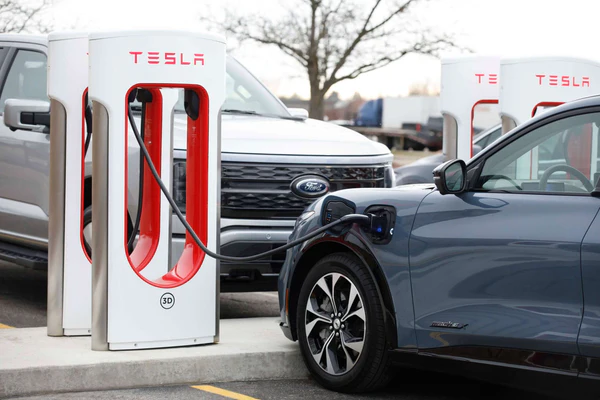
For years, the electric vehicle industry has been plagued by a fragmented and unreliable public charging infrastructure. The lack of a unified standard and inconsistent service has created a significant barrier to mainstream EV adoption. Against this backdrop, Tesla has embarked on a strategic pivot that is set to redefine its role in the industry. The company is not only rolling out its next-generation V4 Supercharger hardware but is also actively championing the widespread adoption of its North American Charging Standard (NACS). This is a strategic masterstroke that transforms the company from a proprietary ecosystem player into the de-facto charging utility for the entire electric vehicle market, leveraging its network dominance to generate new revenue streams and solidify its leadership position.
The V4 Supercharger: A Hardware Revolution
The V4 Supercharger is a significant evolution of the company's charging hardware, designed to meet the needs of an expanding EV market. The new monolith-like, white-and-black stations are engineered to deliver a much higher aggregate power per site, with a target of approximately 500 kW per stall in many configurations. The cabinets are also designed to support a broader range of vehicle electrical architectures, including both 400V and 800V systems, and to enable faster peak charge sessions for high-capability cars.
Beyond the raw power, the V4 Supercharger incorporates a number of user-centric design features that are crucial for the broader industry. The new posts feature longer cables, which are designed to reach all EVs regardless of where the charge port is located. This addresses a common pain point for non-Tesla drivers using the network. The V4 stations also have integrated payment terminals, which allows non-Tesla users to pay for their charging session directly at the post without needing to use a mobile app. This seamless payment experience is a critical step toward making the network more accessible and user-friendly for all drivers.
The NACS Tipping Point
The hardware improvements of the V4 Supercharger are inextricably linked to the industry-wide adoption of the North American Charging Standard (NACS). The NACS, which was originally developed and deployed by Tesla, has been adopted by a growing list of major automakers, including Ford, General Motors, Mercedes-Benz, and Rivian. This mass migration to a single charging standard is a powerful endorsement of Tesla's network and is driven by the desire to provide customers with access to a reliable and extensive charging infrastructure. The goal for automakers is to offer a "plug-and-charge" experience that is as simple as the one a Tesla owner has. This move is also a response to competitive pressure, as other brands follow suit once premium brands commit to NACS. The Society of Automotive Engineers (SAE) has also adopted NACS as its own standard, SAE J3400, further cementing its position as the de-facto standard in North America.
Strategic Implications and Commercial Realities
By opening its Supercharger network and championing the NACS, Tesla is making a profound strategic shift. The company is transitioning from a closed ecosystem player to a critical infrastructure provider, effectively becoming a charging utility for the entire EV market. This move is a recognition that the company's network, which has been a powerful competitive moat, can be monetized as a new, high-margin, recurring revenue stream. The energy solutions business, which includes the Supercharger network, already accounted for nearly 20% of the company's revenue in Q3 2025, demonstrating the viability of this business model.
However, this strategy is not without its challenges. The influx of new EVs could lead to network congestion, especially at popular sites. This will require new etiquette norms among a broader user base and could potentially degrade the charging experience for Tesla owners. The company will also need to manage the complexity of billing and customer support across different vehicle brands.
The Supercharger as a new business pillar is a masterstroke in business strategy. The V4 rollout and NACS adoption are not incremental improvements; they are the foundation of a new, high-margin business unit. The research material notes that the company's energy business, which includes Superchargers, already accounts for nearly 20% of revenue in Q3. By opening the network, the company is creating a new revenue stream from an asset it has already built. This monetizes a competitive moat and transforms a cost center into a profit center. This is a key part of the "Master Plan" to achieve "Sustainable Abundance" by democratizing access to autonomous goods and services and creating new revenue streams beyond vehicle sales.
The strategic move to open the network is an example of leveraging a powerful "network effect." As more OEMs adopt NACS, the value of the Supercharger network increases for all EV drivers. This creates a self-reinforcing loop: more OEMs adopt NACS because the network is dominant; the network becomes even more dominant because more OEMs adopt it. This cements the company's position as the de-facto standard, making it a critical "utility" for the entire EV industry. This is a long-term play for market leadership that transcends the automotive sector.
In conclusion, the V4 Supercharger and NACS adoption are the most significant infrastructure developments in the EV world today. They position the company not just as a leading automaker but as a critical utility provider, and their success or failure will determine the future of EV charging in both North America and Europe.
V4 Supercharger vs. V3 Supercharger
| Feature | V3 Supercharger | V4 Supercharger | Benefit |
| Max Power | 250 kW |
500 kW |
Faster charging speeds for all EVs, especially those with 800V architectures. |
| Cable Length | Shorter |
Longer |
Accommodates a wider range of vehicles with different charge port locations. |
| Payment Terminal | No |
Yes |
Allows non-Tesla drivers to pay without an app, improving user experience. |
| Non-Tesla Support | Requires Magic Dock or adapter |
Native support for NACS; some locations also have integrated adapters |
Broader interoperability and easier access for a wider range of EVs. |
Frequently Asked Questions
Q: Which automakers have adopted NACS? A: A growing list of major automakers have adopted NACS, including Ford, General Motors, Mercedes-Benz, and Rivian. More companies are expected to follow suit to provide their customers with access to the Supercharger network.
Q: How does the new V4 payment system work? A: The V4 posts include integrated payment terminals that allow non-Tesla drivers to use a credit card or other payment method directly at the post. This is a significant improvement over the app-based payment system required at older Supercharger sites.