
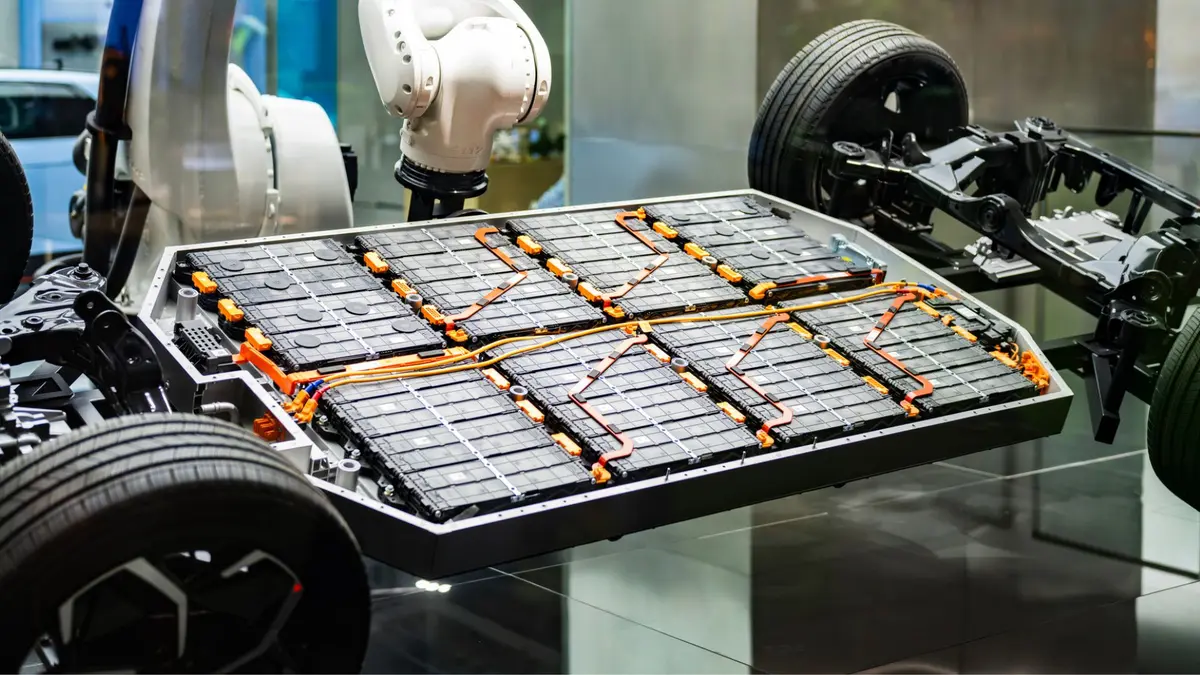
Panasonic has announced an aggressive development target for a next-generation “anode-free” lithium metal EV battery that it aims to bring to a world-leading level by the end of 2027. Panasonic says the design could raise cell capacity by roughly 25% versus its current high-performance cells — a gain that, if deployed in a Tesla Model Y, would translate to a very large real-world increase in driving range (industry coverage has estimated an uplift in the order of ~80–90 miles for a typical Model Y configuration) or allow smaller, lighter, and potentially cheaper packs for the same range. This article explains what anode-free batteries are, why they matter, the technical and manufacturing challenges ahead, how realistic Panasonic’s timeline is, and what the practical impacts would be for Tesla owners, buyers, and the broader EV market.
1. Introduction — why this announcement matters now
Range remains one of the clearest differentiators among battery-electric vehicles. Improvements in energy density either give cars longer range for the same pack size or allow manufacturers to downsize packs (and weight/cost) while maintaining the same range. Panasonic’s recent public statements about achieving a step change with an anode-free lithium metal design are consequential because Panasonic is a major EV battery supplier (and long-time Tesla partner). If Panasonic achieves a 25% capacity improvement in a mass-manufacturable cell by the end of 2027, the practical outcomes are large: materially longer range for the same vehicle, lighter packs, potentially lower system costs per kilometer, and new product and pricing strategies for automakers that secure the technology.
But major technical and manufacturing questions remain. Historically, lithium metal anodes deliver high theoretical energy density but are difficult to make robust, safe, and durable at automotive scale because of issues like dendrite growth, low initial coulombic efficiency, and complex formation cycles. Panasonic’s announcement is therefore both exciting and necessarily speculative: the company has set an ambitious target and a timeline, but whether it will result in safe, cost-effective, and high-yield manufacturing remains to be proven.
This article takes a technical and practical view: it explains what anode-free means, walks through the likely benefits for a car like the Tesla Model Y, examines the practical hurdles Panasonic will face to meet its timeline, and lays out the market and consumer implications.
2. Battery fundamentals: cells, packs, and why energy density is the bottleneck
Before diving into the innovation, it helps to recap how EV batteries are built and why changes at the cell level matter so much.
-
Cell → module → pack: A battery “cell” is the electrochemical unit (the cylindrical, prismatic, or pouch cell). Cells are grouped into modules, which are assembled into the battery pack that sits in the vehicle. Gains at the cell level scale across the pack: a 25% improvement per cell typically means a similar percent gain in pack energy all else equal (pack architecture and pack-level overhead will reduce that number slightly).
-
Energy density: Measured in Wh/kg (gravimetric) and Wh/L (volumetric), energy density dictates how much energy can be stored for a given mass and size. Higher cell energy density lets automakers put more miles into the same space or produce the same range with a lighter/smaller pack.
-
Why it matters for the Model Y: The Model Y’s current range depends on its battery chemistry, cell format, and pack sizing. Small percent gains in energy density multiply across the pack and yield non-trivial increases in vehicle range that matter to consumers — they can mean fewer charging stops, or reduced weight and cost for the same range.
-
System considerations: Range is not purely a function of pack energy. Drivetrain efficiency, aerodynamics, rolling resistance, and thermal management all shape real-world range. But, other things equal, a cell with 25% more capacity is transformational: it either raises the baseline range significantly or allows a certifiable downsize of pack capacity for cost/weight savings.
3. What “anode-free” actually means — chemistry and formation explained
“Anode-free” is a term used to describe lithium metal cells where the manufactured cell contains no pre-formed graphite (or any other) anode. Instead, lithium is plated onto a current collector (commonly copper foil) during the first charge (the formation cycle). The cell therefore contains cathode active material and a lithium source (typically from the cathode or a small amount of lithium metal in a reservoir format) but not a conventional anode structure.
Key points about the chemistry and why it raises energy density:
-
Eliminating the anode saves volume and mass. Traditional cells dedicate volume and material to the graphite (or silicon-graphite) anode and binder/porosity within it. Removing that material means the same pack can hold more active cathode material for a given size or mass — hence higher energy density.
-
Lithium metal has much higher theoretical capacity than graphite. Graphite intercalation (the traditional anode mechanism) has lower capacity per unit mass than plated lithium metal. So when lithium metal is formed in situ, the cell can store more energy.
-
Initial formation is critical. The first charging cycle forms the lithium metal anode on the current collector. This process must create a uniform, stable, and adherent lithium layer. Non-uniform plating leads to dendrites — tiny needles of lithium that can pierce the separator and cause short circuits.
-
Coulombic efficiency (CE) matters. Early-cycle CE for lithium metal is often lower than graphite cells, meaning some lithium is irreversibly lost each cycle. For a practical automotive cell, CE must be extremely high (very close to 100%) to achieve long cycle life. Engineers achieve higher CE with electrolyte additives, protective interlayers, or precise formation protocols — but these introduce additional cost and processing complexity.
-
Electrolyte and separator design are essential. Anode-free approaches often require advanced electrolytes and separators engineered to stabilize lithium plating and suppress side reactions.
-
Cathode design must accommodate more active material. With space saved on the anode side, designers often add more high-energy cathode material (e.g., higher nickel content NCA/NMC formulations), which itself has thermal and mechanical challenges.
In short: anode-free cells promise significant energy density improvement, but the technical tradeoffs are in formation control, interfacial chemistry, cycle life, and scalability.
4. Panasonic’s announcement: the claims and the timeline
Panasonic has publicly stated a target of developing an anode-free battery that reaches a “world-leading” capacity level by the end of 2027. The company’s announcements include several important claims:
-
Targeted capacity increase: Panasonic has characterized the new cells as potentially delivering about a 25% increase in usable capacity per cell versus the company’s current high-end cells. That number is the clearest headline metric and is the basis for many published estimates of vehicle range uplift.
-
Practical outcomes offered: Panasonic said the cells could either extend range significantly (industry estimates suggest the Model Y could gain roughly 80–90 miles of range at the same pack size) or allow for lighter/smaller packs that maintain current range but reduce vehicle mass and potentially cost.
-
Timeline: Panasonic aims to get anode-free cells to a world-leading level by the end of 2027 — a roughly two-year development horizon from the announcement. That timeline is aggressive but not unprecedented among major battery OEMs pursuing advanced chemistries.
-
Strategic objectives: Panasonic indicated an intent to reduce dependency on expensive materials (notably nickel) by increasing active cathode use efficiency and improving cell chemistry balance, though exact material mixes were not disclosed.
These claims have catalyzed widespread industry commentary and enthusiastic coverage because the theoretical upside is large. But they also raise questions: how fast can Panasonic solve the known technical issues (formation, dendrites, CE), how will yields and costs look at production scale, and what vehicle programs (if any) would adopt the cells early?
5. Translating cell gains to vehicle range: math, assumptions, and caveats
This section translates the headline 25% cell capacity improvement into practical vehicle range effects. The math is straightforward if we lay out assumptions clearly — but the real world has many caveats.
Assumptions for the exercise
-
Assume a baseline Model Y pack usable energy (examples vary by trim and model year; to make the point, choose a plausible baseline): for illustration, assume a usable pack energy of ~75 kWh for a long-range Model Y (this is an approximation that matches many long-range class vehicles; exact numbers vary by market/spec).
-
A 25% cell capacity improvement means, all else equal, the same pack architecture could hold 25% more energy if the pack size and volume remain unchanged. If the usable baseline is 75 kWh, a 25% increase yields ≈ 93.75 kWh (75 × 1.25 = 93.75).
-
Range scales approximately with usable energy only when efficiency (Wh/mile) is unchanged.
Example calculation (simple)
-
Baseline: 75 kWh → assume baseline real-world range of 330 miles (example figure). That implies a consumption of roughly 75 kWh / 330 miles ≈ 0.227 kWh/mile (227 Wh/mile).
-
New pack (25% more energy): 93.75 kWh / 0.227 kWh/mile ≈ 413 miles.
-
Range uplift: 413 − 330 ≈ 83 miles.
This simple estimate shows a realistic ballpark increase — on the order of 80–90 miles — matching industry reports that cite roughly this uplift. If the baseline pack is larger or efficiency is better/worse, the absolute numbers change, but the percent improvement is roughly 25% of baseline range (minus pack overhead changes), so a typical long-range Model Y (300–360 mile class) would see on the order of dozens of additional miles — not a small increment.
Two alternative deployment strategies and their impacts
-
“Range expansion” approach: Keep pack volume and mass roughly the same and put the higher-capacity cells into the existing pack. This maximizes range gains and is what many consumers most desire.
-
“Right-size” approach: Use higher-capacity cells to shrink the pack (reduce the number of cells for same range), which cuts weight and cost. This helps vehicle efficiency, dynamic performance, and manufacturing costs, but raises questions about energy buffer, thermal control, and cost per kWh.
Both are viable — automakers will choose based on their commercial priorities.
Caveats that reduce headline gains
-
Pack overhead & structural mass: Vehicle packs include casing, thermal management, and auxiliary electronics that do not scale directly with cell capacity; so a 25% cell gain does not yield a full 25% pack energy gain in every design. Expect a slightly lower pack-level percent increase.
-
Thermal management & cycle life tradeoffs: Higher energy density cells often need more advanced thermal control to maintain life and safety; that can increase pack mass or cost.
-
Real-world efficiency variation: Driving style, climate, vehicle payload, and accessory loads change real-world consumption and thus the vehicle’s realized increase. If efficiency improves simultaneously (for example, through aero or motor improvements), the combined result could be even larger.
Practical takeaway
A 25% cell capacity increase is large enough to materially change the ownership experience — either through significantly longer range or through lighter, cheaper packs at the same range. Industry reports estimating ~80–90 miles more for a Model Y are reasonable within the simple assumptions above. The actual consumer benefit depends on whether automakers choose to prioritize range, cost savings, or weight reduction.
6. Manufacturing hurdles: formation, yield, and quality control at scale
The chemistry is only half the story — mass manufacturing is where most battery innovations fail or succeed. Panasonic’s challenge is turning lab-scale performance into reliable, high-yield, cost-effective production lines operating at GWh and eventually tens of GWh per year. Key manufacturing challenges include:
6.1 Initial formation and uniform lithium plating
-
Uniform plating requirement: Anode-free cells require that lithium plates as a uniform, dense layer on the current collector during the first charge. Non-uniform plating produces “hot spots” and dendrites, which reduce lifetime and raise safety risks.
-
Formation speed vs quality: Automotive manufacturing requires efficient formation cycles. If formation takes too long (hours, or specialized multi-step protocols), throughput suffers and cost rises sharply.
-
Electrolyte & additive handling: Mass production will need consistent mixtures of electrolytes and additives that ensure stable plating. Managing these chemistries at scale increases process complexity.
6.2 Yield and scrap risk
-
Yield is king: Small reductions in cell yield at automotive scale translate to huge cost penalties. For a large gigafactory, a yield drop from 99% to 95% greatly increases effective cost per usable cell.
-
Quality control systems: Automotive standards require extremely low defect rates and strong traceability. Inline inspection, electrochemical testing, and thermal checks must be robust.
6.3 Cycle life and warranty considerations
-
Automaker warranties drive design constraints. Vehicles typically carry long warranties; battery suppliers must guarantee multi-year, multi-thousand-mile usable capacity. If early anode-free cells cannot meet cycle life expectations, automakers will resist adoption.
-
Process control to preserve life: Avoiding side reactions, maintaining stable SEI (solid electrolyte interphase), and preventing micro-shorts are essential — and these depend in large part on process control during manufacture.
6.4 Integration into existing production footprints
-
Retooling costs: Existing lines tuned for graphite anode cells may require new tooling, formation ovens, drying lines, and handling procedures.
-
Supply of specialty materials: Advanced electrolytes, separators, or interfacial layers may be proprietary, constrained, or costly, complicating rapid scale-up.
6.5 The economics of scale
-
Capex and opex: Capital investments for new production lines are large. Panasonic will balance capex against expected market adoption; delays in automaker adoption increase financial risk.
-
Throughput vs R&D tradeoffs: Panasonic will need to iterate on designs while also establishing production volume; balancing that tradeoff is a classic commercialization challenge.
In short, anode-free is promising — but the real test is whether Panasonic can make cells at automotive yields, with formation times and process control compatible with existing high-volume lines, and with acceptable unit economics.
7. Safety, cycle life, and real-world durability concerns
Lithium metal cells historically struggle with longevity and safety compared with graphite anode cells. When considering adoption in cars, the main considerations are:
7.1 Dendrites and short circuits
-
Dendritic growth risk: During plating, lithium can form filamentary structures (dendrites). If these pierce the separator, they can cause internal short circuits, leading to thermal runaway.
-
Mitigations: Advanced separators, controlled formation protocols, electrolyte engineering, and protective interlayers can reduce dendrite risk. But these add complexity and material cost.
7.2 Cycle life and capacity retention
-
Initial irreversible loss: Some lithium is lost during the first cycles (formation loss). Anode-free designs often face higher initial loss unless carefully engineered.
-
Calendar vs cycle aging: Both forms of aging must be managed; automotive cells need to retain meaningful capacity over many years (commonly >70–80% capacity retention over 8–10 years depending on warranty).
7.3 Thermal runaway and abuse testing
-
Automotive abuse standards are rigorous. Crash, overcharge, nail-penetration, and thermal tests must be passed. New cell designs often fail early iterations of abuse tests; suppliers then add protections that increase cost/weight.
-
System-level safety: OEMs add pack-level protections (fuses, thermal disconnects, advanced BMS algorithms) to manage cell behavior. Higher-energy cells demand equally robust pack architecture.
7.4 Real-world environmental extremes
-
Cold climate performance: Lithium metal behavior at low temperatures is often worse than graphite cells because plating/stripping efficiencies degrade; this affects winter range and charging.
-
High ambient temps: High energy density cells storing more energy per volume must be cooled more aggressively under sustained charging or heavy usage.
7.5 Regulatory and certification timelines
-
Testing takes time and scale. Passing global automotive certifications requires extensive test cycles; this in part shapes OEM adoption timelines.
Conclusion on safety/durability: Panasonic must demonstrate parity or superiority in safety and long-term durability compared to incumbent cells. Achieving high energy density is necessary but not sufficient — cells must be safe, durable, and manufacturable at scale to be acceptable for cars.
8. Supply-chain and materials implications (nickel, lithium, cobalt, silicon, etc.)
Panasonic’s messaging said the new approach could reduce the proportionate use of expensive nickel. Broader materials implications include:
8.1 Nickel and cathode composition
-
High-nickel cathodes (NMC/NCA) drive high energy density today but are costly and carry supply/risk issues. If anode-free cells allow more active cathode without enlarging pack size, Panasonic could theoretically use materials more efficiently or reduce total nickel per kWh.
-
Tradeoffs: Pushing more active cathode material often means increasing nickel content (for higher energy) or better cathode packing density — but either scenario raises thermal and mechanical stresses.
8.2 Lithium supply
-
Lithium is the limiting raw material. Higher energy density packs require more lithium per kWh if energy density increases come from more active cathode or lithium metal utilization. However, anode-free designs may shift the lithium source and usage pattern; the net lithium requirement per vehicle could change in complex ways.
-
Material sourcing & geopolitics: Battery makers will need stable lithium and precursor supplies; higher energy density cells could both increase demand and shift geographic sourcing.
8.3 Electrolytes, additives, and separators
-
Specialty electrolytes: Anode-free designs typically rely on additives and engineered electrolytes to stabilize lithium plating. These materials can be expensive and may require new suppliers and scaled manufacturing.
-
Separator advancements: New separators that resist dendrite penetration and control ionic flow are critical; these may be ceramic-coated or otherwise engineered, with implications for cost and supply.
8.4 Cost per kWh economics
-
Lower cost per km vs higher capex: If the cell’s energy density increases while per-cell cost rises modestly, the cost per usable kWh could fall (because less pack mass/volume and reduced balance-of-pack overhead). But if advanced additives or processes are expensive, per-kWh cost might not improve initially.
-
Mass adoption vs early adopter premium: Early production typically carries a cost premium. Costs may decline with scale but the timing of that decline matters to automaker adoption decisions.
Overall materials conclusion: anode-free technology may reduce some dependencies (e.g., per-kWh nickel cost) but introduces new material dependencies (advanced electrolytes, separators). The aggregate supply-chain impact will depend on the precise chemistry choices and how Panasonic scales those inputs.
9. Tesla + Panasonic: supplier relationships, sourcing, and strategic fit
Panasonic has been a long-time supplier to Tesla, including for cylindrical cells historically and as a development partner. How anode-free cells fit into Tesla’s product and manufacturing roadmap matters.
9.1 Strategic alignment
-
Tesla’s multi-supplier strategy: Tesla uses cells from multiple suppliers and has historically pushed for competitive pricing and custom specs. Panasonic’s innovation offers Tesla a potential competitive edge if Tesla secures supply or works jointly on validation.
-
Compatibility with Tesla pack architecture: Tesla’s cell-to-pack (CTP) and structural pack approaches will need to integrate new cell form factors or chemistry behavior. Tesla has experience integrating novel cell types (e.g., 4680), which reduces but does not eliminate integration risk.
9.2 Commercial dynamics
-
Supply allocation: If Panasonic achieves reliable anode-free cells, Tesla would likely negotiate priority supply for high-volume models (Model Y especially) — but pricing and volume commitments will matter.
-
Tesla’s internal R&D: Tesla also runs its own battery research and has multiple supply sources. For large shifts in cell chemistry, Tesla may test multiple suppliers before committing.
-
Geopolitical and regional manufacturing: Panasonic operates globally; Tesla’s production in Texas, Nevada, Berlin, and Shanghai has different supply footprints. Local production of Panasonic cells (or localized supply chains) would influence allocation and logistics.
9.3 Risk sharing and validation
-
Validation cycles: Tesla will demand extensive validation — crash, thermal, cycle, and real-world testing — before large fleet adoption. Panasonic and Tesla would need to align on test protocols and failure modes.
-
Warranty and liability: Automakers require clear warranty and liability frameworks for new cell types — Panasonic may need to shoulder more risk or provide performance guarantees for widespread adoption.
In sum: Panasonic’s innovation could plug into Tesla’s product roadmap quickly if the cells meet automotive standards and if supply/pricing align. But Tesla will test thoroughly and likely stagger adoption even if the chemistry looks promising.
10. Market impacts and competitive dynamics
Panasonic is not alone. Multiple battery makers and automakers are chasing lithium metal, solid-state, and other high-energy chemistries. The competitive landscape shapes how quickly the market could change.
10.1 Who else is in the race?
-
Toyota, Honda, and other OEMs: Many automakers pursue solid-state or lithium metal solutions with partnerships across the supplier base.
-
LG Energy Solution, CATL, Samsung SDI: Major cell suppliers are exploring high-capacity chemistries and proprietary solutions.
-
Startups and research labs: Dozens of startups pursue anode-free or lithium metal variants; some have demonstrated promising cells at lab scale but face scale-up challenges.
10.2 Potential market winners and losers
-
Early adopter automakers who secure reliable supply and can integrate cells safely could enjoy a range advantage, opening product differentiation opportunities.
-
Suppliers with scale and manufacturing expertise (Panasonic, LG, CATL) are better positioned to commercialize quickly than smaller labs — but they still must retool factories and ensure yields.
-
Price-sensitive competitors may find it harder to justify early adoption if the cells carry a cost premium; these OEMs will watch for when cost parity is reached.
10.3 Impact on vehicle segmentation and pricing
-
Premium EVs & long-range trims: These models will be first to benefit from energy-dense cells if automakers prioritize range increases for premium value.
-
Mass market models: If pack costs decline with scale, more affordable segments will gain higher ranges or lighter packs, accelerating EV adoption.
-
Charging network effect: Greater range reduces dependency on frequent fast charging, reshaping charging-infrastructure demand patterns and total cost of ownership calculations.
11. Scenarios & practical timelines — best, middle, and conservative cases
Because the technology is promising but unproven at scale, it helps to break down plausible adoption scenarios.
Best-case (optimistic): Panasonic hits technical and manufacturing targets by late-2026/2027
-
What happens: Panasonic achieves high yields and robust cycle life at anode-free cells; automakers (including Tesla) begin phased adoption on high-end trims in late 2027–2028. Consumer cars begin to show 25% pack gains in 2028 model years.
-
Implication: Range leaders emerge; automakers can either create >400-mile variants or reduce pack size/weight. Prices remain stable as costs fall with scale.
Middle (probable) case: Panasonic demonstrates safe, durable cells in pilots and scales gradually through 2028–2029
-
What happens: Initial pilot production runs in 2027, with controlled automotive validation throughout 2028. Mass adoption for mainstream models occurs in 2029 when yields and costs normalize.
-
Implication: Consumers see incremental rollouts: premium trims first, then broader adoption. Costs fall over 2–4 years after initial ramp.
Conservative (pessimistic) case: technical or yield issues delay broad adoption past 2030
-
What happens: Formation, dendrite control, or cost per kWh challenges prove tougher than expected; Panasonic iterates for several years. Adoption is slower and limited to niche applications in the 2027–2030 window.
-
Implication: The industry focuses on incremental improvements in existing chemistries and other approaches (silicon-rich anodes, cell design tweaks), delaying a true lithium-metal wave.
Which case is most likely? Given the announced timeline and the known technical risks, the realistic middle case — demonstration pilots in 2027 with broader adoption 2028–2030 — is a reasonable expectation. But funding, scale, and OEM validation timelines could push mass adoption later.
12. Consumer takeaways — what Tesla owners and prospective buyers should expect
For current Tesla owners
-
No immediate change: Short term (next 6–18 months) owners should not expect major retroactive changes to existing vehicles — upgrades will be reserved for future model years or retrofitted rarely via pack swap (which is expensive and unlikely at large scale).
-
Resale & value effects: If Panasonic’s cells succeed and adopters introduce significantly higher-range models, used vehicle pricing for older ranges could be pressured over time — but new-car introductions usually have bigger effects.
-
Charging and range behavior: In markets where higher-range models are introduced, charging behavior may shift toward fewer but longer trips; however, charging infrastructure remains important.
For prospective buyers (U.S. & Europe)
-
Timing matters: If you need a car immediately, buy based on current offers and incentives. If you can wait ~18–36 months and desire the absolute longest range, monitor announcements — but do not assume immediate availability.
-
Trim choices: Automakers may shift strategy — some will release “ultra-range” trims and also “right-sized” trims that are cheaper thanks to smaller pack sizes. Your priority (range vs price) will determine what to buy.
For fleet and commercial buyers
-
Real TCO impact: Higher energy density can lower weight and cost per km for high-utilization fleets; these buyers will watch for early pilots and validate lifecycle economics.
Practical caution
-
Validate real-world performance: Early press claims are often optimistic; wait for independent range, cycle life, and safety tests before assuming headline numbers.
13. Conclusion — cautious optimism and what to watch next
Panasonic’s anode-free battery target is one of the more consequential near-term developments in battery technology news. A 25% capacity gain, if achieved with automotive safety, durability, and acceptable cost, would materially change the EV landscape by boosting range or enabling lighter/cheaper packs — and for popular models like the Tesla Model Y, that translates into dozens of additional miles per charge or meaningful cost improvements.
Yet the path from lab to gigafactory is fraught with engineering, manufacturing, and supply-chain challenges. The most important near-term milestones to watch are: pilot production yields, formation times and protocols at scale, independent safety and cycle-life testing, the introduction of pilot vehicles incorporating the cells, and announcements of long-term supply agreements with automakers.
For Tesla owners and buyers in the U.S. and Europe, the sensible stance is to be optimistic but patient: this could be a transformative step, but it will take time to move from headlines to tens of thousands (and then millions) of vehicles on the road.
14. FAQ — practical questions Tesla owners and buyers ask
Q: Panasonic said “25% capacity improvement” — does that mean my Model Y will get 25% more range instantly?
A: Not instantly. A 25% cell improvement translates roughly into a similar percent at the pack level in the ideal case, but pack overhead, thermal management, and real-world driving reduce that headline. If deployed directly into a Model Y pack with similar efficiency, expect range increases on the order of tens of percent (e.g., ~80–90 extra miles on a ~330-mile baseline) under ideal conditions. But OEMs may instead choose to right-size packs or price trims differently.
Q: Will these batteries be safe?
A: Safety is a top concern. Lithium metal cells historically have higher risk of dendrite formation, but many mitigations exist (advanced separators, electrolytes, formation controls). Panasonic’s claim hinges on demonstrating safe, high-yield manufacturing and passing automotive abuse tests. That will take extensive validation.
Q: How long until these cells show up in Teslas?
A: Panasonic targets end-of-2027 demonstration at a world-leading level; realistic consumer adoption may begin in late-2027/2028 for premium trims, with broader rollout in the following years depending on yields, cost, and OEM validation.
Q: Will the new battery make EVs more expensive?
A: Early production often carries a premium. Over time, if yields and scale improve, the cost per usable kWh could fall. The strategic choice automakers make (range vs smaller pack) will determine pricing outcomes.
Q: Does this mean solid-state batteries are irrelevant?
A: No. Solid-state and anode-free lithium metal approaches are complementary strategies in the broader push to raise energy density. Many players pursue multiple pathways.