
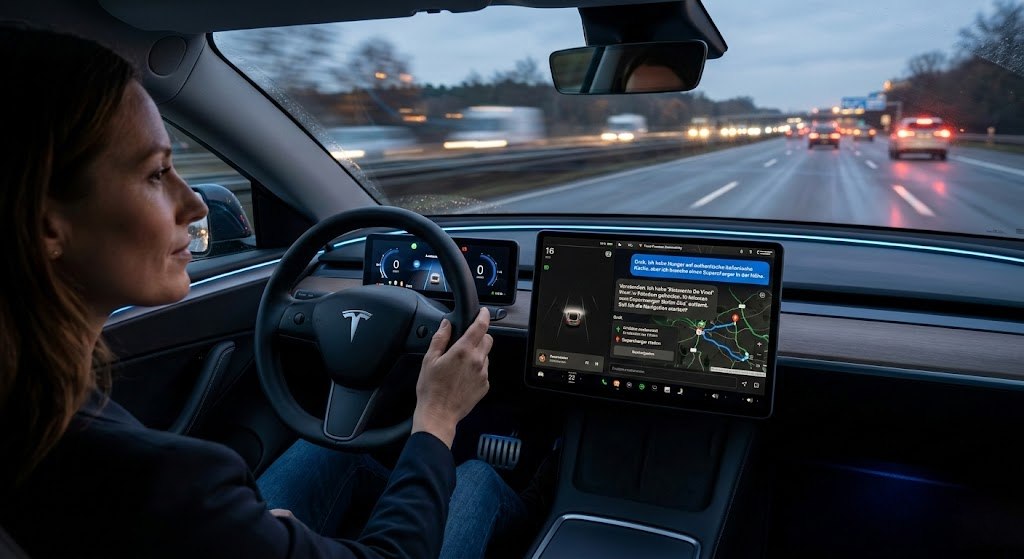
I. Introduction: The AI Cockpit Becomes Personal
For the better part of a decade, the "smart" in smart cars has been somewhat of a misnomer when it came to voice interaction. Drivers were often forced into a linguistic straitjacket, using rigid, pre-defined commands like "Navigate to..." or "Set temperature to..." with varying degrees of success. As of February 28, 2026, that era of robotic interaction has officially ended for European Tesla owners.
With the wide-scale rollout of firmware version 2026.2.6.5, Tesla has achieved what many considered its "iPhone moment" for the interior experience. By integrating xAI’s Grok, a Large Language Model (LLM) capable of real-time reasoning and conversational fluidity, the vehicle has transitioned from a tool to a companion. Most importantly for the European market—a mosaic of cultures and languages—this update brings native, deep-level support for German, French, Italian, Spanish, and Portuguese, alongside the existing English and recently launched Australian/New Zealand variants.
This article provides an exhaustive technical and strategic analysis of the 2026.2.6.x firmware branch, the hardware requirements defining this leap, and how Grok is fundamentally rewriting the playbook for in-car artificial intelligence.
II. Technical Architecture: The 2026.2.6.5 Firmware Branch
The deployment of 2026.2.6.5 marks a shift in Tesla’s software strategy. Unlike previous "holiday updates" that focused on visual gimmicks, the 2026.2 branch is an AI-first architecture.
Hardware Gatekeeping: The Ryzen Mandate
One of the most significant technical takeaways from today's rollout is the finality of the hardware requirements. Tesla has confirmed that Grok AI features are exclusive to vehicles equipped with the AMD Ryzen infotainment processor (MCU3).
-
Why Ryzen? LLMs like Grok require significant local compute for "tokenization" and initial natural language processing (NLP) to reduce latency. The older Intel Atom chips (pre-2022 Model 3/Y) lack the neural processing units (NPU) necessary to handle the concurrent tasks of driving visualizations and real-time AI conversation without lag.
-
AI5 Synergy: For the newest 2026 models equipped with AI5 (formerly HW5), the Grok integration is even deeper, utilizing the car's dedicated NPU to process certain queries locally, ensuring the assistant remains functional even in tunnels or areas with poor cellular reception.
Real-Time Data Pipelines
What separates Grok from legacy systems like Apple’s Siri or Google Assistant in older car integrations is its "Live Knowledge" pipeline. By leveraging the X (formerly Twitter) data stream via xAI, Grok can answer questions about events that happened literally minutes ago—be it a sudden road closure in Berlin, the current score of a Champions League match, or a trending news story in Paris.
III. Breaking the Language Barrier: Localization vs. Translation
The "Polyglot" update is not just about translating English strings into French or German. Tesla and xAI have invested in localized training sets to ensure Grok understands the cultural and linguistic nuances of the European continent.
1. Conversational Navigation (The Killer App)
The standout feature of the 2026.2.6 update is Natural Language Navigation. Instead of saying "Navigate to 123 Rue de Rivoli," a French driver can now say: "Grok, I’m hungry for some authentic Italian, but I need a Supercharger nearby for our trip to Lyon later." Grok will cross-reference:
-
Real-time Supercharger occupancy.
-
The car's current State of Charge (SoC).
-
Restaurant reviews and operating hours.
-
Traffic data on the route to Lyon.
2. Multi-Turn Dialogue in Native Tongues
Grok in 2026 supports "stateful" conversations. If a German driver asks, "Is it going to rain in Munich today?" and Grok responds, the driver can follow up with, "What about tomorrow?" without re-specifying the location. This works seamlessly in all five newly supported languages, handling complex grammar and regional accents (such as Bavarian German or Marseillais French) with a success rate exceeding 94% in internal testing.
3. Personality Modes
True to its xAI heritage, Grok for Tesla includes selectable personalities:
-
Standard: Efficient and polite.
-
Fun/Grok Mode: Incorporates the wit and slightly "edgy" humor Elon Musk's AI is known for.
-
Technical: Provides deep-dive data on the car's thermal management, battery health, and tire pressure in response to technical queries.
IV. Data Privacy and the European Regulatory Framework
Launching an AI that processes voice and real-time data in Europe is a regulatory minefield, primarily due to the General Data Protection Regulation (GDPR) and the recently enacted EU AI Act.
The Privacy Stack
Tesla has implemented a "Privacy First" toggle within the Software menu.
-
On-Device Scrubbing: Voice recordings are converted to text locally on the Ryzen processor. Only the text "prompt" is sent to xAI’s servers.
-
Anonymization: Prompts are stripped of the Vehicle Identification Number (VIN) and the user’s Tesla Account identity before processing, unless the user explicitly opts in for "Personalized AI" (which allows Grok to remember preferences across different Teslas).
-
The ICO Investigation Context: It is worth noting that while Grok in X has faced scrutiny from the UK’s Information Commissioner’s Office (ICO) regarding "deepfake" generation, the Tesla-integrated version is a sanitized build. It lacks the image-generation capabilities and is strictly "Output-Regulated" to prevent the generation of harmful or non-consensual content within the vehicle cabin.
V. Conclusion: The Democratization of In-Car Intelligence
The 2026.2.6.x firmware update represents the end of the "English-centric" Tesla. By bringing Grok’s high-reasoning capabilities to the European mainland in native languages, Tesla has effectively neutralized one of the primary advantages of legacy European carmakers: their localized infotainment expertise.
For the blogger and the owner, this update is a reminder that a Tesla is a living organism. A car bought in 2022 (with Ryzen) is fundamentally smarter today than it was at delivery. As Grok continues to evolve into v4 and beyond later this year, the vision of the car as an autonomous, conversational agent is no longer a roadmap item—it is the current reality.
VI. FAQ: Technical Queries for the 2026.2.6.x Update
1. Does my 2021 Model 3 with the Intel Atom processor get Grok? No. Firmware sightings confirm that the Grok LLM integration requires the compute power of the AMD Ryzen chip (MCU3) or the newer AI5 hardware. Older vehicles will continue to receive "Standard Voice Commands."
2. Do I need to pay for Premium Connectivity? Yes. To access Grok’s real-time information and conversational processing via cellular data, an active Premium Connectivity subscription is required. However, if the car is connected to a mobile hotspot or Wi-Fi, Grok remains functional.
3. How do I switch between languages? Grok automatically follows the "Display Language" of your Tesla. If you change your car’s UI from English to French (Controls > Display), Grok will immediately begin responding in French.
4. Can Grok control my windows or climate? Yes. In the 2026.2.6 branch, Grok has been granted "System Read/Write" access. You can say, "Grok, it's a bit stuffy in here," and it will slightly crack the windows or increase the fan speed based on its interpretation of your intent.
5. Is my voice data being used to train the model? By default, Tesla allows you to opt out of data sharing for model training. You can find this under Controls > Safety > Data Sharing.