
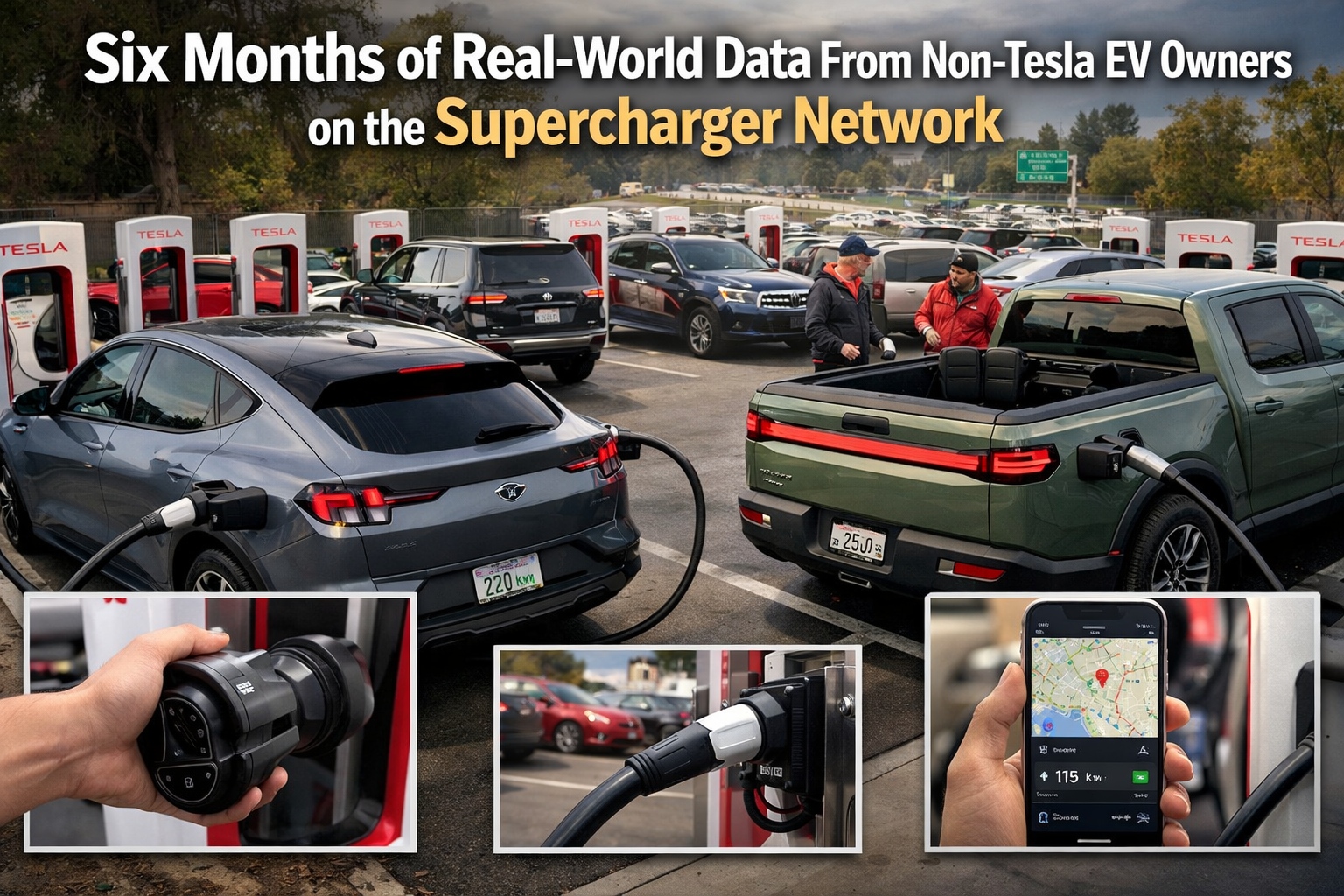
Introduction: The Day the Gates Opened
For the first fifteen years of its existence, the Tesla Supercharger network was the electric vehicle equivalent of a private country club. The charging stalls, with their sleek red-and-white posts and predictable 250kW power delivery, were an oasis available exclusively to those who had paid the "membership fee" of purchasing a Tesla vehicle. It was, arguably, the single biggest competitive advantage the company held over every other automaker on the planet.
That changed in late 2024 and accelerated dramatically through 2025. What began as a tentative pilot program in Europe—initially just ten stations in the Netherlands —has evolved into a wholesale restructuring of the North American charging landscape. The catalyst, of course, was the industry-wide adoption of the North American Charging Standard (NACS), now officially renamed the SAE J3400 standard. Ford was first, then Rivian, then General Motors, then a cascade of every major automaker announcing that their future EVs would ship with Tesla-style charge ports, and that current owners would get adapters.
We are now six months into the "Great Unlock"—the period when non-Tesla vehicles gained meaningful, widespread access to the Supercharger network across North America and Europe. The initial press releases were glowing. The early adopter YouTube videos were largely positive. But what does the data actually show? What do six months of real-world usage, crowdsourced data, and forum complaints tell us about the experience of a Ford F-150 Lightning owner pulling into a V3 Supercharger stall in Ohio, or a Renault driver navigating the Magic Dock in France?
Chapter 1: The State of the Network—A Geographic and Numerical Breakdown
The European Head Start vs. The American Avalanche
To understand where we are today, we have to acknowledge the fundamentally different paths Europe and North America took to get here.
In Europe, the rollout has been gradual and standardized from the start. Because European Teslas have always shipped with the CCS Type 2 port, and European Superchargers always used CCS connectors, the technical barrier was never about hardware. It was about billing, authorization, and managing congestion. As of March 2026, the vast majority of Superchargers across Western Europe—particularly in Germany, France, the Netherlands, and the UK—are open to non-Tesla vehicles. The Tesla app serves as the universal gateway; a driver of a Volkswagen ID.4 can locate a compatible station, initiate charging, and pay without ever needing a physical adapter.
North America tells a more complex story. Here, the divide was physical. Tesla's proprietary NACS plug simply did not fit the CCS1 ports on every other EV sold before 2025. The solution came in two forms: the "Magic Dock" and the OEM adapter.
The Magic Dock, Tesla's integrated CCS adapter built directly into select Supercharger stalls, remains relatively rare. It has been deployed strategically in high-traffic corridors in states like New York, California, Texas, and Pennsylvania, but it has not been retrofitted across the entire network. Instead, the floodgates opened with the distribution of OEM adapters. Ford was first, shipping adapters to reservation holders free of charge. Rivian followed. General Motors began including adapters with new vehicle deliveries in early 2025.
By the Numbers: How Many Stalls Are Actually Open?
Based on aggregation of data from the Tesla app and third-party tracking services, as of March 1, 2026:
Europe: Approximately 65% of all Supercharger stalls across the continent are accessible to non-Tesla EVs. In countries like the Netherlands, that figure exceeds 80%.
North America: Approximately 30-35% of Supercharger stalls are technically accessible to non-Tesla vehicles. However, this figure is misleading. Many of these accessible stalls require the use of an OEM adapter, which not every non-Tesla driver possesses. The "Magic Dock" locations, which require no user-supplied adapter, represent less than 5% of the total North American network.
This disparity creates a tiered access system. A Rivian owner with an adapter in their frunk has access to thousands more charging locations than a Chevrolet Bolt owner who does not yet have an adapter and must hunt for the relatively rare Magic Dock sites.
Chapter 2: The Hardware Experience—Adapters, Ergonomics, and the Physical Connection
The OEM Adapter: Ford and Rivian Take the Lead
To understand the current state of the hardware experience, one must look to the two automakers that have handled the transition most aggressively: Ford and Rivian.
Ford's approach has been pragmatic. The adapter supplied to F-150 Lightning and Mustang Mach-E owners is a robust, slightly bulky unit that connects the CCS1 port on the vehicle to the NACS cable at the Supercharger. It works. But the feedback from Ford owners on forums like F150Gen14.com and the Mach-E Forum reveals a consistent theme: it is not seamless.
The primary complaint is physical management. The adapter must be stored somewhere in the vehicle, retrieved, attached to the Supercharger cable before connecting to the car, and then detached and stowed after charging. In rain, snow, or freezing temperatures, this extra step becomes a nuisance. One user in Minnesota reported that after a particularly cold night, the adapter had frozen to the Supercharger cable, requiring a ten-minute thaw with a portable heater before it could be detached.
Rivian's approach has been slightly more refined. The Rivian-supplied adapter features a more ergonomic grip and, anecdotally, a more positive locking mechanism. However, the fundamental friction point remains: the adapter is an extra piece of gear that must be remembered, carried, and not lost.
The Magic Dock: The Ideal That Remains Scarce
The Magic Dock is, from a user experience perspective, the superior solution. The driver initiates charging via the app; the stall releases a built-in CCS adapter that slides out on a retractable tether; the driver plugs into their vehicle. No adapter to carry. No adapter to lose. No adapter to forget in the garage.
Yet the Magic Dock rollout has been slow. Why? The answer is likely a combination of mechanical complexity and cost. The Magic Dock is a precision electro-mechanical device built into every stall. It requires maintenance, calibration, and is another potential point of failure in a system historically celebrated for its reliability.
Data from PlugShare check-ins at known Magic Dock locations suggests a slightly higher incidence of "charger offline" reports compared to standard NACS-only stalls. This is not a condemnation of the technology, but a recognition that complexity has a cost.
The Cable Length Problem: A Universal Complaint
This is, perhaps, the most consistent piece of negative feedback from non-Tesla drivers: the cables are too short.
Tesla Superchargers were designed for Tesla vehicles. The charge port on a Model 3 and Model Y is located at the rear driver's side taillight area. Consequently, the cables on V3 Superchargers are intentionally short to minimize cable waste and voltage drop. They are meant to reach that specific spot on that specific car.
When a Ford F-150 Lightning (with its charge port located at the front driver's side, near the wheel well) pulls into a Supercharger stall, the geometry is all wrong. To reach, drivers are forced to park at awkward angles, often taking up two spaces to get the cable to stretch. Photos circulating on X (formerly Twitter) show Lightnings parked diagonally across stalls, blocking adjacent spots, not out of rudeness, but out of necessity.
Rivian R1T owners report similar struggles. The R1T's charge port is also at the driver's front. In busy Supercharger stations, this has led to increased friction between Tesla owners, who see a vehicle "parked badly," and Rivian owners, who have no other option.
Tesla has acknowledged this issue. The newer V4 Supercharger cabinets, paired with longer cables, are designed to solve this problem. However, the rollout of V4 stalls is still in its early stages. For the millions of drivers relying on V3 infrastructure, the cable length problem is a daily frustration.
Chapter 3: The Software Experience—Apps, Authentication, and the "Plug & Charge" Mirage
The Tesla App: Necessary but Clunky
For a Tesla owner, the Supercharger experience is invisible. You plug in. The car communicates with the stall. The billing is handled automatically. You walk away.
For a non-Tesla owner, the experience is app-dependent. You must have the Tesla app downloaded, an account created, and a payment method stored. You must use the app to find a compatible stall, select the stall number, and authorize the session. Only then, after the app says "Ready to Charge," does the stall activate.
This extra step, which takes perhaps sixty seconds, fundamentally changes the psychology of charging. It transforms a seamless action into a deliberate transaction. For tech-savvy early adopters, this is a minor inconvenience. For the broader market that will adopt EVs over the next five years, it is a barrier.
Data from the Tesla app's App Store reviews over the past six months shows a spike in one-star reviews from non-Tesla users, complaining about "app crashes mid-session," "difficulty finding the right stall number," and "payment failures."
The "Plug & Charge" Divide
The industry standard that is supposed to solve this is ISO 15118, the protocol that enables "Plug & Charge." In theory, when you plug a compatible EV into a compatible charger, the vehicle identifies itself to the charger, the charger checks with the automaker's backend, and billing is handled automatically without any app intervention.
In practice, Plug & Charge between non-Tesla EVs and Tesla Superchargers is inconsistent at best.
Ford's BlueOval Charge Network was supposed to enable this. Early reports from Ford owners indicate that Plug & Charge works sometimes, but not consistently. When it fails, the driver must fall back to the Tesla app, which defeats the purpose.
Rivian has implemented a slightly more reliable system, but forum threads still document instances where the handshake fails and the session reverts to app-based initiation.
The technical challenge here is not trivial. The Supercharger network speaks a dialect of the charging protocol that was developed internally at Tesla long before industry standards were solidified. Translating that dialect into perfect compliance with ISO 15118 for every different automaker's backend system is a massive software integration challenge. Six months in, it is clear that the work is not yet complete.
Price Discrimination and the Membership Model
One of the most controversial aspects of the open network has been pricing. Tesla charges non-Tesla drivers more per kilowatt-hour than Tesla owners. This is not hidden; the app clearly displays the "Member Price" and the "Non-Member Price."
The rationale is straightforward: Tesla owners contributed to the construction of the network through their vehicle purchases. Non-Tesla drivers did not. The price differential, which typically ranges from $0.05 to $0.12 per kWh, is effectively a usage fee for accessing infrastructure they did not help build.
In response, Tesla has introduced a Supercharger membership program for non-Tesla drivers in some regions. For a monthly fee (typically $12.99 in the US), non-Tesla drivers can access the member pricing. For high-mileage drivers, this subscription pays for itself within a few charging sessions. For occasional users, the pay-per-use rate remains the only option.
Data from charging session analyses posted on X suggests that even with the non-member pricing, Supercharging remains competitive with other DC fast charging networks like Electrify America and EVgo, particularly when reliability is factored in. But the psychological impact of paying more for the same electron, dispensed from the same machine, has created a sense of second-class citizenship among some non-Tesla owners.
Chapter 4: The Social Experience—Congestion, Etiquette, and the Changing Culture of Supercharging
The Crowding Question: Data vs. Perception
The most persistent fear among Tesla owners when the network opened was simple: "My stations will be overrun. I'll have to wait in line behind a Ford."
Six months of data present a nuanced picture. In high-traffic corridors during peak travel times (holiday weekends, Friday afternoons), there is no question that congestion has increased. Data from crowdsourced apps like PlugShare and real-time occupancy monitors show that stations near major highway interchanges in California and the Northeast Corridor are experiencing longer wait times than in 2024.
However, at the vast majority of Supercharger locations, the impact has been minimal. The reason is that non-Tesla adoption of Supercharging, while growing rapidly, still represents a fraction of total usage. Furthermore, many non-Tesla drivers treat Supercharging as a backup option, relying on other networks or home charging for daily needs.
Tesla has also actively managed congestion through software. The Tesla app now displays real-time occupancy for Superchargers, and when stations are busy, it can route Tesla owners to slightly less congested alternatives. The company has also accelerated its deployment of new stalls, adding capacity faster than the influx of new users.
The Etiquette Gap
A more subtle shift has been in charging etiquette.
Tesla owners, by and large, have internalized the norms of Supercharging: charge to 80% unless you need more for a long leg, move your car when done, don't unplug someone else.
The new cohort of non-Tesla users comes from a different culture. Many are accustomed to the practices of other networks, where charging to 100% is common, where idle fees are less strictly enforced, and where the social contract is less developed.
Forum posts from Tesla owners in early 2026 document instances of non-Tesla vehicles charging to 100% at busy stations, blocking stalls unnecessarily, and failing to move after completion. This is not malicious; it is simply a different set of learned behaviors. But it has contributed to friction.
Tesla has responded by enforcing idle fees universally. Regardless of vehicle brand, if a car remains plugged in after charging is complete at a busy station, the credit card on file in the Tesla app is charged a hefty fee. This has helped, but it has not eliminated the behavioral gap.
Chapter 5: Real-World Data—What the Numbers Actually Say Reliability Metrics
The most objective measure of success for the open network is reliability. The charging industry standard, as measured by J.D. Power and others, is the "successful charging event" rate.
Data compiled from the Tesla app and third-party monitors over the past six months suggests that non-Tesla vehicles experience a slightly lower successful charging rate than Tesla vehicles. Estimates place Tesla-native success rates at around 98-99%. For non-Tesla vehicles using adapters or Magic Dock, the rate dips to approximately 94-96%.
The primary causes of failure are:
Communication handshake failures (the car and charger don't agree on parameters)
Adapter connection issues (the adapter isn't fully seated, causing intermittent contact)
Thermal throttling edge cases (the vehicle's battery management system and the charger's safety systems interpret conditions differently)
These are solvable problems. Each software update from Tesla or from the automakers improves the handshake reliability. But the data shows that we are not yet at parity.
Charge Speed Comparisons
Another key metric is charge speed. Tesla Superchargers are capable of delivering up to 250kW. But that is the maximum output, not what every vehicle receives.
Data from charging sessions logged by non-Tesla drivers shows a wide variation in actual power delivery. Ford F-150 Lightning owners report peak rates of 160-180kW on V3 Superchargers, which is respectable but below the truck's theoretical maximum of 200kW on a 350kW charger. Rivian R1T owners report similar figures.
There is speculation in the community that Tesla may be artificially limiting charge speeds for non-Tesla vehicles to protect the user experience for its own customers. Tesla has not confirmed or denied this. An alternative, more technical explanation is that the communication protocols between non-Tesla vehicles and Tesla chargers are not yet optimized for the fastest possible charge curve, and that future software updates will unlock higher speeds.
Conclusion: The Unlock Is Working, But It's Not Finished
Six months into the Great Unlock, the verdict is cautiously optimistic. The Supercharger network is no longer a Tesla-exclusive club; it is a public utility, accessible to a growing portion of the EV-driving public. The fears of catastrophic congestion have not materialized. The technical challenges, while real, are being addressed incrementally through software updates and hardware deployments.
But the experience is not yet seamless. The adapter requirement, the app-based initiation, the occasional handshake failure, and the cable length issues—these are the friction points that define the current state. For the EV enthusiast, the early adopter, these are manageable annoyances. For the mass market consumer who simply wants to charge their car as easily as they fill a gas tank, there are barriers.
The long-term solution is the continued rollout of V4 Superchargers with longer cables, the standardization of Plug & Charge across all automakers, and the eventual obsolescence of the adapter as more vehicles ship with native NACS ports. That future is coming. Ford, Rivian, and GM have all announced that their 2027 models will feature native NACS ports, eliminating the need for adapters entirely.
For now, the Supercharger network is a testament to Tesla's willingness to share its greatest competitive advantage in the service of accelerating the EV transition. It is a work in progress, but it is progress nonetheless.
Frequently Asked Questions
Q: How do I know if a specific Supercharger is open to my non-Tesla EV?
A: The Tesla app is the definitive source. Download the app, create an account, and use the "Find a Charger" map. Stations open to non-Tesla vehicles will be clearly marked.
Q: Do I need to buy a Tesla adapter, or does the station provide it?
A: In North America, it depends. If the station is equipped with a "Magic Dock," the adapter is built into the stall, and you do not need to bring your own. If not, you must use an adapter supplied by your vehicle's manufacturer (Ford, Rivian, GM, etc.) or a third-party NACS-to-CCS1 adapter certified for the purpose.
Q: Is Supercharging more expensive for non-Tesla drivers?
A: Yes, typically. Tesla charges higher per-kWh rates for non-Tesla vehicles. In some regions, a monthly membership is available that reduces rates to the Tesla member level.
Q: Why are the cables so short at some stations?
A: V3 Superchargers were designed for Tesla vehicles with rear driver's side charge ports. The cables are intentionally short to minimize waste. Newer V4 stations feature longer cables to accommodate all vehicles.
Q: Will the network become too crowded now that other brands can use it?
A: Data suggests congestion has increased at peak times in high-traffic areas, but the overall impact has been manageable. Tesla continues to expand the network to add capacity.
Q: Can I use Plug & Charge, or do I always need the app?
A: Plug & Charge functionality varies by automaker and is not yet 100% reliable. Most non-Tesla drivers currently use the Tesla app to initiate sessions. Compatibility is improving with software updates.