
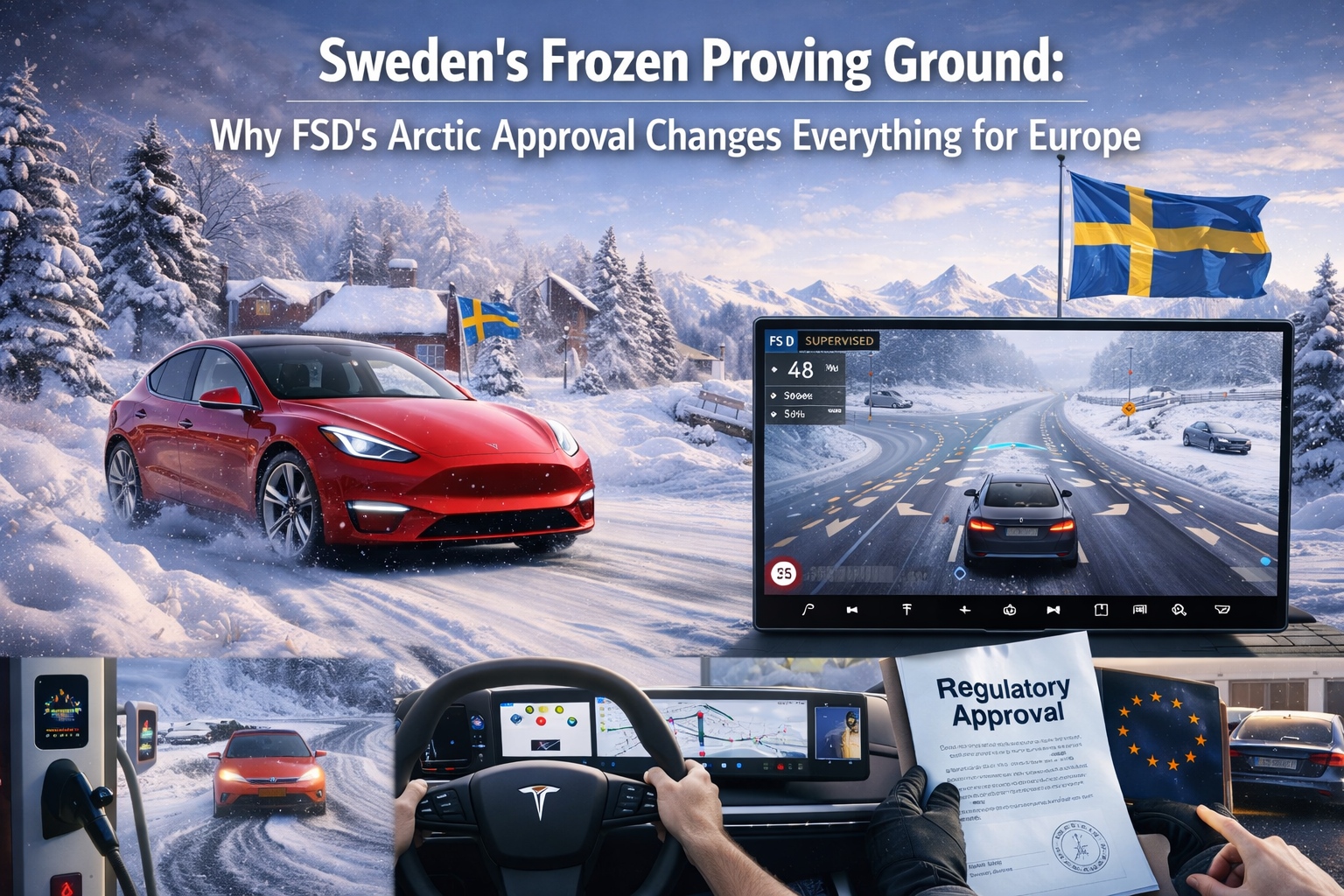
As Tesla Secures Nationwide Testing Rights in Sweden, the Final Piece of the European Puzzle Falls Into Place
The timing could not be more poetic. Just as a late-winter storm blankets Scandinavia in fresh snow, Tesla has secured something far more valuable than a regulatory checkbox: the unconditional right to prove itself in one of the world's most demanding driving environments.
On February 28, 2026, the news rippled through the Tesla community with the quiet force of an avalanche. Sweden, the crown jewel of Nordic automotive skepticism, has granted Tesla approval to test its Full Self-Driving (Supervised) system on the nation's entire road network. From the roundabouts of Nacka to the frozen highways stretching toward the Arctic Circle, Tesla's fleet of test vehicles will now navigate conditions that have, until now, existed only as a theoretical challenge in the company's training data.
This is not merely another municipality signing off on a pilot program. This is Sweden—a country where winter lasts half the year, where moose wander onto highways with zero regard for traffic laws, and where roundabouts are not a suggestion but a way of life. If FSD can master Sweden, it can master Europe. And with the Dutch RDW approval now expected on March 20, the dam is finally breaking.
For European Tesla owners who have watched their American counterparts enjoy FSD for years, watching videos of autonomous highway merges in California while sitting in Berlin traffic, the wait is nearly over. But the version arriving on European shores will not be the same FSD that Americans know. It will be something better: hardened, refined, and battle-tested by the unique brutality of Nordic roads.
Chapter 1: The Approval That Mattered Most
When Tesla first began its European FSD testing program, the company followed a predictable path: start with the friendliest regulators, prove the technology in controlled environments, and gradually expand. Germany came first, then France, then Italy. But Sweden held back. And for good reason.
Sweden's roads are unlike anywhere else in Europe. The country spans nearly 1,000 miles from south to north, encompassing climates that range from temperate coastal zones to subarctic wilderness. In the winter, daylight lasts barely four hours in the north. Snow obscures lane markings for months at a time. Reindeer herds cross highways with the same nonchalance as suburban deer in Connecticut, but with far greater consequences.
Yet on February 26, 2026, Tesla received confirmation that its application to test in Jönköping had been submitted and was under active consideration. Sofia Bennerstål, Tesla's Head of Public Policy for Northern Europe, confirmed the development to local media, noting that the company was "satisfied with the tests" conducted elsewhere in the region. Jönköping, a city of 100,000 people located between Stockholm and Gothenburg, would become the latest Swedish municipality to host FSD test vehicles.
The significance of Jönköping cannot be overstated. Situated at the southern tip of Lake Vättern, the city experiences heavy lake-effect snow, complex urban roundabouts, and the kind of mixed traffic—bicycles, pedestrians, trams, and delivery trucks—that separates competent autonomous systems from truly intelligent ones. If FSD can navigate Jönköping in February, it can navigate anywhere.
But the real breakthrough came when Tesla announced that its testing approval was not limited to individual municipalities. The Swedish Transport Administration had granted permission for FSD testing across the entire national road network, including the critical urban areas of Nacka Municipality, just miles from Stockholm.
This matters for reasons that extend far beyond Sweden's borders. Under the UNECE regulatory framework that governs European vehicle approvals, testing data from one member state carries weight with others. When Tesla can demonstrate that its system has successfully completed thousands of kilometers of Swedish winter driving without incident, the arguments against approval in France, Italy, or Spain become significantly harder to sustain.
Chapter 2: Why Sweden Is the Ultimate FSD Laboratory
To understand why Tesla fought so hard for Swedish approval, one must understand the unique challenges that Nordic roads present to autonomous systems. These are not the problems that FSD was trained to solve in California or Texas.
The Vanishing Lane Problem
In most of North America, lane markings are reliable. They are painted with reflective beads, maintained regularly, and designed to remain visible in all but the heaviest snow. In Sweden, winter roads are often a sea of white. Snowplows scrape the asphalt clean, but they also erase the paint. For weeks at a time, drivers navigate by intuition, following the subtle contours of the road, the placement of guardrails, and the tracks of the vehicle ahead.
FSD's end-to-end neural network architecture, which processes raw video inputs and outputs driving commands, is uniquely suited to this challenge. Unlike traditional autonomous systems that rely on detecting lane lines as a discrete step, Tesla's approach treats the entire driving scene as a unified whole. The car does not need to "see" lane lines because it has learned, from billions of miles of training data, where lanes should be based on the position of other vehicles, the curvature of the road, and the behavior of human drivers.
The Roundabout Paradox
Americans often joke that Europeans are obsessed with roundabouts. The truth is more complicated: roundabouts are simply the most efficient way to manage traffic in densely populated areas with limited space. In Sweden, roundabouts are everywhere. They range from single-lane rural circles to multi-lane urban monsters with separate bike paths, pedestrian crossings, and tram lines running through them.
FSD v14, the version that will power Tesla's European rollout, has been specifically trained to understand roundabout priority. This is not a simple matter of "yield to traffic in the circle." In European roundabouts, drivers entering the circle must simultaneously monitor multiple streams of traffic, anticipate the intentions of vehicles already in the roundabout, and position themselves to exit correctly—all while managing the spatial constraints of a circle that may be barely wider than the car itself.
The neural network approach shines here. Rather than following rigid rules, FSD v14 has learned to "nose in" to traffic, communicating intent through subtle movements in the same way human drivers do. It has learned that the delivery truck signaling left may actually be going straight, and that the cyclist hugging the curb is planning to exit at the next street. These are not behaviors that can be programmed; they must be learned through observation.
The Moose Problem
No discussion of Swedish driving is complete without addressing the elephant—or rather, the moose—in the room. Sweden has one of the highest densities of moose-vehicle collisions in the world. A full-grown moose stands over six feet tall at the shoulder and weighs nearly 1,500 pounds. When struck by a vehicle, the animal's mass is concentrated high above the bumper, often resulting in the moose crashing through the windshield rather than being deflected by the hood.
For FSD, moose represent an edge case of terrifying complexity. They are large, dark-colored, and often appear at dawn or dusk when visibility is poor. They move slowly but unpredictably, and their eyes do not reflect light like those of deer or other smaller animals. If FSD can reliably detect and avoid moose in the Swedish countryside, it can handle virtually any obstacle European roads can present.
Tesla's testing program in Nacka and Jönköping will generate precisely the kind of data needed to refine the moose detection models. Every encounter, every near-miss, every successful avoidance becomes another training example for the neural network. By the time FSD is released to European customers, the system will have seen more Swedish moose than most Swedish drivers encounter in a lifetime.
Chapter 3: The Regulatory Domino Effect
While Sweden's approval is significant, it is not the final piece of the puzzle. That honor belongs to the Netherlands, where the RDW (Rijksdienst voor het Wegverkeer) is poised to make a decision that could unlock FSD across the entire European Union.
On February 26, 2026, Elon Musk revealed during an internal address to Tesla's Berlin Gigafactory employees that he had been informed by regulators that FSD approval in the Netherlands would arrive on March 20. The timing is critical: the Netherlands serves as a Type Approval authority for the entire EU, meaning that certification there can streamline approvals in other member states under the Article 39 exemption framework.
The Article 39 strategy is worth understanding. Rather than waiting for the slow machinery of pan-European regulation to grind forward, Tesla is seeking approval at the national level, using the Netherlands as a gateway. Once the RDW certifies that FSD meets safety standards, other countries can grant reciprocal approvals without conducting their own exhaustive reviews.
This approach has precedent. When Tesla first introduced its "Navigate on Autopilot" feature in Europe, it followed exactly this path: Dutch approval first, followed by rapid expansion across the continent. The difference now is the stakes. FSD represents a fundamentally more capable system, one that Tesla claims will eventually allow drivers to fall asleep behind the wheel and arrive at their destination safely.
The RDW has been cautious, as regulators should be. In late 2025, the agency pushed back against Tesla's optimistic timelines, noting that while it had planned to complete its review by February 2026, the actual date remained uncertain. Tesla, for its part, had mobilized European owners to contact the RDW directly, urging faster action. The campaign backfired, with the agency publicly asking Tesla fans to stop flooding its communication channels.
But by February 2026, the tone had shifted. The combination of successful testing in Germany, France, Italy, and now Sweden has provided the RDW with the data it needed. The March 20 date, if it holds, represents a genuine breakthrough—the first time FSD will be legally available to European consumers in their own vehicles.
Chapter 4: What FSD Supervised Actually Means for European Owners
With the regulatory pieces falling into place, the question becomes practical: what will European Tesla owners actually get when FSD arrives?
The Supervision Requirement
First and foremost, the system is called "Full Self-Driving (Supervised)" for a reason. Despite Musk's ambitious rhetoric about sleeping passengers, the version arriving in Europe will require constant driver attention. The car can handle steering, acceleration, braking, and lane changes in most situations, but the human behind the wheel must remain ready to intervene at any moment.
This is not a limitation of Tesla's technology; it is a legal requirement. Under current UNECE regulations, no production vehicle is permitted to operate without a licensed driver prepared to take control. Even as Tesla pushes the boundaries of what autonomy can achieve, the regulatory framework lags behind. The supervised designation is not marketing spin; it is a legal necessity.
The Hardware Divide
European owners should also understand that not all Teslas are created equal. FSD's capabilities depend heavily on the onboard computer. Vehicles equipped with Hardware 3 (HW3), which includes most cars manufactured between 2019 and 2023, will receive a functional version of FSD. But owners with Hardware 4 (HW4), found in newer vehicles, will experience the full fluidity of the v14 stack.
The difference is noticeable. HW4's additional computing power allows the neural network to process more frames per second, make more frequent predictions, and respond with greater nuance. In complex situations—merging onto a busy Autobahn, navigating a multi-lane roundabout, or threading through narrow medieval streets—the HW4 experience will be noticeably smoother.
The Subscription Model
Perhaps the most significant change for European owners will be how they pay for FSD. Following the lead of the United States and Australia, Tesla is moving away from the one-time purchase option in favor of monthly subscriptions.
The pricing structure is already taking shape. Code discovered in Tesla's Dutch website source code reveals a placeholder for a €99 monthly subscription, matching the $99 price point in the United States. While this could change before launch, the direction is clear: Tesla wants recurring revenue from software, not one-time lump sums.
For European owners, the subscription model makes particular sense. FSD in Europe will initially be a supervised, evolving product. Committing thousands of euros upfront for a system that is still being validated in local conditions is a hard sell. At €99 per month, owners can subscribe during road trip season, cancel during the winter, and re-subscribe when significant updates arrive. The flexibility aligns perfectly with the uncertainty of the early rollout phase.
Tesla has already eliminated the one-time purchase option in North America, and Australian owners face a March 31 deadline to buy FSD outright before it switches to subscription-only. Europe will follow the same path, likely within months of the initial launch.
Chapter 5: The Technical Leap—Why v14 Changes Everything
The version of FSD arriving in Europe is not the same system that American drivers have been using for the past two years. FSD v14, which will power the European rollout, represents a fundamental architectural shift that addresses many of the challenges specific to European roads.
End-to-End Neural Networks
Previous versions of FSD relied on what engineers call a "modular" architecture. One module identified lane lines. Another detected other vehicles. A third calculated steering angles. A fourth decided when to brake. Each module operated independently, and if any module failed—if lane lines disappeared under snow, for example—the entire system could falter.
FSD v14 replaces this modular approach with a single, unified end-to-end neural network. Raw video from the eight cameras flows into the network, and driving commands flow out. There is no intermediate step where the car "thinks" about lane lines or other vehicles in the traditional sense. Instead, the network has learned, from billions of miles of training data, the statistical relationships between visual inputs and appropriate driving behaviors.
This approach is mathematically elegant but computationally demanding. The neural network must simultaneously solve for safety, comfort, and efficiency, optimizing a cost function that balances competing priorities:
J(0)= ∑t-[Safety + Comfort + Efficiency]
Where $\theta$ represents the weights of the neural network, constantly adjusting based on new training data. In v14, the AI doesn't follow rules; it follows learned intuition. It has learned that in a European roundabout, you don't just look for lane lines; you look for the intent of the car in the lane to your left. It has learned that a cyclist hugging the curb is likely to continue straight, while one drifting toward the center may be preparing to turn.
Contextual Awareness
The most visible improvement in v14 is what Tesla engineers call "contextual awareness." The system no longer treats every situation as an isolated decision. It understands context: time of day, weather conditions, local driving norms, and even the behavior of specific vehicles over time.
On the Autobahn, this manifests as predictive lane management. When the system detects a fast-approaching vehicle in the left lane, it doesn't simply move right at the earliest opportunity. It calculates the optimal moment to change lanes, considering the speed differential of the approaching vehicle, the traffic in the right lane, and the distance to the next exit. It acts like a human driver—anticipating, planning, and executing with purpose.
In urban environments, contextual awareness means understanding that a delivery truck with its hazard lights flashing is likely to remain stationary, even if its turn signal is on. It means recognizing that a pedestrian standing at a crosswalk but looking at their phone is not about to step into the street. These are judgments that human drivers make instinctively; v14 has learned to make them through massive-scale training.
Chapter 6: The Data Privacy Question
No discussion of FSD in Europe would be complete without addressing the elephant in the server room: data privacy. Europe's General Data Protection Regulation (GDPR) is the strictest privacy framework in the world, and it presents unique challenges for a system that relies on continuous video capture.
Tesla has approached this challenge with a technical solution that may become a model for the entire autonomous vehicle industry. All video processing for FSD in Europe happens on-device. The raw video feed from the cameras never leaves the car. Diagnostic data sent back to Tesla is stripped of identifying information before transmission, and the company has implemented what it calls an "EU-First" data architecture that keeps European customer data within European borders.
The implications are significant. Unlike in North America, where Tesla can use customer driving data to continuously improve its models, European FSD will initially rely on training data collected by Tesla's own test fleet and anonymized snippets from consenting owners. This limitation may slow the pace of improvement, but it satisfies the rigorous requirements of European privacy regulators.
For owners, the practical effect is invisible. The car does not "watch" you; it watches the road. The neural network operates locally, making split-second decisions without phoning home. When improvements arrive via over-the-air updates, they come as new network weights, not as new data about your driving habits.
Chapter 7: The Nordic Winter—Real-World Testing Begins
As February 2026 draws to a close, Tesla's test vehicles are already fanning out across the Swedish road network. In Nacka, just east of Stockholm, they navigate the same roundabouts that baffled early FSD versions. In Jönköping, they contend with lake-effect snow and the chaotic dance of urban traffic. Further north, they face the true test: darkness, ice, and the ever-present possibility of moose.
The data from these tests will shape the final version of FSD that reaches European customers. Every disengagement—every moment when the safety driver must take control—becomes a training example. Every successful navigation of a challenging situation reinforces the neural network's confidence. By the time the RDW signs off on March 20, the system will have accumulated thousands of hours of Nordic driving experience.
This is not the kind of testing that can be simulated. No matter how sophisticated Tesla's training infrastructure becomes, there is no substitute for real-world experience on frozen roads, in blinding snow, with real traffic and real consequences. Sweden is providing that experience, and European owners will reap the benefits.
Chapter 8: What Comes Next—The Road Ahead
Assuming the March 20 timeline holds, the initial FSD release will target owners in the Netherlands and Germany who have opted into Tesla's Early Access Program. From there, the rollout will expand methodically: first to other early access participants across Western Europe, then to all owners in approved countries, and finally to the broader European market.
The pace of expansion will depend on the data. Tesla needs to validate that FSD performs safely in each new country's unique driving environment. France's priority-to-the-right rule, which requires yielding to vehicles approaching from the right even on major roads, is unlike anything in the training data. Italy's aggressive urban driving culture presents its own challenges. The United Kingdom's left-side driving and countless roundabouts require separate validation.
But the Swedish approval changes the calculus. If FSD can handle Sweden's winters, it can handle Germany's autobahns. If it can navigate Jönköping's roundabouts, it can manage Paris's chaotic intersections. The hardest tests are happening now, in the frozen north. What comes after is refinement, not reinvention.
Conclusion: The Car You Bought Just Got Smarter
For European Tesla owners who have waited years for this moment, the arrival of FSD represents more than a new feature. It is validation—proof that the car they bought was always capable of more than it showed. The sensors were there. The computing power was there. The only missing piece was regulatory permission and the final refinement of the software.
Sweden has provided the permission, and v14 has provided the refinement. The result is a system that, while still requiring supervision, fundamentally changes what your Tesla can do. On the highway, it handles lane changes with the confidence of a veteran driver. In the city, it navigates complex intersections without hesitation. In the roundabouts that define European driving, it finally understands the dance.
Is it perfect? No. Will there be moments when you need to grab the wheel? Absolutely. But compared to the driver-assist systems of just two years ago, FSD v14 represents an order-of-magnitude improvement. The car you bought in 2024, or 2022, or even 2020, is now capable of things its original owners could only dream of.
That is the magic of Tesla's approach. The hardware is installed at the factory, but the intelligence arrives over the air. Your car does not age; it improves. And with Sweden's frozen roads now part of the training data, the improvements are coming faster than ever.
The frozen north has spoken. FSD is ready for Europe. The only question left is whether you are ready for FSD.
Frequently Asked Questions (FAQ)
Q: When will FSD actually be available in my country?
A: The Netherlands is expected to receive approval on March 20, 2026, with an immediate rollout to Early Access Program participants. Germany, Sweden, and other Western European countries will follow in the subsequent months, pending successful validation in each market.
Q: Do I need a new Tesla to get FSD?
A: No. FSD v14 will be available for all Teslas with Hardware 3 or Hardware 4. Owners with HW4 will experience the smoothest performance, but HW3 vehicles will receive a fully functional version. Vehicles with older hardware (MCU1) may receive a limited version.
Q: How much will FSD cost in Europe?
A: Based on code discovered in Tesla's Dutch website, the monthly subscription is expected to be €99. This matches the US pricing and is consistent with Tesla's global shift toward subscription-only FSD access. One-time purchase options will likely be phased out before or shortly after the European launch.
Q: Can I use FSD with my hands off the wheel?
A: No. European regulations require constant driver supervision. You must remain attentive and ready to take control at any moment. The system is called "Full Self-Driving (Supervised)" for a reason.
Q: Will FSD work in winter conditions?
A: That is precisely why Tesla is testing in Sweden. The system has been trained extensively on winter driving data and is designed to handle snow, ice, and reduced visibility. However, like any system, it has limitations. Extreme weather may require manual control.
Q: How does FSD handle European roundabouts?
A: FSD v14 includes specific training for European roundabouts. The system has learned to navigate multi-lane circles, yield correctly to traffic already in the roundabout, and position itself for proper exits. Early testing suggests it performs at a near-human level in most situations.
Q: What about data privacy? Is my car watching me?
A: All video processing for FSD in Europe happens on-device. Raw video never leaves the car. Diagnostic data is anonymized, and Tesla has implemented an "EU-First" data architecture that keeps European customer data within European borders.
Q: Will FSD ever be truly autonomous in Europe?
A: That depends on regulation, not technology. Tesla continues to push toward full autonomy, and Musk has stated that he believes the technology will be ready for unsupervised operation within the next few years. However, regulatory approval at that level will require changes to international vehicle standards, which move slowly.