
Introduction
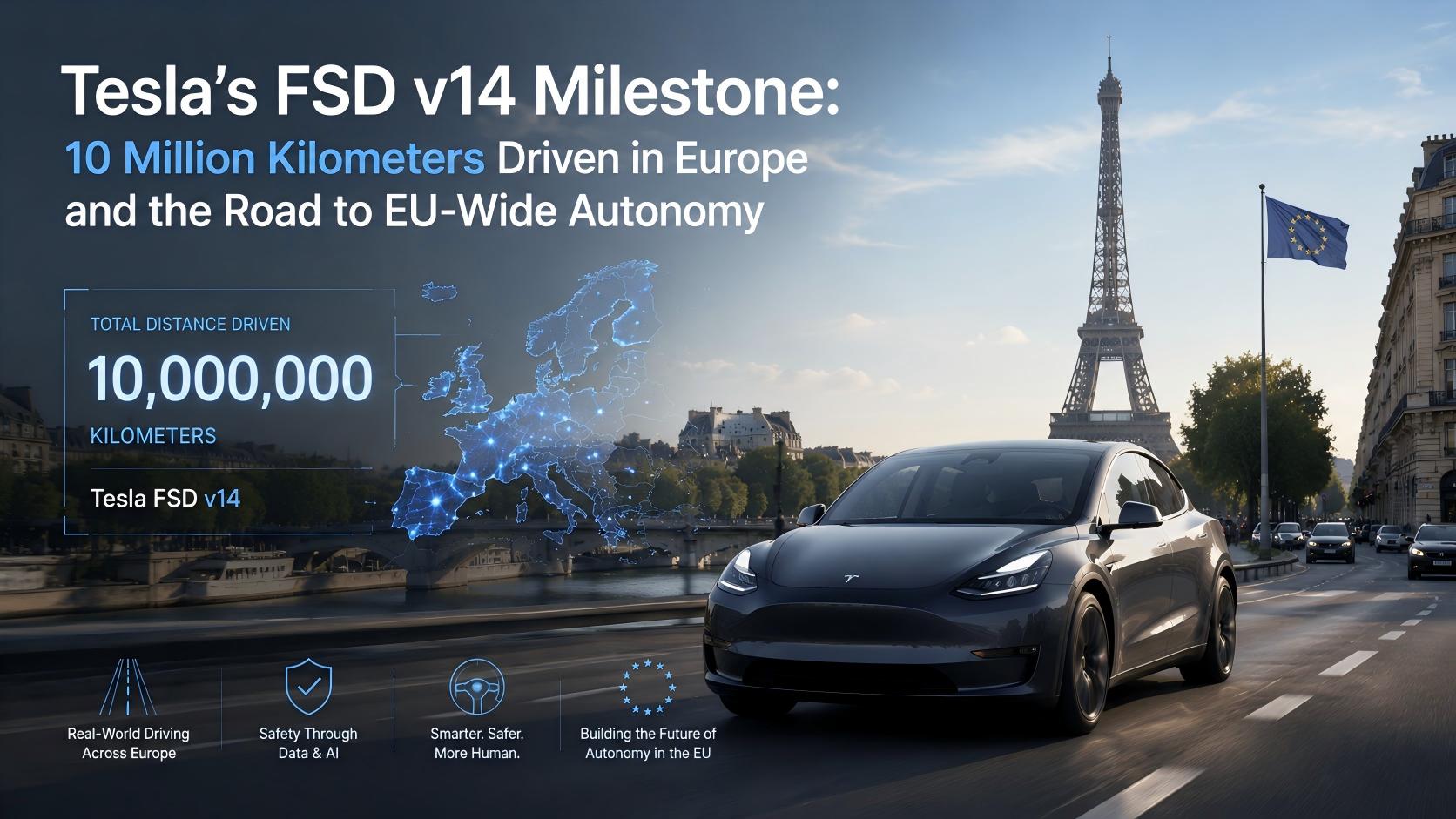
As of May 6, 2026, the European electric vehicle landscape has reached a definitive tipping point. For years, European Tesla owners looked across the Atlantic with envy as North American drivers tested the boundaries of AI-driven navigation. Today, the data is in: following the official release of FSD (Supervised) v14 in select European markets last month, Tesla has confirmed that users in the Netherlands alone have surpassed 10 million cumulative kilometers driven on the system. This is not just a number; it is a declaration that Tesla’s neural networks have successfully adapted to the chaotic, medieval street layouts of Old World cities.
I. The Economic Catalyst: The €99 Subscription Model
One of the primary drivers behind this sudden explosion in mileage is Tesla’s strategic pivot to a €99/month subscription model in Europe. Previously, the high barrier to entry—a €7,500 one-time payment—relegated FSD to a luxury add-on for the elite. By democratizing access, Tesla has essentially turned its entire European fleet into a massive data-harvesting machine. In the Q1 2026 earnings call, CFO Vaibhav Taneja noted that subscription rates in the Netherlands jumped 40% within the first 30 days of v14 availability. This financial accessibility ensures that the "data flywheel" spins faster in Europe than it ever did during the early days of the U.S. rollout.
II. Technical Mastery: Conquering the European "Edge Cases"
The European driving environment is fundamentally different from the wide, predictable grids of California or Texas. FSD v14 introduces specific neural network kernels designed for:
-
Roundabout Fluidity: Unlike v12, which often hesitated at high-speed European roundabouts, v14 utilizes "predictive intent" algorithms to gauge the speed of approaching vehicles from the left, allowing for more assertive entries.
-
Narrow Passages: In cities like Amsterdam and Utrecht, where cars must share space with thousands of cyclists and pedestrians, v14’s new "Spatio-Temporal Vision Encoder" provides sub-centimeter precision in lane positioning.
-
Cyclist Predictability: Europe’s high density of bicycles required a specialized training set. The 10 million kilometers driven so far show a 95% reduction in "phantom braking" incidents near bike lanes compared to the v12.5 alpha tests.
III. The Path to EU-Wide Approval
While the Netherlands’ RDW (Road Transport Authority) has been a champion for Tesla, the rest of the European Union remains a patchwork of skepticism. The RDW has formally notified the European Commission of its findings, suggesting that FSD (Supervised) meets the safety requirements for broader deployment under the latest UNECE regulations. However, internal leaks from the EU Commission suggest that Germany and France are holding out for more "explainable AI" data—a challenge for Tesla’s "black box" end-to-end neural networks.
Conclusion
The 10-million-kilometer milestone is the "proof of concept" that the European market has been waiting for. For Tesla, this data is the currency with which it will buy regulatory favor in Brussels. For the owners, it represents the beginning of a future where the commute from London to Berlin is as effortless as a ride on the TGV.
FAQ
Q: Which countries currently support FSD v14?
A: Currently, the Netherlands, Germany (Beta), and Norway have active v14 fleets.
Q: Can I transfer my subscription to another Tesla?
A: No, the subscription is currently tied to the VIN, though rumors of account-level licensing persist for 2027.