
1. Introduction: The Quiet Revolution Behind the Steering Wheel
While the world’s attention is often captured by the dazzling acceleration of a Model S Plaid or the futuristic angles of the Cybertruck, a far more profound transformation has been quietly unfolding within Tesla’s corporate DNA. For years, Elon Musk has asserted that Tesla Energy would eventually rival, if not surpass, the automotive side of the business. On March 11-12, 2026, that assertion moved from visionary rhetoric to concrete regulatory reality.
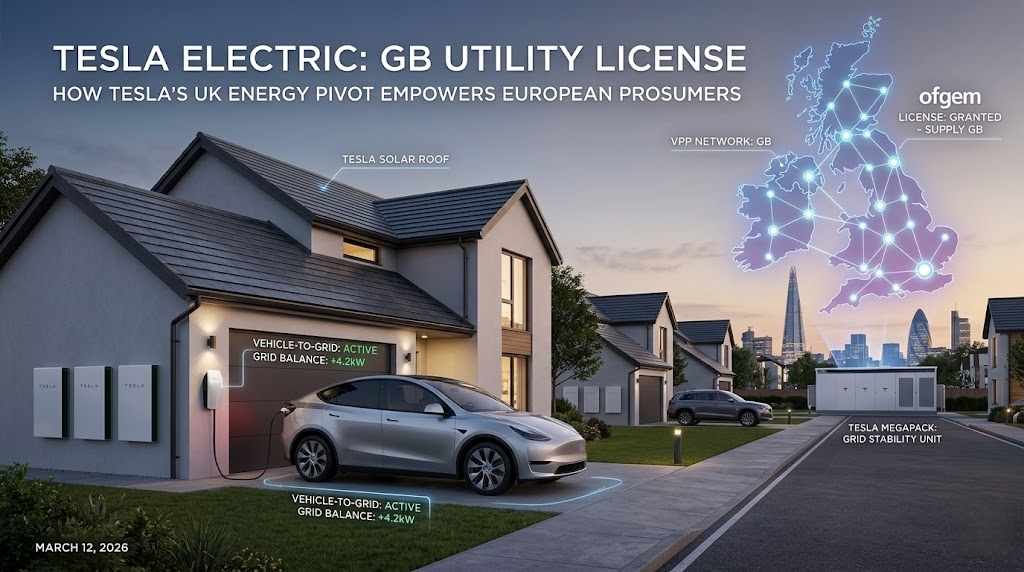
Tesla Energy Ventures Ltd., a subsidiary of the Texas-based giant, was officially granted a smart electricity supply license by Ofgem (the Office of Gas and Electricity Markets), the energy regulator for Great Britain.
This is not merely a bureaucratic milestone. It is a seismic shift in the European energy landscape. This license transforms Tesla from a manufacturer of "distributed energy resources" (DERs)—like cars, Powerwalls, and Solar Roofs—into a fully authorized, vertically integrated electricity supplier. For the approximately 200,000 Tesla owners in the UK, and by extension, the millions across Europe watching this pilot, this development fundamentally redefines what it means to own a Tesla. It transitions the customer from a passive consumer of electrons into an active, revenue-generating participant in a digitized, decentralized energy grid.
2. The Strategic Pivot: Vertical Integration of the Megajoule
To understand why this license is so significant, we must look at Tesla’s overarching strategy. Tesla’s goal has never been just to sell cars; it is to "accelerate the world's transition to sustainable energy."
2.1 The Retail Electric Provider (REP) Model
Until now, a UK Tesla owner with solar panels and a Powerwall still had to contract with a traditional utility company (like British Gas or Octopus Energy) to import electricity when the sun wasn't shining or to export excess power. While innovative tariffs exist, Tesla was always the "middleman hardware provider."
By becoming a licensed supplier, Tesla eliminates the middleman. The "Tesla Electric" model, successfully piloted in Texas in 2023-2025, is now coming to Europe. Tesla can now manage the entire energy stack for a household:
-
Generation: Solar Roof/Panels.
-
Storage: Powerwall.
-
Consumption: Model 3/Y/S/X and home appliances.
-
Distribution/Trading: Direct connection to the National Grid via the new license.
2.2 The Margin Game: Automating the Arbitrage
This integration allows for unprecedented software-driven optimization. Tesla’s algorithms, knowing the owner’s driving habits, weather forecasts, and real-time grid prices, can automate energy arbitrage.
-
Importing: The system will automatically charge the Powerwall and the vehicle during "negative pricing" windows, common in the UK when wind generation outstrips demand.
-
Exporting: When the grid spikes during the evening peak (e.g., 5 PM to 7 PM), Tesla can automatically discharge excess Powerwall energy back to the grid, capturing maximum value for the customer (and taking a micro-transaction fee).
3. The Power of a Million Batteries: Virtual Power Plants (VPP)
The single most powerful weapon in Tesla’s new utility arsenal is the Virtual Power Plant (VPP). This concept is crucial for European markets, which are aggressively phasing out fossil fuels but struggling with the intermittency of renewables.
3.1 Aggregation as Strength
A single 13.5 kWh Powerwall cannot stabilize a national grid. However, 50,000 Powerwalls, network-connected and precisely synchronized by Tesla’s Autobidder software, become a massive, distributed battery.
As of early 2026, Tesla celebrated the installation of its 1 millionth Powerwall globally. The density of these installations in the UK is now high enough to form a potent VPP. When the National Grid experiences a sudden drop in frequency (e.g., a power plant fails), Tesla’s software can instantly command thousands of UK Powerwalls to discharge simultaneously, providing millisecond-level frequency response that traditional gas "peaker" plants cannot match.
3.2 The European Blueprint
The UK is the ideal laboratory for this model in Europe. It has a high penetration of wind energy, high electricity prices, and a mature regulatory framework (of which Ofgem’s approval is evidence). Success here provides Tesla with a blueprint and credibility to enter the German, French, and Scandinavian markets, where similar grid instability and high DER adoption create a perfect storm for Tesla Electric.
4. Customer Benefits: From Vehicle Owner to Prosumer
What does this mean concretely for a Tesla owner in London, Manchester, or Edinburgh? The value proposition changes dramatically.
4.1 Lower Bills and Revenue Generation
The immediate benefit is financial. Early data from the Texas pilot suggested that homeowners participating in the Tesla Electric VPP could reduce their annual electricity bills by 30% to 50% compared to traditional flat-rate tariffs. In times of extreme grid stress, some owners actually generated net revenue. In the UK, with its more volatile pricing, the savings could be even more pronounced.
4.2 Energy Independence and "Sustainable Home" Branding
Beyond finances, there is a powerful psychological benefit. The license allows Tesla to offer a cohesive "Sustainable Home" package. The Tesla app will show a unified view of the home's energy flow, carbon impact, and potential savings. Owners are no longer reliant on aging, fossil-fuel-dependent utility bureaucracies.
4.3 Enhanced Vehicle-to-Grid (V2G) Synergy
While Powerwall is the immediate focus, this license paves the way for wider Vehicle-to-Grid (V2G) implementation in Tesla vehicles (especially with the newer 4680-based packs). If the grid can tap into the 60-100 kWh batteries parked in hundreds of thousands of driveways, the Powerwall is just the beginning. The utility license is the legal prerequisite for organizing this massive automotive storage capacity.
5. Industrial Impact: The Megapack Multiplier
While retail customers are the public face, Tesla’s energy strategy has a major industrial component that the UK license strengthens.
5.1 Megapack Deployments and Grid Services
Tesla has been aggressively deploying its industrial-scale utility storage product, the Megapack, throughout Europe. In the UK alone, major projects like the Pillswood BESS (Battery Energy Storage System) have demonstrated how Megapacks provide crucial stability.
The new supply license allows Tesla to integrate its industrial and retail offerings. A "Tesla VPP" could include both 10,000 homes with Powerwalls and two 196 MWh Megapack installations, all managed under one Autobidder umbrella. This combined capacity gives Tesla significant leverage in grid services auctions, competing directly with major European energy generators like EDF and RWE.
6. Conclusion: The Ultimate Realization of a Vision
The granting of the Ofgem supply license on March 12, 2026, will be remembered as the moment Tesla Energy truly came of age in Europe. It is the realization of the multi-decade vision that began with the first "Master Plan": a world where energy is democratized, digitized, and decentralized.
For the competitor, whether automotive or energy-focused, it is a warning. Tesla is no longer a car company that you can ignore; it is a competitor in the foundational sector of modern civilization: energy.
For the Tesla blogger and owner, it is a moment of validation. Your purchase was not just a car; it was an investment in a new, sustainable ecosystem where you, the owner, are finally in control.
FAQ: Deciphering Tesla Electric in the UK
Q: Do I need to own a Tesla vehicle to sign up for Tesla Energy in the UK? A: No. As a licensed supplier, Tesla can serve any household. However, the deepest integration, automated arbitrage, and VPP participation benefits will be reserved for those who own the "Tesla Ecosystem" (Vehicle, Powerwall, or Solar). Non-Tesla households may get competitive smart tariffs but not the full automated savings.
Q: When can I officially sign up for the service? A: While the license is granted, a full retail rollout requires final backend integration with UK smart meter networks and settlement systems. Official public enrollment for UK residents is expected to open by late Q3 2026. A waitlist is expected to appear in the Tesla app in the coming weeks.
Q: Will Tesla Electric work with my existing non-Tesla solar panels? A: Generally, yes. The Powerwall can integrate with most existing third-party solar inverters. However, the software optimization may not be as precise as with a fully integrated Tesla Solar Roof.
Q: How does this affect my standard factory warranty for Powerwall and Vehicle? A: VPP participation is approved by Tesla and is designed within the safe operating parameters of the batteries. It will not void your warranty. The system prioritizes maintaining your specified "Backup Reserve" (e.g., keeping 20% of your Powerwall charged for an outage) before trading energy.