
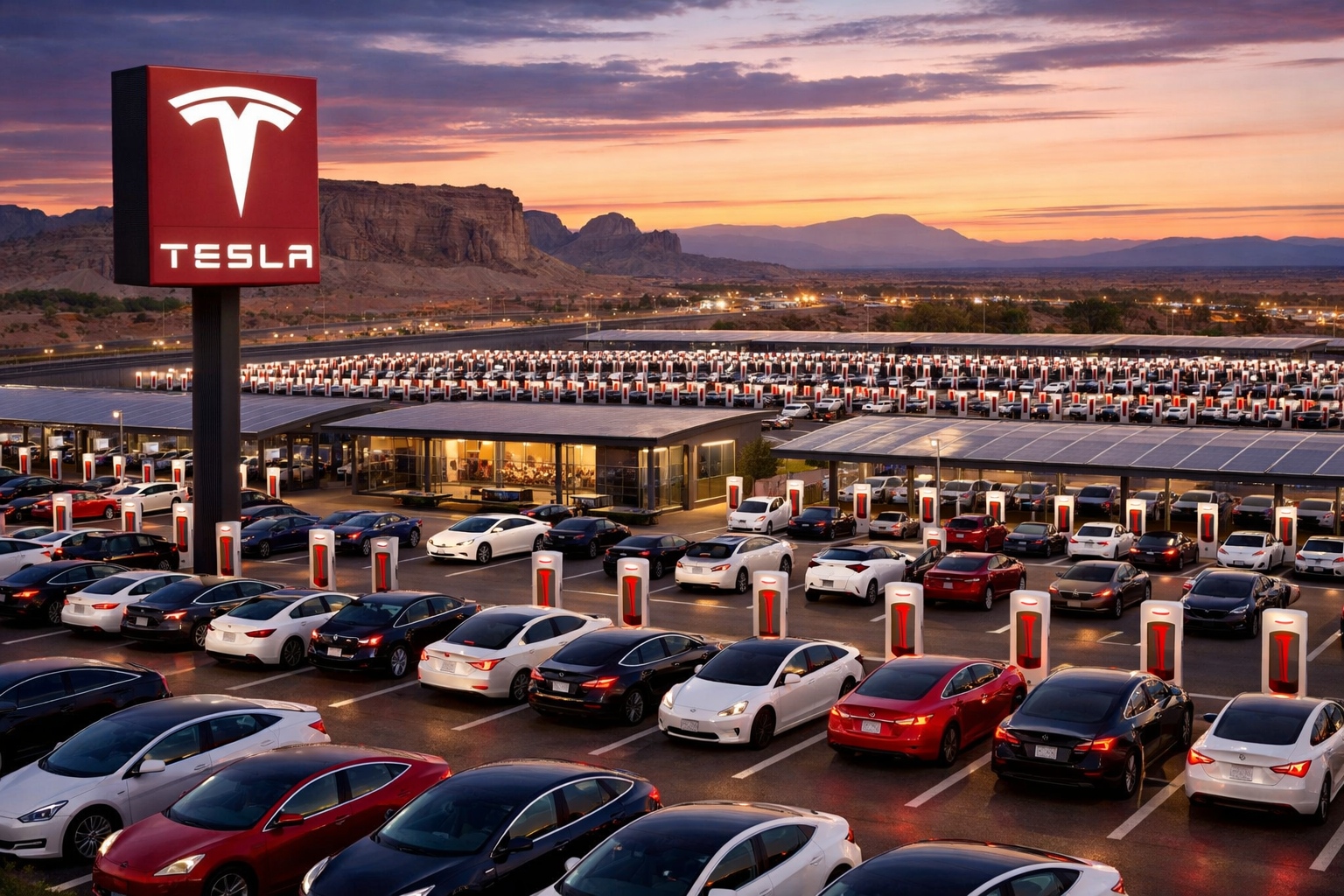
Section 1: The Vision Behind the Mega-Hub
1.1 From 22 Stalls to 400: The Scale of Ambition
The existing Eddie World Supercharger station in Yermo currently operates with just 22 V2 and V3 charging stalls, delivering maximum power of approximately 150 kilowatts . When this facility was first constructed, it adequately served the needs of early EV adopters traversing the Mojave Desert between Southern California and Las Vegas. However, the exponential growth of Tesla's vehicle fleet has rendered this once-adequate station increasingly insufficient, particularly during holiday weekends when wait times can stretch to hours.
Tesla's new proposal, designated "Eddie World 2" in planning documents submitted to California authorities, represents a complete reimagining of what a charging station can be . The six-phase expansion will ultimately deliver more than 400 V4 Supercharger stalls, making it by far the largest Tesla charging facility globally and more than double the size of the current record-holder, the 168-stall "Project Oasis" station in Lost Hills, California .
To understand the magnitude of this expansion, consider that 400 stalls could theoretically charge 400 vehicles simultaneously. Assuming an average charging session of 30 minutes for a typical 10-80% charge, this facility could process approximately 800 vehicles per hour or nearly 20,000 vehicles per day at full capacity. This throughput begins to approach the fuel dispensing capacity of traditional gasoline service plazas, marking a critical milestone in EV infrastructure maturity.
1.2 Strategic Location Analysis
The choice of Yermo, California, for this mega-hub is far from arbitrary. The site sits at a strategically critical junction where multiple transportation corridors converge . Located approximately 130 miles northeast of Los Angeles and 150 miles southwest of Las Vegas, Yermo positions this Supercharger station at the midpoint of one of the busiest recreational travel routes in the American West.
Interstate 15 serves as the primary connection between the Los Angeles basin and Las Vegas, carrying millions of vehicles annually to the gaming and entertainment destination. Additionally, the route connects to Interstate 40, providing access to Arizona and the broader Southwestern United States. The nearby junction with State Route 58 offers connections to Bakersfield and Central California.
For Tesla owners, this location is already familiar as a necessary charging stop. Current data indicates that within approximately 20 miles of the site, there are already more than 200 high-power charging stalls, including 250kW and 325kW facilities . The nearby community of Baker already hosts 96 charging stalls. Yet despite this relative abundance of charging infrastructure, peak period congestion remains problematic. This existing demand validates the need for a facility of unprecedented scale.
The European parallel is immediately apparent. Routes such as the German Autobahn between Frankfurt and Munich, the French A7 from Lyon to the Mediterranean coast, or the Italian A1 from Milan to Rome face similar seasonal congestion challenges. A facility of this scale in Europe might be strategically positioned near a major Autobahn intersection such as the Frankfurter Kreuz or along the busiest segments of the Brenner Pass route connecting Germany to Italy.
Section 2: V4 Technology Deep Dive
2.1 Next-Generation Charging Capabilities
The Yermo mega-hub will be among the first facilities globally to deploy Tesla's latest V4 Supercharger technology at scale . These new dispensers, powered by upgraded V4 cabinets, deliver charging speeds up to 500 kilowatts for compatible vehicles, representing a substantial advancement over the 250kW capability of V3 Superchargers.
The technical specifications of the V4 system are impressive. The new cabinets operate across a voltage range of 400 to 1,000 volts, enabling optimal charging performance for a wide variety of electric vehicles . This broad voltage compatibility means that while Tesla vehicles benefit from faster charging, the infrastructure also supports the growing ecosystem of non-Tesla EVs gaining access to the Supercharger network.
For Tesla owners, the practical implications are significant. A Cybertruck, which operates on an 800-volt architecture, can take full advantage of the higher voltage output to achieve substantially faster charging speeds than previously possible. Legacy Tesla vehicles with 400-volt systems still benefit from the improved efficiency and reliability of the new hardware, even if their maximum charge rate remains limited by vehicle-side constraints.
2.2 Efficiency Improvements and Cabinet Architecture
Perhaps more important than the raw speed increase is the fundamental redesign of the charging infrastructure itself. The new V4 cabinets can support up to eight charging stalls per cabinet, doubling the four-stall capacity of previous V4 installations .
This architectural improvement yields multiple benefits. First, it reduces the physical footprint of the charging equipment, allowing more space to be dedicated to vehicle parking and maneuvering. Second, it simplifies the electrical distribution infrastructure, reducing complexity and potentially improving reliability. Third, it enables faster deployment of large-scale facilities like the Yermo mega-hub, as fewer cabinets need to be manufactured, transported, and installed.
Tesla has previously indicated that this new cabinet design and electrical configuration will reduce overall system complexity and, importantly, decrease the space required for equipment at each site . For European Tesla owners, this efficiency gain suggests that similar mega-hubs could eventually be deployed in space-constrained environments where real estate costs are high.
2.3 Solar Integration and Sustainability
The Yermo planning documents reveal multiple solar canopies integrated throughout the charging bays . This photovoltaic integration serves multiple purposes. During peak daylight hours, solar generation can offset grid electricity consumption, reducing operating costs and potentially allowing for lower charging prices. The canopies also provide shade for charging vehicles, a meaningful comfort consideration in the Mojave Desert where summer temperatures routinely exceed 100 degrees Fahrenheit.
Tesla's experience with solar-integrated charging stations dates back to earlier projects, including the Lost Hills facility, which combines 168 stalls with solar generation and Megapack battery storage . The Yermo project appears to build on this template, though planning documents do not specify whether battery storage will be included in the initial phases.
For environmentally conscious Tesla owners in Europe, where renewable energy integration is increasingly expected of infrastructure providers, this solar component reinforces Tesla's commitment to sustainable energy beyond the vehicles themselves.
Section 3: Phased Construction and Operational Strategy
3.1 The Six-Phased Approach
Tesla's planning documents outline a deliberate, phased approach to constructing the Yermo mega-hub . This strategy reflects careful consideration of operational continuity, demand patterns, and investment pacing.
Phase one, scheduled to begin construction later in 2026, will add 72 V4 stalls to the existing facility . This initial expansion alone would create a station larger than most existing Supercharger locations, providing immediate relief to current congestion while demonstrating the viability of the site for further expansion.
Subsequent phases through phase five will continue adding stalls along the Calico Boulevard corridor, creating expansive parking and charging zones. Each phase will include complete site improvements, including parking area development and infrastructure connections. Phase six remains conceptual, with final design contingent on future demand and grid capacity assessments .
This incremental approach offers several advantages. It allows Tesla to match infrastructure investment with actual demand growth, avoiding overbuilding before the vehicle fleet justifies the capacity. It minimizes disruption to existing charging operations, as new sections can be commissioned independently without shutting down operational stalls. It also provides flexibility to adapt the final site configuration based on operational learnings from early phases.
3.2 Construction Timeline and Anticipated Completion
While specific completion dates remain tentative, the phased approach suggests that the Yermo mega-hub will evolve over several years. Phase one construction is expected to begin in late 2026, with subsequent phases following as demand materializes and construction resources permit .
For Tesla owners planning trips through the region, this means the facility will gradually improve over time rather than appearing fully formed. Early phases will provide meaningful capacity increases, while later phases will transform the site into the world's largest charging facility.
3.3 Minimizing Disruption During Construction
The phased construction plan also addresses the practical challenge of maintaining charging access during site development. By building new capacity alongside existing operations, Tesla can ensure that current users retain access to charging while construction proceeds on adjacent parcels .
This approach acknowledges the critical role that the existing Yermo station plays in regional travel patterns. Shutting down the site for comprehensive reconstruction would strand travelers and force detours to already-congested alternative locations. The incremental expansion strategy maintains operational continuity while delivering capacity growth.
Section 4: Commercial Integration and Owner Experience
4.1 Beyond Charging: The Travel Plaza Concept
The Yermo mega-hub represents a fundamental evolution in Tesla's approach to charging infrastructure. Rather than simply installing rows of charging stalls in parking lots, the project integrates substantial commercial development designed to enhance the owner experience during charging sessions .
Planning documents reveal approximately 10,100 square feet allocated to a Cracker Barrel Old Country Store restaurant, a brand synonymous with highway travel and comfort food in the United States. An additional 4,300 square feet will house a McDonald's restaurant with drive-through capability. Convenience store space, outdoor dining areas, and leasable commercial space round out the retail offerings .
This commercial integration addresses the fundamental reality of EV charging: even the fastest charging sessions require 20 to 40 minutes for a meaningful range replenishment. During this time, owners want amenities. They want restrooms, food, beverages, and perhaps some shopping. By co-locating substantial commercial space with charging infrastructure, Tesla transforms the charging stop from a necessary inconvenience into a pleasant break in the journey.
European Tesla owners will recognize this concept as similar to the service areas found on major autoroutes, autobahns, and motorways. Facilities like the German Autobahn's "Raststätte" or the French "Aire de Service" combine fuel stations with restaurants, shops, and sometimes even hotels. The Yermo project suggests Tesla is moving toward this integrated model, which could eventually be replicated in Europe at strategic locations along major travel corridors.
4.2 Drive-Through Charging for Towed Vehicles
One of the most innovative design elements revealed in the planning documents is the inclusion of drive-through charging stalls specifically designed to accommodate vehicles towing trailers .
Traditional charging layouts position stalls perpendicular to driving aisles, requiring drivers to back into spaces. This configuration works well for passenger vehicles but becomes problematic when towing trailers. Backing a trailer into a standard charging stall is difficult or impossible, forcing owners to disconnect their trailers before charging—a significant inconvenience that discourages EV adoption among the towing community.
The Yermo project addresses this by incorporating straight-through charging positions that allow vehicles with trailers to pull forward into the stall and depart forward after charging . This design, increasingly common in European truck stops but rare at US charging stations, accommodates not only recreational vehicles towing boats or campers but also the Cybertruck, which may frequently be used in towing applications.
The planning documents explicitly note that this design accommodates future electric semi-truck charging, suggesting that Yermo may eventually serve as a charging stop for Tesla's Semi as commercial freight electrification advances .
4.3 Comparison with European Service Area Standards
European Tesla owners evaluating the Yermo plans will immediately recognize similarities to the best continental service areas. Facilities like the Italian "Autogrill" locations or the Swiss "Raststätte" have long combined fuel, food, and shopping in integrated complexes.
However, the Yermo project exceeds typical European service area scale. With 400 charging stalls, it dwarfs even the largest European service areas. This reflects both the higher vehicle throughput expected at this location and the longer charging times compared to liquid fuel dispensing.
For European Tesla owners, the Yermo project may preview future developments on the continent. Locations along the A8 between Stuttgart and Munich, the A1 around Paris, or the M25 around London could eventually support similar mega-hubs as EV adoption intensifies and charging demand concentrates at key nodes in the highway network.
Section 5: Implications for Tesla Owners in the US and Europe
5.1 Solving Peak Travel Congestion
The most immediate benefit for Tesla owners will be the dramatic reduction in wait times during peak travel periods. The existing charging infrastructure in the Yermo area, while substantial by current standards, cannot handle the concentrated demand of holiday weekends when thousands of Southern California EV owners simultaneously depart for Las Vegas or other destinations.
With 400 stalls, the Yermo mega-hub will have sufficient capacity to absorb these demand peaks. Even during Thanksgiving weekend, Christmas travel periods, or major holiday weekends, the facility should be able to accommodate the vehicle flow without creating the multi-hour queues that have plagued popular charging locations .
For owners planning trips through the region, this reliability transforms trip planning. Rather than anxiously monitoring charging availability and adjusting schedules to avoid peak periods, owners can confidently traverse the route knowing that adequate capacity exists.
5.2 Reducing Range Anxiety Through Infrastructure Density
Beyond peak period benefits, the sheer scale of the Yermo facility contributes to the broader ecosystem of charging infrastructure along the I-15 corridor. With more than 200 existing high-power stalls within 20 miles and the addition of 400 more at Yermo, the route achieves a density of charging infrastructure that approaches or exceeds that of gasoline stations on major highways.
This density fundamentally changes the ownership experience. When chargers are abundant, range anxiety diminishes. Owners no longer need to plan charging stops with precision; they can charge when convenient rather than when necessary. The Yermo mega-hub, combined with surrounding infrastructure, moves the I-15 corridor toward this ideal state.
5.3 European Parallels and Lessons
European Tesla owners can extract valuable lessons from the Yermo project. While European travel patterns differ from American long-distance driving, the same principles apply. Concentrated demand at specific choke points—the Channel Tunnel access routes, the Brenner Pass, the Öresund Bridge approaches—creates the need for similarly scaled infrastructure.
European regulators and infrastructure planners studying the Yermo project will note the importance of commercial integration, the value of drive-through charging for towed vehicles, and the benefits of solar integration. These design elements could productively inform European charging infrastructure development.
5.4 The Cybertruck Factor
The timing of the Yermo announcement coincides with increasing Cybertruck deliveries across the United States. The Cybertruck's unique size, towing capability, and 800-volt architecture create specific charging requirements that earlier Tesla models do not share.
The drive-through charging stalls at Yermo directly address Cybertruck owner needs . The high-power V4 charging delivers the speeds necessary to make towing practical, as the Cybertruck's large battery can accept charge at rates that minimize stop duration even when pulling heavy loads.
For European Tesla owners awaiting Cybertruck availability, the Yermo project demonstrates that Tesla is thinking comprehensively about the infrastructure requirements of its full vehicle lineup.
Section 6: The Future of Tesla Charging Infrastructure
6.1 Template for Future Mega-Hubs
The Yermo project establishes a template that Tesla can replicate at other strategic locations across North America and eventually globally. The combination of massive scale, next-generation technology, commercial integration, and specialized vehicle accommodations creates a blueprint for the charging stations of the future.
Locations that might warrant similar treatment include the I-5 corridor between Los Angeles and San Francisco, the I-95 corridor along the East Coast, and major intersections of the interstate highway system. Each would require site-specific adaptations, but the Yermo model provides a starting point for planning.
6.2 Implications for Non-Tesla EV Adoption
As Tesla opens its Supercharger network to non-Tesla electric vehicles across North America, facilities like Yermo take on additional significance. The North American Charging Standard (NACS) is rapidly becoming the continent's dominant charging connector, with major automakers adopting the Tesla-designed plug for their future vehicles .
This means that the Yermo mega-hub will eventually serve not only Tesla owners but the broader EV community. Ford, General Motors, Rivian, and other manufacturers have announced Supercharger access for their vehicles, creating additional demand that the massive scale of Yermo can accommodate.
For Tesla owners concerned about sharing "their" chargers with other brands, the 400-stall scale provides reassurance. Even with substantial non-Tesla traffic, adequate capacity exists for all users.
6.3 European Expansion Possibilities
While the Yermo project is specific to California, the underlying logic applies equally to Europe. The European Commission's Alternative Fuels Infrastructure Regulation (AFIR) mandates specific charging capacity along the TEN-T core network, creating regulatory drivers for large-scale deployment.
Tesla's European operations could potentially replicate the Yermo model at strategic locations such as:
-
The Wijnegem shopping center area near Antwerp, serving Benelux traffic
-
The Uddevalla area in Sweden, serving Oslo-Gothenburg traffic
-
The A1/A4 intersection near Florence, serving north-south Italian traffic
-
The Lille region, serving London-Paris-Brussels triangle traffic
Each location would require adaptation to local commercial patterns, grid constraints, and regulatory requirements, but the fundamental concept translates across borders.
Conclusion
Tesla's planned 400-stall V4 Supercharger mega-hub in Yermo, California, represents a watershed moment in electric vehicle infrastructure development. By combining unprecedented scale with next-generation technology, solar integration, substantial commercial amenities, and specialized accommodations for diverse vehicle types, Tesla is creating a template for the charging stations of the future.
For Tesla owners in the United States, the facility promises to eliminate one of the remaining pain points of long-distance electric travel: peak-period charging congestion. The I-15 corridor to Las Vegas, long a stress point for EV owners, will become a showcase for what properly scaled infrastructure can achieve.
For European Tesla owners and infrastructure planners, the Yermo project offers both inspiration and practical lessons. While European conditions differ in many respects, the fundamental challenges of concentrated demand, the need for commercial integration, and the importance of accommodating diverse vehicle types apply equally on both sides of the Atlantic.
As EV adoption continues its accelerating trajectory, facilities like Yermo will become increasingly common. The era of charging as an afterthought, with a few stalls tucked into the corner of a parking lot, is ending. In its place emerges a new paradigm: charging destinations that combine utility with amenity, serving not just as places to replenish energy but as pleasant stops on the journey.
Tesla's Yermo mega-hub, with its 400 stalls and integrated commercial space, leads the way toward this future. For owners planning trips through the American Southwest in the coming years, it will be a welcome sight. For the broader EV ecosystem, it sets a new standard for what charging infrastructure can and should be.
Frequently Asked Questions
Q: When will the Yermo Supercharger mega-hub be completed?
A: The project will be constructed in six phases, with phase one (72 stalls) expected to begin construction in late 2026. Subsequent phases will add capacity over several years, with the full 400-stall configuration potentially completed by the end of the decade .
Q: Will my older Tesla Model 3 or Model Y charge faster at V4 stalls?
A: While V4 stalls can deliver up to 500kW, your vehicle's charge rate is limited by its onboard systems. Older Teslas will charge at their maximum supported rate, which is typically 250kW for newer vehicles and less for older models. However, all Teslas will benefit from the improved reliability and efficiency of V4 infrastructure .
Q: Will this station be open to non-Tesla electric vehicles?
A: Based on Tesla's current Supercharger access policies, it is likely that the Yermo mega-hub will eventually support non-Tesla EVs equipped with NACS connectors or appropriate adapters. The massive scale of the facility suggests it is designed to accommodate significant third-party traffic .
Q: Does the station include battery storage like the Lost Hills facility?
A: Planning documents confirm solar canopies but do not explicitly specify Megapack battery storage. However, given Tesla's experience with integrated storage at other large sites, it would be reasonable to expect some form of on-site energy storage to optimize grid interaction and potentially reduce charging costs .
Q: Can I charge my Cybertruck while towing a trailer?
A: Yes. The Yermo plans include drive-through charging stalls specifically designed for vehicles towing trailers. These allow you to pull forward into the stall and depart forward without disconnecting your trailer .
Q: How does this compare to European Supercharger locations?
A: The Yermo facility will be substantially larger than any existing European Supercharger station. However, it may preview future European developments as EV adoption intensifies on the continent. The commercial integration concept is similar to existing European service areas .
Q: Will charging at Yermo be more expensive than at smaller stations?
A: Tesla typically maintains consistent pricing across regions rather than varying by station size. However, the solar integration at Yermo could potentially offset some grid electricity costs, which might influence future pricing decisions .
Q: How will construction affect existing charging at the current Yermo station?
A: The phased construction approach is designed to maintain operational continuity. New stalls will be added alongside existing operations, minimizing disruption to current charging availability .