
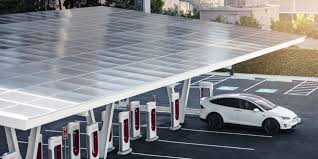
Tesla influence extends far beyond its car lineup. The company has made massive strides in building out EV charging networks and in energy products like batteries and solar. For Tesla owners and EV drivers in general, these initiatives are game-changers. They reduce range anxiety, lower energy costs, and help stabilize the grid. Below we examine Tesla’s latest efforts in charging infrastructure, battery storage, and entry into residential energy markets, especially in the US and Europe.
Expanding the Supercharger Network
One of Tesla’s earliest advantages was its proprietary Supercharger network – fast-charging stations exclusive to Tesla drivers. Over the last decade, Tesla has installed tens of thousands of chargers worldwide. In 2025, Tesla is continuing to pour concrete on this lead, especially in Europe.
-
Europe’s 2025 Charge-Building Push: By mid-2025, Tesla has committed to adding over 1,000 new Supercharger stalls across Europe. Key highlights include doubling its footprint in Spain by year-end, building dozens of new stations in Italy (to cover tourist and rural areas), and upgrading Nordic locations with Tesla’s new V4 units. Tesla is also targeting scenic and tourist areas, such as ski resorts in Switzerland and Austria (seasonal chargers), and urban centers like Paris and Berlin (garage Superchargers). These moves reflect Tesla’s strategy to cover both highway corridors and cities.
-
V4 Superchargers: Tesla’s latest V4 station hardware delivers up to 350 kW of peak power, faster than the previous generation. It also comes with longer cables and integrated payment terminals. This is part of making Superchargers more convenient for everyone. Crucially, Tesla has opened most of its Supercharger network to non-Tesla EVs in Europe. As of mid-2025, over 70% of European Superchargers support CCS plugs used by other brands. This opening accelerates EV adoption by giving all electric drivers more high-speed charging options.
-
Strategic Locations: Tesla has been creative: building temporary “pop-up” Superchargers for big events (like the 2024 EuroCup soccer tournament). In the US, Tesla announced in 2025 plans for new Supercharger sites along major corridors. For instance, on the I-95 corridor between New York and DC, Tesla is placing urban Superchargers at service plazas and retail lots (often paired with amenities). The goal is to ensure Tesla owners can confidently travel across the continent.
-
International Charging: In Canada and Asia, Tesla is also expanding. In particular, Tesla’s move to support CCS means future chargers can service most EVs worldwide, reinforcing Tesla as an EV infrastructure company, not just a carmaker.
Tesla Energy: Batteries and Solar
While Tesla’s cars get headlines, its energy division quietly supplies electricity around the world. Tesla Energy’s offerings include the Powerwall home battery, Megapack utility-scale storage, and solar products (panels and Solar Roof).
-
Battery Storage Leadership: According to a Wood Mackenzie report (Aug 2025), Tesla remains the top global integrator of battery energy storage systems (BESS). In 2024, Tesla held roughly 10-14% of the global market for grid-scale battery installations. Other leaders like Sungrow (a Chinese firm) are catching up, but Tesla is still first. Notably, in North America Tesla’s share soared to 39% in 2024 – an impressive feat given new competitors. This dominance is due to Tesla’s combination of high-capacity products (like the 100+ MWh Megapacks) and software (the Autobidder platform for optimizing energy usage).
In the first half of 2025, Tesla deployed about 20 GWh of energy storage, up 48% from the same period in 2024. By Q2 alone, it had installed 9.6 GWh. At this pace, Tesla will add nearly 40 GWh in just four quarters (enough to power millions of homes). These batteries help grids by storing excess renewables (like wind/solar) and releasing power during peak demand. For regions like California, Texas, and parts of Europe grappling with renewable intermittency, Tesla’s batteries are key.
-
Residential Storage (Powerwall): Tesla’s smaller-scale product, the Powerwall battery for homes, has also been successful. Many EV owners pair a Powerwall with their car charger. When coupled with solar panels, a Tesla owner can “charge” their car for free using sunlight. This combination deepens the synergy between Tesla’s auto and energy divisions.
-
Solar Roof and Panels: Tesla continues to sell solar panels and Solar Roof tiles for homes. While growth has been slower than some hoped (due to material shortages and the high cost of Solar Roof), Tesla is seeing more installations year over year. In the US, new federal incentives for solar (via the Inflation Reduction Act) are making it more attractive. In Europe, some countries have feed-in tariffs or net metering for solar power, encouraging rooftop installations. Every solar panel paired with a Tesla vehicle moves the energy economy toward clean sources.
Tesla Enters the UK Energy Market
In a significant development, news emerged in August 2025 that Tesla is preparing to supply electricity directly to British households. Tesla filed an application with the UK energy regulator Ofgem seeking a domestic electricity supply license. If approved, this “Tesla Electric” service could start as soon as next year, according to reports.
Tesla’s plan is to leverage its products to create integrated home power solutions. The idea is that a Tesla-powered home with a Powerwall and solar panels becomes a mini power generator. Tesla envisions customers generating electricity (via roof solar), storing it in Powerwall, and even sending surplus back to the grid or to charge their EV. UK homes could essentially earn credits for sharing clean energy. This model builds on Tesla’s Texas pilot, where homeowners receive benefits for sharing solar power and demand response through Tesla’s Autobidder system.
However, Tesla faces challenges in the UK. Current sales of Tesla vehicles in the UK have slumped (down ~60% in July 2025). This is partly due to intense competition and partly public sentiment. Nevertheless, Tesla’s existing base of EVs and Powerwalls in the country (hundreds of thousands of EVs, tens of thousands of batteries) is a strong foundation. If Tesla manages to join a market dominated by companies like Octopus Energy, it could disrupt the industry by coupling car ownership with electricity supply.
Impact on EV Adoption and Infrastructure
Tesla’s infrastructure and energy moves have big ripple effects:
-
For All EV Owners: An ever-widening Supercharger network benefits not just Tesla drivers, but the whole industry. More charging options make EV ownership more practical. Tesla’s push to open its network to other brands in Europe has been a boon for EV adoption continent-wide.
-
Battery Demand: As Tesla (and others) install huge battery systems, the demand for raw materials (lithium, nickel, etc.) grows. This has sparked investments in mining and recycling, some driven by Tesla’s own projects (like its scrap battery recycling plans at Gigafactories).
-
Grid Resilience: Tesla’s projects help stabilize local grids. In California and Texas, for example, large Tesla battery installations have provided backup power during peak summer loads. In Europe, where rolling blackouts are a concern (e.g., after the 2022 energy crisis), storage is increasingly seen as essential.
-
Renewable Integration: By pairing its solar and storage products, Tesla encourages renewable adoption. Homeowners who charge a Tesla with solar power reduce demand on fossil-fuel generators, cutting overall emissions. If enough Tesla owners participate, it edges the grid closer to 100% renewables.
-
Policy and Competition: Tesla’s leadership forces other companies and governments to step up. Car companies must ensure their cars are “Tesla-compatible” (charging standards, etc.). Energy companies see Tesla as a new rival in electricity sales, prompting some to offer creative energy products. Regulators worldwide are also feeling pressure to create EV-friendly infrastructure and updated energy policies.
Conclusion
Tesla’s role today spans cars, energy storage, and solar power. By aggressively expanding charging networks and energy services, Tesla is shaping the EV ecosystem. Owners benefit from robust infrastructure and innovative energy solutions, while potential buyers enjoy a more mature market. As Tesla integrates cars with batteries and grids, it fulfills a vision of a sustainable transportation and energy cycle. The company’s moves in 2025 — from UK energy ambitions to record battery deployments — will influence how quickly the world can move off fossil fuels. For Tesla owners, this means not just driving electric, but being part of a bigger clean energy revolution.
FAQ
-
What are Superchargers and can I use them?
Tesla Superchargers are high-speed charging stations originally exclusive to Tesla cars. In many countries, Tesla now allows other EVs to charge there (using CCS plugs). In Europe, most Tesla stations are open to non-Teslas, and in the U.S. Tesla is gradually converting stations to support all EVs with an adapter. Check your local Tesla app for an “Open Supercharger” option. -
What is Tesla Energy?
It’s Tesla’s energy division, which makes battery products (Powerwall for homes, Megapack for utilities) and solar products (panels and Solar Roof). It also includes energy management software like Autobidder. -
Can I sell power back to the grid with Tesla products?
In many places, yes. If you have solar panels and a Powerwall, excess electricity can flow to the grid, usually earning you credits or payments (depending on local policies). For example, in the UK, Tesla’s planned power service could let homeowners earn money by feeding power back. -
How does Tesla’s expansion affect me as an EV owner?
You gain from faster charging infrastructure (more Superchargers on roads). If you own a Tesla, you can charge conveniently almost anywhere. Even if you drive a different EV, Tesla’s charging stations offer more options. Plus, Tesla’s involvement in batteries and energy helps stabilize the grid, meaning more reliable power for your home and EV charger. -
Why is Tesla entering the electricity market in the UK and elsewhere?
Tesla aims to create an ecosystem: cars, batteries, and solar working together. Selling electricity allows Tesla to tie these products together. For example, a Tesla owner with solar panels and a Powerwall could buy the car, the home battery, and even electricity from Tesla, streamlining everything under one company. It’s a natural extension of selling energy storage to selling the energy itself