
1. Introduction
As Tesla kicks off its second‑quarter 2025 earnings season, all eyes turn toward the company’s performance in both its automotive and energy businesses. With inflationary pressures easing but consumer sentiment still mixed, Tesla’s results will offer critical insight into demand resilience for electric vehicles (EVs) and renewable‑energy products. Investors, analysts, and Tesla owners alike will be dissecting every metric—from deliveries and revenues to free‑cash‑flow generation and margin trends—to gauge whether the world’s most valuable automaker can sustain its growth trajectory.
This article provides a comprehensive deep dive into the factors shaping Tesla’s Q2 results. We’ll set the macroeconomic backdrop, identify the key financial indicators to watch, explore performance across Tesla’s business segments, analyze regional strength in North America and Europe, summarize street expectations, highlight catalysts and risks, and conclude with takeaways for investors. A detailed FAQ at the end addresses common questions about the upcoming release.
2. Macro Backdrop
2.1 Global EV Demand Trends
Global EV penetration continues to rise, with plug‑in vehicles accounting for roughly 15–18 percent of new sales in the first half of 2025. In the U.S., EV share reached an estimated 11 percent in May, up from 8 percent a year earlier, supported by expanding charging infrastructure and federal tax credits. Europe remains the EV leader, with Norway, Netherlands, and Germany registering penetration north of 25 percent. However, growth has moderated from the torrid pace of 2022–2023, as mainstream consumers weigh price against improved gasoline performance.
2.2 Interest‑Rate Environment
Central banks in key markets, including the U.S. Federal Reserve and the European Central Bank, have held policy rates steady after aggressive hikes in 2022–2023. While headline inflation has cooled into the 3–4 percent range, real borrowing costs remain elevated relative to the pre‑pandemic era. Higher financing rates can dampen auto loans and lease deals, putting pressure on demand for premium EV models, such as the Model S and Model X.
2.3 Consumer Sentiment & Purchasing Power
Consumer confidence indexes in both the U.S. and Europe have shown modest improvement but remain below pre‑Covid peaks. Wage growth has eased, and persistent housing‑market concerns in Europe are weighing on household budgets. Nonetheless, fiscal incentives—such as the U.S. Inflation Reduction Act’s EV tax credits and EU green subsidies—continue to bolster affordability for mid‑range EV buyers.
3. Key Financial Metrics to Watch
3.1 Revenue and Delivery Figures
Tesla’s top‑line growth hinges on vehicle deliveries and average selling price (ASP). Analysts estimate Q2 deliveries of approximately 450,000 vehicles, representing about 50 percent year‑over‑year growth. Any deviation—positive or negative—from this consensus will be a major market mover. ASP is influenced by model mix (i.e., proportion of Model 3/Y vs. Model S/X/Cybertruck) and regional pricing adjustments to spur uptake.
3.2 Gross Margin Dynamics
Gross margin remains Tesla’s hallmark metric, with the automotive segment historically delivering margins above 25 percent. For Q2, investors will scrutinize whether cost‑reduction initiatives—such as 4680‑cell battery rollouts and vertical integration of castings—offset inflation in commodities and logistics. Energy‑product margins, while smaller in absolute dollars, also warrant attention as deployments of Powerwall units and solar installation volumes ramp up.
3.3 Operating Expenses & R&D Spend
Tesla’s operating leverage hinges on controlling sales, general, and administrative (SG&A) costs and funding continued R&D for autonomy and next‑generation platforms. Watch for commentary on sales‑network investments, service ramp‑up, and software development outlays.
3.4 Free‑Cash Flow & Balance‑Sheet Health
Post‑pandemic, Tesla shifted from negative to positive free‑cash‑flow generation. Q2 free‑cash flow will indicate how well the company converts earnings into liquidity for capex, stock buybacks, and debt reduction. Any change in cash burn or leverage ratios will be closely monitored.
4. Segment Deep Dives
4.1 Automotive Segment
-
Model 3/Y Performance: As volume drivers, these mid‑range sedans and crossovers account for over 90 percent of unit sales. Production capacity in Fremont, Shanghai, and Austin is nearing plateau, making throughput improvements and software‑defined feature add‑ons critical levers.
-
Model S/X and Cybertruck: Though lower in volume, flagship models command higher ASPs and margins. Cybertruck’s limited production ramp remains a wildcard; deliveries are expected to edge higher but may face supply constraints.
4.2 Energy Generation & Storage
-
Solar Roof & Panels: Sales growth in residential solar has been sluggish amid competition from third‑party installers and supply‑chain bottlenecks. Solar deployments are expected to contribute modest revenue, with gross margins under pressure due to installations backlogs.
-
Powerwall & Megapack: Energy storage demand remains strong in markets with grid‑reliability issues (e.g., California, Texas, and parts of Europe). Utility‑scale Megapack projects announced in Q2 could provide near‑term backlog visibility.
4.3 Services & Software
-
Full Self‑Driving (FSD) Subscriptions: Recurring revenue from FSD has grown meaningfully, with subscription penetration now over 10 percent of the installed base. Software updates, over‑air deployments, and new feature add‑ons can drive ARPU (average revenue per user).
-
Supercharger Network & Service Centers: Supercharger utilization rates and service‑center throughput (repair times, parts availability) will influence segment profitability.
5. Regional Performance Analysis
5.1 North America
-
U.S. Demand: Government incentives, such as the $7,500 federal tax credit, continue to support Model 3/Y sales, particularly when stacked with state incentives in California, New York, and Colorado. Dealer‑franchise challenges in some states (e.g., Texas, Michigan) remain a headwind for direct‑sales expansion.
-
Canadian Market: Slower EV adoption relative to the U.S., but growing public charging infrastructure partnerships could bolster sales.
5.2 Europe
-
Germany & France: Subsidies and tax breaks for EV buyers have lifted deliveries, with Model Y seeing robust uptake. German consumers show growing interest in higher‑trim configurations.
-
Nordic Region: Norway’s EV saturation provides high ASP but limited incremental volume. Other Nordic markets (Sweden, Denmark) offer moderate growth opportunities.
-
Regulatory Impact: New EU CO₂‑emission standards are accelerating fleet electrification for automakers, intensifying competition but also raising overall EV visibility.
6. Analyst Expectations & Street Estimates
Analysts polled by major brokerages forecast:
-
Deliveries: 445,000–455,000 vehicles
-
Revenue: $27.0–27.5 billion
-
Automotive Gross Margin: ~26.0 percent
-
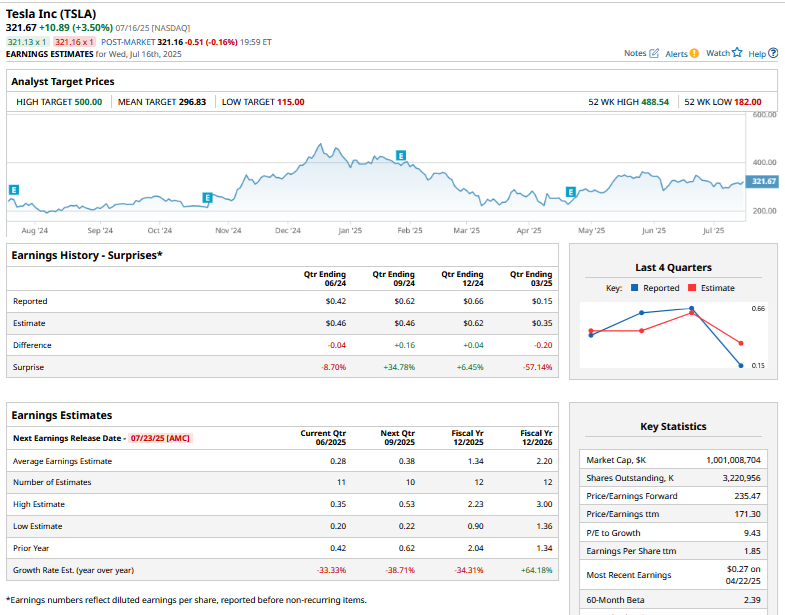
EPS (Non‑GAAP): $0.60–0.65 per share
Bullish scenarios cite continued cost reductions, stronger-than‑expected Cybertruck ramp, and FSD monetization upside. Bearish views point to margin compression from price cuts, slower energy deployments, and macroeconomic headwinds dampening demand.
7. Catalysts and Risks
7.1 Catalysts
-
Cybertruck Production Expansion: Announcement of new Gigacasting tools or third‑shift additions could signal volume upside.
-
Battery Cost Breakthroughs: Wider rollout of 4680 cells at Gigafactory Texas and Berlin could unlock margin expansion.
-
FSD Regulatory Approval: Any nod from NHTSA or EU regulators for broader beta programs could lead to revenue acceleration.
7.2 Risks
-
Pricing Pressure: Continued discounting to drive near‑term volume could erode ASP and margins.
-
Supply‑Chain Disruptions: Geopolitical tensions impacting nickel, lithium, or semiconductor availability could constrain production.
-
Macroeconomic Slowdown: A deeper consumer‑spending pullback in the U.S. or Europe could weigh on new EV sales.
8. Conclusion
Tesla’s Q2 2025 results will be a litmus test for the company’s ability to balance growth with profitability amid a maturing EV market. Key takeaways for investors:
-
Delivery Guidance vs. Execution: Execution on the ground—particularly Cybertruck ramp and Shanghai throughput—will determine upside.
-
Margin Preservation: Monitoring cost‑reduction progress versus pricing strategies will reveal margin trajectory.
-
Software & Energy Growth: Recurring‑revenue businesses, like FSD subscriptions and energy‑storage deployments, can provide stability and offset cyclical auto margins.
Long‑term, Tesla’s lead in software‑defined vehicles, charging infrastructure, and vertical integration underpins its growth story. Short‑term volatility around earnings will likely hinge on margin swings and delivery beats/misses.
9. FAQ
-
What is the date and time of Tesla’s Q2 2025 earnings release?
Tesla is scheduled to report on July 23, 2025, after U.S. markets close. The accompanying conference call typically begins at 5:30 PM Eastern Time. -
Where can I find the earnings webcast?
The live webcast link will be available in the “Investor Relations” section of Tesla’s official website. A replay is posted shortly after the call concludes. -
How have past Q2 results compared to expectations?
Over the last three years, Tesla has beaten delivery and EPS consensus in Q2, driven by volume beats in Model 3/Y and margin resiliency. -
Will Tesla provide forward guidance?
Tesla generally does not issue formal quarterly guidance. Management commentary during the call serves as directional guidance on volumes, margins, and capex. -
How significant is the energy segment to Q2 results?
While energy revenues are smaller (around 8–10 percent of total), year‑over‑year energy revenue growth can signal progress in solar and storage deployments. -
What delivery figure should investors watch?
The net deliveries figure—Tesla’s metric after accounting for fleet, rental, and recall adjustments—is the most critical. -
How do regional price cuts affect ASP?
Local price adjustments to spur demand in key markets can create temporary ASP headwinds but often lead to volume gains. -
Can FSD subscription revenue offset auto‑margin pressure?
Incremental FSD subscriptions can meaningfully add to high‑margin revenue, partially offsetting any compression in automotive gross profit. -
What external factors could surprise the market?
Sudden changes in commodity prices, new government incentives, or significant regulatory developments on autonomous driving could all drive market reactions.