
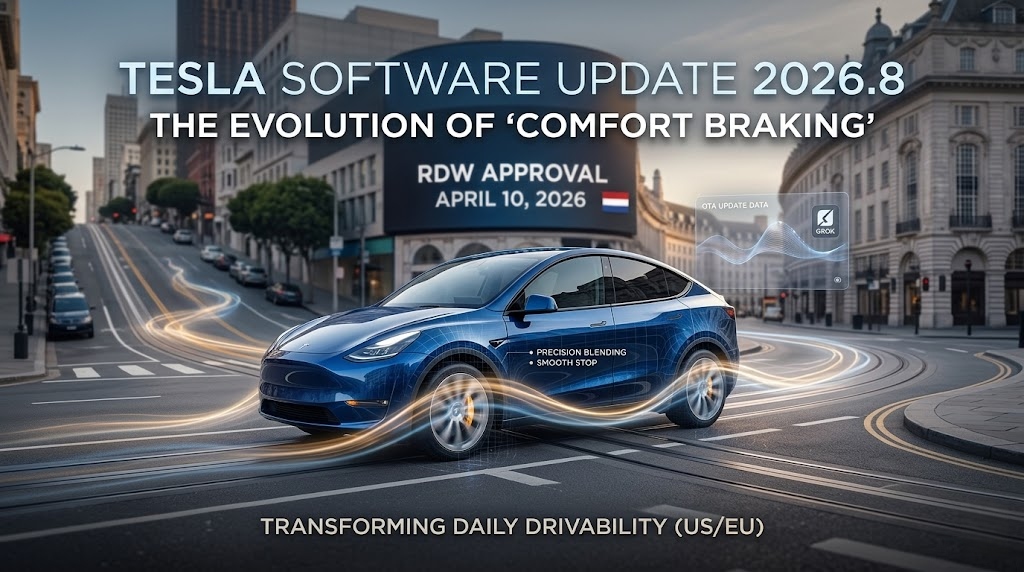
For Tesla owners across the United States and Europe, the thrill of ownership extends far beyond the initial acceleration off the dealership lot. The true magic of the Tesla ecosystem lies in its Over-The-Air (OTA) architecture—the promise that the car you bought yesterday will be fundamentally better tomorrow.
Throughout the first quarter of 2026, the community has been laser-focused on the dramatic leaps in Full Self-Driving (FSD) version 14. But in late March 2026, Tesla initiated the widespread global rollout of software version 2026.8. While it lacks the sci-fi allure of autonomous driving, the 2026.8 branch is a masterclass in subtle engineering. It targets a fundamental aspect of the driving experience that affects every single owner, every single day: stopping.
The standout feature of this update, modestly titled "Comfort Braking," is fundamentally altering the daily commuting experience. By addressing one of the most long-standing nuances of regenerative braking, Tesla is proving that its engineering maturity is not just about writing better AI code, but about refining the physical kinematics of the vehicle. Here is a deep dive into what Comfort Braking is, how it works, and why it represents a massive quality-of-life upgrade for drivers from Los Angeles to London.
Chapter 1: The Anatomy of a Stop – Decoding "Comfort Braking"
To understand the brilliance of Comfort Braking, we first have to examine the physics of how a Tesla stops. According to Tesla’s official 2026.8 release notes: "Your Tesla now provides a smoother feel as you come to a complete stop during routine braking." To the layman, this sounds like a minor software tweak. To an automotive engineer, it represents a highly complex blending of electromagnetic and physical forces.
Electric vehicles rely heavily on regenerative braking. When you lift your foot off the accelerator, the vehicle uses the electric motor's resistance to slow the car down, converting kinetic energy back into electrical energy to recharge the battery. This allows for the beloved "one-pedal driving" experience.
However, the laws of physics dictate a flaw in this system: as the vehicle's speed approaches zero—specifically in the final 2 mph to 0 mph phase—the motor's rotational energy drops off exponentially. To achieve a complete, holding stop (the "Hold" mode feature), the vehicle must seamlessly transition from electromagnetic motor resistance to physical friction brakes (the brake pads clamping onto the rotors).
Historically, this handoff could feel slightly abrupt. If the friction brakes were cold, damp from a European rainstorm, or slightly rusted from lack of use, that final bite of the caliper could result in a noticeable "grab." This creates a micro-jerk, often referred to as the "head-toss effect," where passengers' heads nod forward just as the car settles.
Comfort Braking utilizes a highly refined, high-frequency software algorithm that pre-conditions the brake calipers and dynamically modulates hydraulic pressure during that critical handoff. Instead of a binary "on/off" application of the friction brakes, the software tapers the brake pressure on a microscopic level, perfectly mirroring the exact decay curve of the regenerative braking. The result is a buttery-smooth, chauffeur-like stop that completely eliminates the final jerk, making the transition virtually imperceptible to the driver and passengers.
Chapter 2: Hardware Exclusivity – Why "Juniper" Leads the Charge
As with many advanced Tesla features, software is ultimately bound by hardware capabilities. Currently, the Comfort Braking feature is primarily rolling out to the newer Model Y vehicles—specifically the refreshed models known internally and by the community as "Juniper" (late 2025 and 2026 model years).
Why this exclusivity? It comes down to actuation and processing bandwidth. The refined suspension geometry, updated hydraulic brake actuators, and much faster internal communication buses in the refreshed Model Y allow the vehicle's computer to read and react to the vehicle's pitch, yaw, and wheel speed with sub-millisecond precision.
To achieve the perfect Comfort Braking curve, the car's computer needs to poll the wheel speed sensors at an incredibly high frequency and send micro-adjustments to the brake calipers faster than human perception. While older legacy Model 3 and Model Y vehicles possess excellent hardware, the newer architecture in the Juniper refresh allows the software to execute this delicate dance flawlessly. Tesla has a strong track record of backporting features, so a modified, slightly less granular version of this algorithm may eventually make its way to legacy vehicles, but the absolute realization of this comfort feature currently belongs to the newest hardware suite.
Chapter 3: Regional Realities – From Los Angeles Gridlock to Parisian Roundabouts
The real-world implications of the 2026.8 update are highly dependent on where you drive. The challenges faced by an American owner on the interstate are vastly different from those of a European owner navigating centuries-old urban infrastructure.
The United States: Conquering the Commute In the US, particularly in heavily congested metropolitan areas like Los Angeles (I-405), Atlanta, or the I-95 corridor, "stop-and-go" traffic is a grueling daily reality. Drivers can spend hours creeping along at low speeds, engaging in thousands of micro-accelerations and decelerations. This constant, repetitive stopping is exactly where the legacy "grabby" brake handoff becomes exhausting, often inducing motion sickness in sensitive passengers. Comfort Braking neutralizes the jarring head-toss effect entirely. By smoothing out the bottom of the braking curve, gridlock is transformed into a much more serene, premium experience, reducing driver fatigue significantly over a long commute.
Europe: Precision in the Urban Labyrinth Conversely, European driving dynamics demand high precision. Cities like London, Paris, and Amsterdam are characterized by tight multi-lane roundabouts, frequent pedestrian zebra crossings, and strictly enforced speed transition zones. European drivers heavily rely on single-pedal driving to navigate these complex, fluid environments.
In a tight European roundabout, a driver might need to slow down to 1 mph to yield, and then instantly accelerate if a gap opens up. The smoother braking profile of 2026.8 allows European owners to glide into these yield situations with far greater confidence. It removes the hesitation or jerkiness of the car trying to decide whether to apply the holding brake, enhancing the safety, predictability, and physical comfort of the vehicle in dense, unpredictable European traffic.
Chapter 4: Beyond the Brakes – The Hidden Gems of 2026.8.3
While Comfort Braking is the headline feature, the subsequent point release (2026.8.3) brought a host of quality-of-life improvements and undocumented tweaks to the broader fleet that daily drivers will appreciate.
-
Active Driver Profile Visibility: Multi-driver households, rejoice. A subtle but highly requested update to the Tesla mobile app integration now clearly displays the "Active Driver Profile" directly under the Security & Drivers tab. This allows you to verify that your specific seat, steering wheel, and mirror adjustments are active before you even pull the door handle, preventing the awkward crush of sitting in a spouse's much closer seating position.
-
Spotify Navigation Tweaks: For the audiophiles, the in-car Spotify interface received a minor UI polish. Users will notice a new dedicated "jump to bottom" arrow on long playlists and podcast episode lists, solving a persistent navigational annoyance when trying to access older content while driving.
-
Under-the-Hood Security: As always, the release notes feature the vague "minor security fixes." In 2026, as vehicles become highly connected rolling computers, these invisible OTA patches are vital for patching vulnerabilities and ensuring the integrity of the vehicle's cellular and Wi-Fi connections against emerging cyber threats.
Conclusion: The Luxury of Subtlety
Software update 2026.8 serves as a powerful reminder of Tesla's maturing development cycle. In the early days of the company, OTA updates were celebrated for adding flashy features—fart apps, new games, or dramatic UI redesigns. Today, Tesla is focusing heavily on the nuances of vehicle dynamics.
By dedicating vast engineering resources to something as subtle as the final two miles-per-hour of a stop, Tesla is acknowledging that ultimate automotive luxury is not just about raw 0-60 speed or the promise of future autonomy. True luxury is the quiet, seamless, and frictionless perfection of the daily drive. With Comfort Braking, Tesla has taken a massive step toward making the electric driving experience fundamentally flawless.
Frequently Asked Questions (FAQ)
Q: Will my 2023 Model 3 eventually get the Comfort Braking feature? A: Currently, Comfort Braking is highly optimized for the suspension and braking hardware found in the newest refreshed Model Y (Juniper). While Tesla frequently backports features to older hardware whenever computationally possible, there is no official confirmation that legacy Model 3 or older Model Y vehicles will receive this exact algorithm.
Q: Does Comfort Braking reduce the amount of energy my car regenerates? A: No, your efficiency will not be negatively impacted. The Comfort Braking algorithm only alters the final friction-brake handoff at near-zero speeds. This means the vehicle still captures the absolute maximum possible kinetic energy during the primary deceleration phase before the friction brakes are smoothly applied.
Q: I have a refreshed Model Y, but I don't feel a difference. Does it need to be turned on? A: Comfort Braking is deeply integrated into the standard driving dynamics and does not have a separate toggle switch in the UI. If you are on software version 2026.8 or later, it is active. The feature is designed to be imperceptible—you shouldn't "feel" it working; you should simply notice the absence of the final jerk when stopping.
Q: How do I know if I have received the 2026.8 update? A: You can check your current software version by opening your Tesla mobile app and scrolling to the bottom, or by navigating to the "Software" tab on your vehicle's main infotainment screen. If your vehicle is connected to Wi-Fi and is included in the current rollout wave, it will prompt you to download and install.