
Introduction
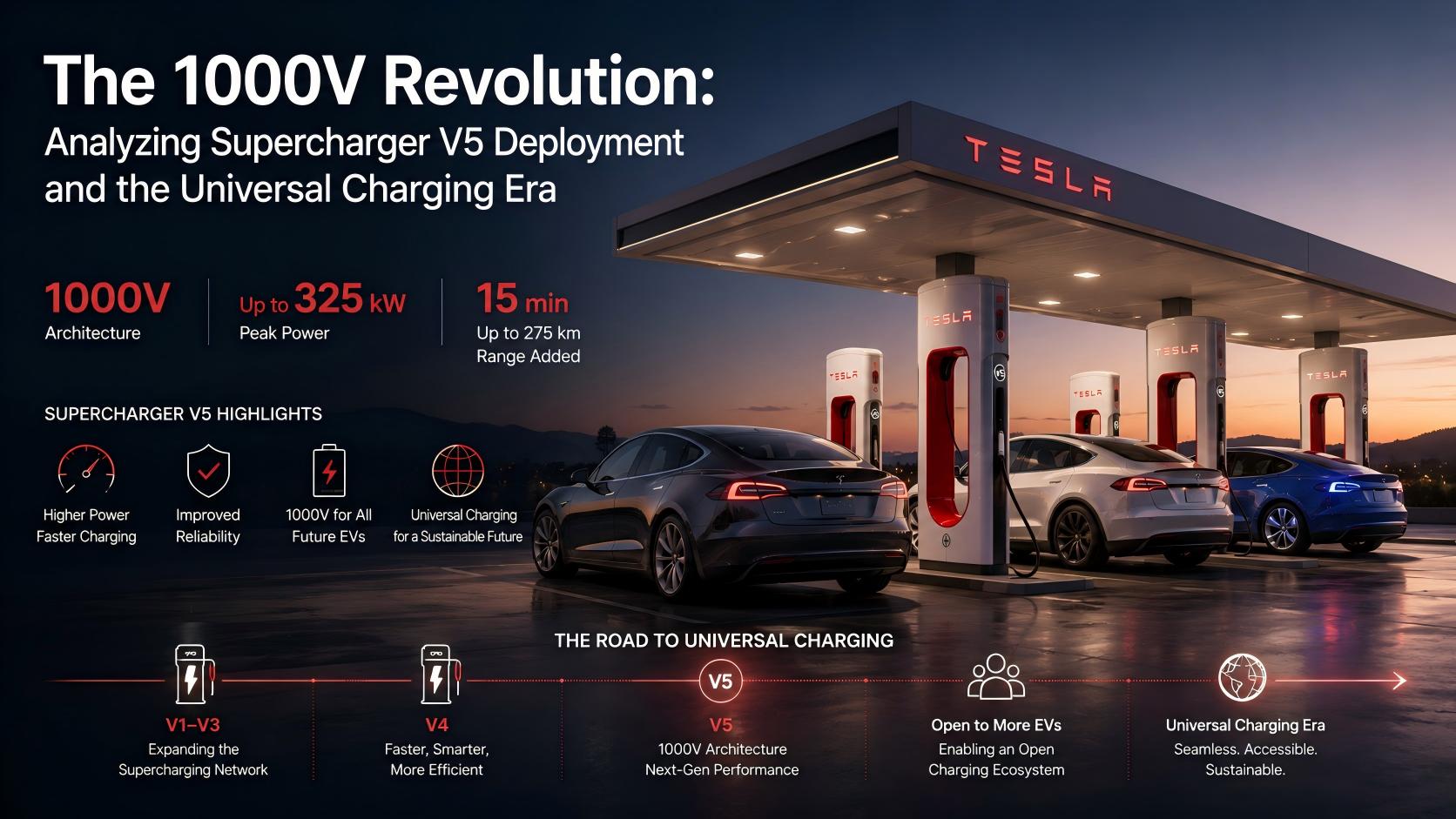
The era of the 400V architecture is officially drawing to a close. Today, Tesla began the wide-scale activation of its Supercharger V5 network across the primary "Green Corridors" of the United States (I-95, I-10) and Europe’s TEN-T network. With the Cybertruck and the upcoming Model Y "Juniper" utilizing high-voltage systems, the V5 is not merely a faster charger; it is the backbone of a new energy ecosystem that bridges the gap between passenger EVs and heavy-duty transport.
I. Engineering the 1000V Backbone
The V5 Supercharger represents a total rethink of power electronics. Unlike the V4, which was largely a cabinet upgrade, the V5 utilizes a native 1000V DC bus. This allows for:
-
500kW Peak Output: For the first time, passenger vehicles can add 200 miles of range in under 8 minutes.
-
Mega-Watt Compatibility: The V5 cabinets are modular, allowing them to be linked to provide 1MW+ for the Tesla Semi at dedicated logistics hubs.
-
Bus-Bar Efficiency: By doubling the voltage, Tesla has reduced the current (amperage) required for high-power sessions, significantly decreasing heat waste and allowing for thinner, more ergonomic liquid-cooled cables.
II. Energy Arbitrage with Megapack 2XL
Every new V5 station is now paired with an on-site Megapack 2XL. This serves two purposes. First, it buffers the local grid from the massive 500kW spikes that occur when a Cybertruck begins its charging cycle. Second, it allows Tesla to engage in energy arbitrage. In Europe, where spot electricity prices can fluctuate wildly, Tesla’s "Autobidder" software buys power during the night and stores it, ensuring that V5 charging remains profitable for Tesla while staying cheaper than diesel for the consumer.
III. The AFIR Impact: A Universal Experience
To comply with the European Union’s Alternative Fuels Infrastructure Regulation (AFIR), the V5 posts now feature integrated high-resolution touchscreens and contactless payment terminals. This move marks the final transition of the Supercharger network from a "Tesla-only" club to a universal utility. Today’s data shows that 30% of V5 sessions in Germany are now being utilized by non-Tesla vehicles, specifically 800V-native cars like the Porsche Taycan and Hyundai Ioniq 6, which can finally reach their full charging potential on Tesla’s hardware.
Conclusion
The V5 Supercharger is the "gas station of the future," but without the gas. By solving the 1000V puzzle, Tesla has ensured that it will remain the dominant infrastructure provider regardless of which manufacturer wins the EV sales race. It is a strategic moat that is now as deep as it is wide.
FAQ
Q: Will my Model 3 charge faster on a V5?
A: Your Model 3 will still be capped by its internal 400V battery limits (250kW), but you will experience more consistent speeds during peak station usage.
Q: Are V5 chargers more expensive?
A: Tesla has introduced "Tiered Pricing" for V5, where 1000V-capable vehicles pay a slight premium for the ultra-fast speeds.