
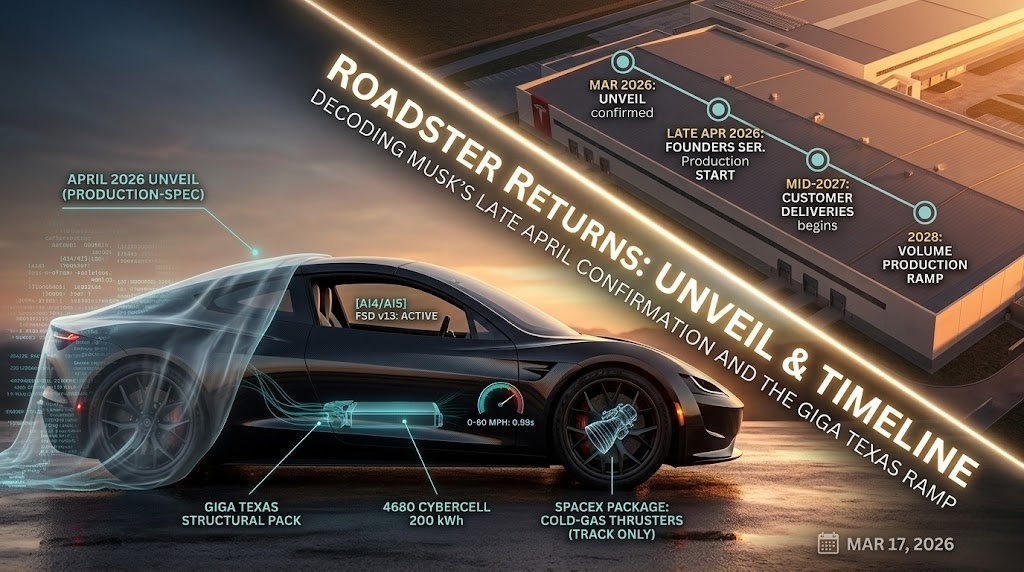
1. Introduction: The Longest Gestation in EV History
For the global Tesla community, the "Next-Gen Roadster" has been a mythical figure for nearly a decade. First unveiled as a surprise prototype in November 2017, it promised to be the "hardcore smackdown" to gasoline supercars. After years of shifting priorities toward the Model 3, Model Y, and Cybertruck, the silence was finally broken today. On March 17, 2026, Elon Musk confirmed via social media that the production-version unveil is now targeted for late April 2026.
This announcement is more than just a date on a calendar; it is a signal that Tesla is ready to reclaim its "Halo Car" status. For North American and European owners—many of whom have held $50,000 reservations for years—this marks the transition from vaporware to a concrete engineering reality.
2. Technical Expectations: What Does "Production-Spec" Mean in 2026?
The Roadster we saw in 2017 was a design study. The car arriving in April 2026 will be a vastly different beast, benefiting from nearly a decade of breakthroughs in battery chemistry, motor efficiency, and AI compute.
2.1 The SpaceX Package and Cold-Gas Thrusters
The most controversial and exciting aspect remains the SpaceX Package. Recent patent filings from early 2026 suggest Tesla has finalized a system of approximately 10 cold-gas thrusters—derived from Falcon 9 rocket technology—hidden behind the license plate and body panels.
-
The "Sub-1 Second" Claim: Musk has doubled down on the claim that with rocket assistance, the Roadster could achieve a 0-60 mph sprint in under one second.
-
Physics vs. Reality: While this would subject the driver to over 2.5 Gs of force, the thrusters are also expected to assist in cornering and braking, essentially using compressed air to "glue" the car to the road, overcoming the traditional weight penalties of high-capacity battery packs.
2.2 Range and the 200 kWh Threshold
To achieve the promised 620 miles (1,000 km) of range, Tesla is expected to utilize its most advanced 4680 "Cybercell" architecture. However, fitting a 200 kWh battery into a compact sports car chassis remains a monumental engineering challenge. Industry analysts expect the production version to utilize a structural battery pack with an energy density significantly higher than that found in the current Model S Plaid.
3. Production Logistics: The Road to 2027
Despite the April unveil, the car will not be in driveways tomorrow. Tesla has signaled a 12 to 18-month production ramp following the reveal.
-
Giga Texas Integration: Production is slated for Giga Texas, utilizing the same specialized high-strength alloy casting techniques pioneered for the Cybertruck.
-
The Delivery Window: Realistically, this places the first "Founders Series" deliveries in mid-to-late 2027, with volume production likely not hitting its stride until 2028.
-
The Founders Legacy: For the first 1,000 reservation holders who paid the full $250,000 upfront in 2017, Tesla is rumored to be offering exclusive "Vanta Black" finishes and personalized interior appointments as a reward for their decade-long patience.
4. Market Positioning: Competing in the Supercar Renaissance
The landscape of 2026 is far more crowded than it was in 2017. Tesla no longer has the high-performance EV market to itself.
-
The Rimac Factor: The Rimac Nevera currently holds the benchmark for production EV speed, but at a price point exceeding $2 million.
-
The Ferrari EV: With Ferrari’s first fully electric supercar set to debut in late 2025, Tesla’s $200,000 Roadster must offer superior "bang for buck" and technology integration (FSD v13/v14) to maintain its edge.
-
Halo Effect: For Tesla, the Roadster isn't just about sales volume; it’s about proving that even in an age of autonomous "Cybercabs," the brand can still produce the "best and final human-driven car."
5. Conclusion: A Decade of Waiting for a Second of Speed
The late April 2026 unveil represents the closing of a chapter for Tesla. It validates the faith of early believers and signals that the company’s engineering focus has finally returned to the "fun" side of the electric revolution. While the 1.1-second 0-60 mph claim may seem like science fiction, the convergence of trademark filings, seat patents, and Musk's personal confirmation suggests that Tesla is ready to deliver a vehicle that will, once again, force the entire automotive industry to recalibrate its definition of "possible."
FAQ: The 2026 Roadster Essentials
Q: Is my 2017 deposit still valid?
-
A: Yes. Tesla has confirmed that all original reservations remain on the books. However, with the expected price adjustments due to inflation since 2017, final MSRP may vary from the original $200,000 estimate.
Q: Will the Roadster be capable of Full Self-Driving?
-
A: Absolutely. The Roadster will ship with AI4 (or even AI5) hardware, fully compatible with the FSD v13/v14 temporal transformer architecture.
Q: Can I really use the "SpaceX" thrusters on public roads?
-
A: This remains a major regulatory hurdle. It is likely that the thrusters will be geofenced for "Track Mode" only, as the noise and force of the compressed air discharge could pose safety risks in urban environments.