
1. Introduction: The Decade of Waiting is Over
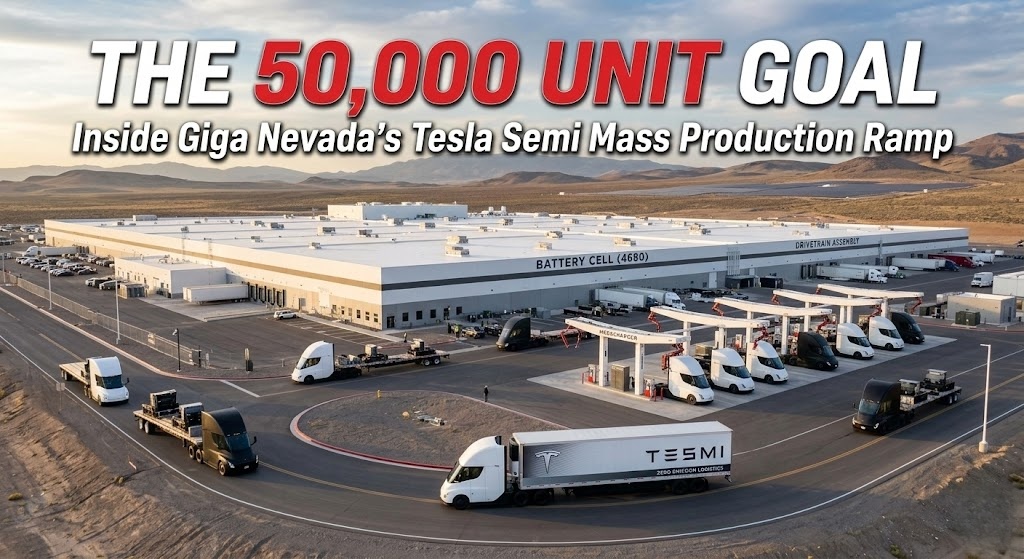
For the global logistics industry, the date March 10, 2026, marks a historic pivot. What began in 2017 as a futuristic prototype on a Hawthorne stage has finally matured into a massive industrial reality. Today, at the newly inaugurated high-volume manufacturing facility adjacent to Giga Nevada, the first "Phase 2" Tesla Semi rolled off the line, signaling the start of a mission to produce 50,000 units annually.
This isn't just about a new truck; it is about the "unboxing" of heavy-duty transport. For years, critics claimed a Class 8 electric truck with a 500-mile range was physically impossible due to battery weight. Today, Tesla is proving that with the right cell chemistry and architectural integration, the "Diesel Era" is entering its final chapter.
2. Manufacturing Innovation: The Giga Nevada Expansion
The secret to the Semi’s mass production lies not in the truck itself, but in the factory. Tesla has invested over $3.6 billion into the Giga Nevada expansion to house the Semi's dedicated production line.
2.1 The "Unboxed" Assembly Process
Unlike traditional truck manufacturers (like Freightliner or Volvo) who use a moving chassis-based assembly line, Tesla has implemented a version of its "Unboxed Process" for the Semi.
-
Modular Sub-assemblies: The cab, the drivetrain (tri-motor set), and the massive battery pack are assembled in parallel dedicated cells.
-
Vertical Integration: By manufacturing the 4680-format Cybercells and the traction motors on-site, Tesla avoids the supply chain bottlenecks that plague traditional OEMs.
2.2 Scaling to 50,000 Units
Elon Musk’s 2022 projection of 50,000 units by 2024 was ambitious, but in 2026, the infrastructure has finally caught up. The new facility utilizes advanced robotics and "Giga Castings" for the rear frame, reducing the part count of the chassis by over 200 components compared to the early pilot units delivered to PepsiCo.
3. Technical Specifications: The 2026 Production Standard
The production-spec Semi differs significantly from the 2017 alpha prototype. It is lighter, smarter, and more efficient.
3.1 Efficiency and Payload
-
Efficiency: The 2026 Semi achieves a verified 1.68 kWh per mile at a Gross Combined Weight (GCW) of 82,000 lbs. This is a 10% improvement over the early test fleet.
-
Battery Technology: Utilizing the "Cybercell" (4680 Type 2), the battery pack is 15% more energy-dense, allowing for a 500-mile range while maintaining a payload capacity that is within 1,500 lbs of a traditional Class 8 diesel sleeper.
3.2 The Tri-Motor Drivetrain
The Semi utilizes three independent motors on the rear axles.
-
Highway Cruising: At steady speeds, two motors decouple to maximize efficiency.
-
Torque Vectoring: During acceleration or mountain climbs (like the Donner Pass), all three motors engage, providing acceleration that leaves diesel trucks far behind.
4. The Megacharger Network: The "Electric Blue" Corridors
Range anxiety for a passenger car is a nuisance; for a logistics company, it is a bankruptcy risk. To support mass production, Tesla is deploying the Megacharger Network across the US and Europe.
4.1 The 1MW+ Standard
The V4 Megachargers utilize a liquid-cooled charging cable capable of delivering over 1.5 Megawatts of power. This allows the Semi to recover 70% of its range (350 miles) in just 30 minutes—perfectly timed for a driver’s mandatory break.
4.2 Corporate Partnerships
Major partners like PepsiCo, UPS, DHL, and Walmart have already begun installing "private" Megacharger hubs at their distribution centers, creating a hub-and-spoke charging model that bypasses the limitations of the public grid.
5. Economic Impact: The 40% TCO Advantage
The primary driver for the Semi's success isn't sustainability; it’s the bottom line. Total Cost of Ownership (TCO) is the only metric that matters in trucking.
-
Fuel Savings: In 2026, electricity remains significantly cheaper per mile than diesel, especially with Tesla’s integrated solar and Megapack storage at charging sites.
-
Maintenance: With no engine, transmission, or emissions after-treatment systems (DEF/DPF), maintenance costs are projected to be 50% lower than diesel alternatives.
-
Regenerative Braking: This feature nearly eliminates brake wear, a massive cost-saving factor for trucks operating in mountainous regions.
6. Conclusion: The Most Significant Revenue Diversifier
As the passenger EV market in the US and Europe reaches a stage of high penetration and fierce competition, the Tesla Semi offers a "Blue Ocean" opportunity. Each Semi sold represents the revenue of roughly 4-5 Model 3s, but with higher potential software margins via "FSD for Logistics."
The transition to mass production in Nevada is the signal that Tesla is no longer just a car company—it is the architect of the world's first truly sustainable, autonomous global logistics network.
FAQ: Frequently Asked Questions
Q: When will the Tesla Semi be available in Europe? A: Tesla has begun testing "Euro-spec" Semis with modified widths and lighting. Production for the European market is expected to start at Giga Berlin in late 2027.
Q: Does the Semi come with Full Self-Driving? A: Every Semi is equipped with the AI4 (Hardware 4) suite. Currently, it supports "Advanced Autopilot" specifically tuned for heavy trailers. A "Convoy Mode" (platooning) is currently in regulatory testing.
Q: How does the weight of the batteries affect the cargo capacity? A: Due to US and EU regulations allowing an extra 2,000 lbs for zero-emission Class 8 trucks, the Semi’s cargo capacity is nearly identical to a diesel truck. Most loads (like beverages or consumer goods) "cube out" (run out of space) before they "gross out" (reach weight limits).