
Introduction
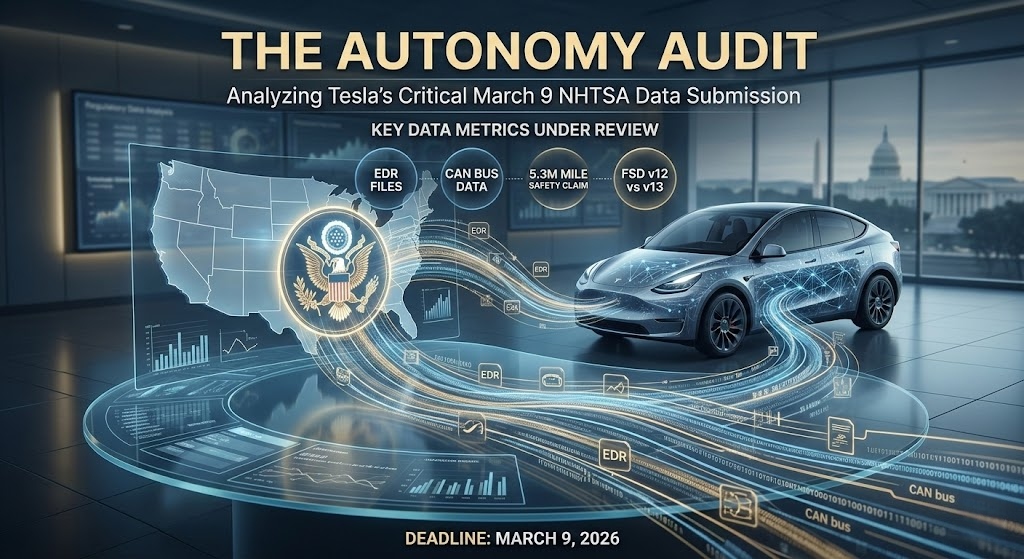
Today, March 9, 2026, represents a watershed moment for Tesla, Inc., and the broader trajectory of autonomous transportation. As the clock strikes midnight on the East Coast, Tesla’s legal and engineering teams are finalizing a massive data transmission to the National Highway Traffic Safety Administration (NHTSA). This is not just another bureaucratic filing; it is the culmination of a high-stakes, federal investigation into Full Self-Driving (FSD) traffic-safety violations—a probe that has seen Tesla secure two previous extensions to review over 8,300 complex records.
For Tesla’s sophisticated owner base in Europe and North America, this deadline is the ultimate "Autonomy Audit." Since the launch of the unsupervised Robotaxi service in Austin in mid-2025, the narrative around Tesla has shifted from "can they build it?" to "is it safer than us?" With 14 reported Robotaxi incidents in the last eight months and an ongoing federal inquiry into 58 specific FSD-related crashes, the data being handed over today will either validate Tesla’s algorithmic progress or provide regulators with the ammunition needed to restrict the software's expansion.
Chapter 1: The Anatomy of the Information Request
The NHTSA’s Information Request (IR) is unprecedented in its technical granularity. Regulators are no longer satisfied with high-level crash counts; they are demanding the "black box" of Tesla’s neural networks.
1.1 The Pre-Crash Timeline
Tesla must provide a second-by-second reconstruction starting 30 seconds before each initial traffic violation. This includes:
-
Perception Logs: What objects did the cameras identify? (e.g., Was the stop sign occluded? Was the emergency vehicle's siren recognized?)
-
Path Planning: What was the intended trajectory vs. the actual movement?
-
Sensor Fusion: Were there discrepancies between the vision-only system’s depth perception and the real-world environment?
1.2 EDR and CAN Bus Files
The submission includes Event Data Recorder (EDR) and CAN bus files. For the uninitiated, the CAN bus is the vehicle's nervous system. These files will reveal the exact millisecond a driver attempted to intervene, the torque applied to the steering wheel, and whether the system "aborted" or "surrendered" control just moments before impact. This is critical for the NHTSA’s "5-second rule"—the agency scrutinizes any crash where FSD was active within five seconds of the event.
1.3 Version Correlation
The agency is tracking software regression. They are specifically looking at whether the transition from FSD v12.x (End-to-End) to the new v13 (Temporal Transformers) fixed previous failure modes or introduced new ones. If the data shows that "phantom braking" or "failure to yield" persists across different architectural stacks, it suggests a systemic flaw rather than an isolated software bug.
Chapter 2: The Austin Robotaxi Incident Analysis
While the broader investigation covers nearly 2.88 million supervised vehicles, the spotlight is arguably brightest on the Austin Robotaxi fleet. Since its debut in June 2025, the fleet has covered roughly 800,000 miles.
2.1 The "14 Crashes" Myth
Headlines often scream about the 14 crashes, but the EDR data submitted today is expected to tell a more nuanced story. A deep dive into these reports reveals:
-
The Low-Speed Reality: 8 of the 14 incidents occurred at speeds below 6 mph.
-
Stationary Strikes: In five cases, the Tesla was either completely stopped or moving at less than 2 mph (e.g., being rear-ended at a traffic light or a minor scrape during a 3-point turn).
-
Reporting Bias: Under the NHTSA’s Standing General Order (SGO), autonomous vehicles must report any property damage. A human driver might not report a 1-mph bumper tap with a curb, but a Tesla Robotaxi must.
2.2 The "Critical Three"
Regulators are most concerned with the three incidents where the vehicle was "proceeding straight" and collided with a moving object. These represent high-risk failure modes. The March 9 data will clarify if these were caused by "edge case" occlusions or a failure in the occupancy network's ability to predict cross-traffic behavior.
Chapter 3: The 5.3 Million Mile Metric vs. Regulatory Scrutiny
Tesla’s central defense is its Vehicle Safety Report. The current 2026 data claims that supervised FSD drivers travel 5.3 million miles between major crashes, compared to the U.S. average of roughly 660,000 miles.
3.1 The Credibility Gap
Critics and safety experts, such as those at the Crash Investigation Sampling System (CISS), argue these numbers are "apples-to-oranges." They point out that FSD is primarily used in favorable weather and often on highways, whereas the national average includes drunk driving, distracted teenagers, and ancient vehicles without active safety features.
3.2 The Importance of the "Comparison Baseline"
Tesla has countered this by using its own fleet of pre-2014 vehicles (without Autopilot) as a "proxy" for the average car. Today’s data submission will likely include more granular comparisons, showing how FSD performs in the exact same urban environments where human-driven Teslas are crashing. If Tesla can prove a 7x safety multiplier in dense city centers, it effectively wins the regulatory argument.
Chapter 4: The Legal and Financial Stakes
The implications of today’s filing extend far beyond safety. For investors and owners, the March 9 deadline is a binary risk event.
-
The "Restriction" Scenario: If the NHTSA finds evidence of recurring, unaddressed failure modes, it can issue a Mandatory Safety Recall. Unlike a typical OTA update, this could involve restricting FSD use in certain geofenced areas or requiring a more intrusive "driver monitoring" system.
-
The "Validation" Scenario: Conversely, if the data shows a clear downward trend in incident rates as software matures (specifically with the rollout of v13), it provides a "green light" for Tesla to expand its unsupervised trials to California and Florida.
Conclusion: The Path to Unsupervised Autonomy
The March 9 submission is not the end of the investigation, but it is the end of the "data gathering" phase. The NHTSA now has the most complete picture of autonomous vehicle performance in history.
For the Tesla blogger and enthusiast community, the takeaway is clear: Tesla is moving away from the "move fast and break things" era. The rigors of this federal audit are forcing a level of transparency that, while painful in the short term, is the only way to build the public trust required for a world without steering wheels. We expect an official agency response or a preliminary report within the next 45 to 60 days. Until then, the data remains the most valuable asset in the race for autonomy.
Frequently Asked Questions (FAQ)
Q: Why did Tesla need two extensions for this March 9 deadline? A: Tesla cited the need to manually review over 8,300 records. Because many incidents involve minor property damage or brief disengagements, human analysts had to cross-reference video logs with telemetry to ensure the data provided to the NHTSA was accurate and contextualized.
Q: Does this investigation only affect US-based Tesla owners? A: While the NHTSA is a US agency, European regulators (such as the UNECE) closely monitor these findings. Success in the US audit is a prerequisite for the approval of unsupervised FSD in European markets.
Q: What is the difference between a "Major Collision" and a "Traffic Violation" in this probe? A: A major collision involves airbag deployment or injury. A traffic violation (the focus of this investigation) includes "near-misses," running red lights, or failing to yield—events that don't always result in a crash but indicate a failure in the software's logic.
Q: Will FSD v13 solve the issues being investigated? A: Early data on v13 shows a significant reduction in "hesitancy" and "unstructured environment" errors thanks to Temporal Transformers. Tesla is likely using this progress to argue that previous issues are already "legacy" bugs.