
Introduction: The Silence After the Cheers
On February 1, 2026, Elon Musk posted a characteristically understated congratulation to his engineering teams on X. There were no confetti cannons, no live-streamed battery day theatrics. Just a quiet acknowledgment: dry electrode 4680 cells, with both cathode and anode processed without a single drop of solvent, are now rolling off lines at Gigafactory Berlin at yields that would have been dismissed as fantasy eighteen months ago.
The industry did not cheer. It recalibrated.
For five years, the narrative around 4680 was a predictable rhythm of hype, delay, and whispered skepticism. Maxwell Technologies’ dry film acquisition was seen as a brilliant hedge, but the manufacturing reality—scaling a powder-to-film process that required rethinking every assumption about web handling, particle integrity, and throughput—proved so brutal that even Panasonic stepped back. Tesla was alone in the deep end.
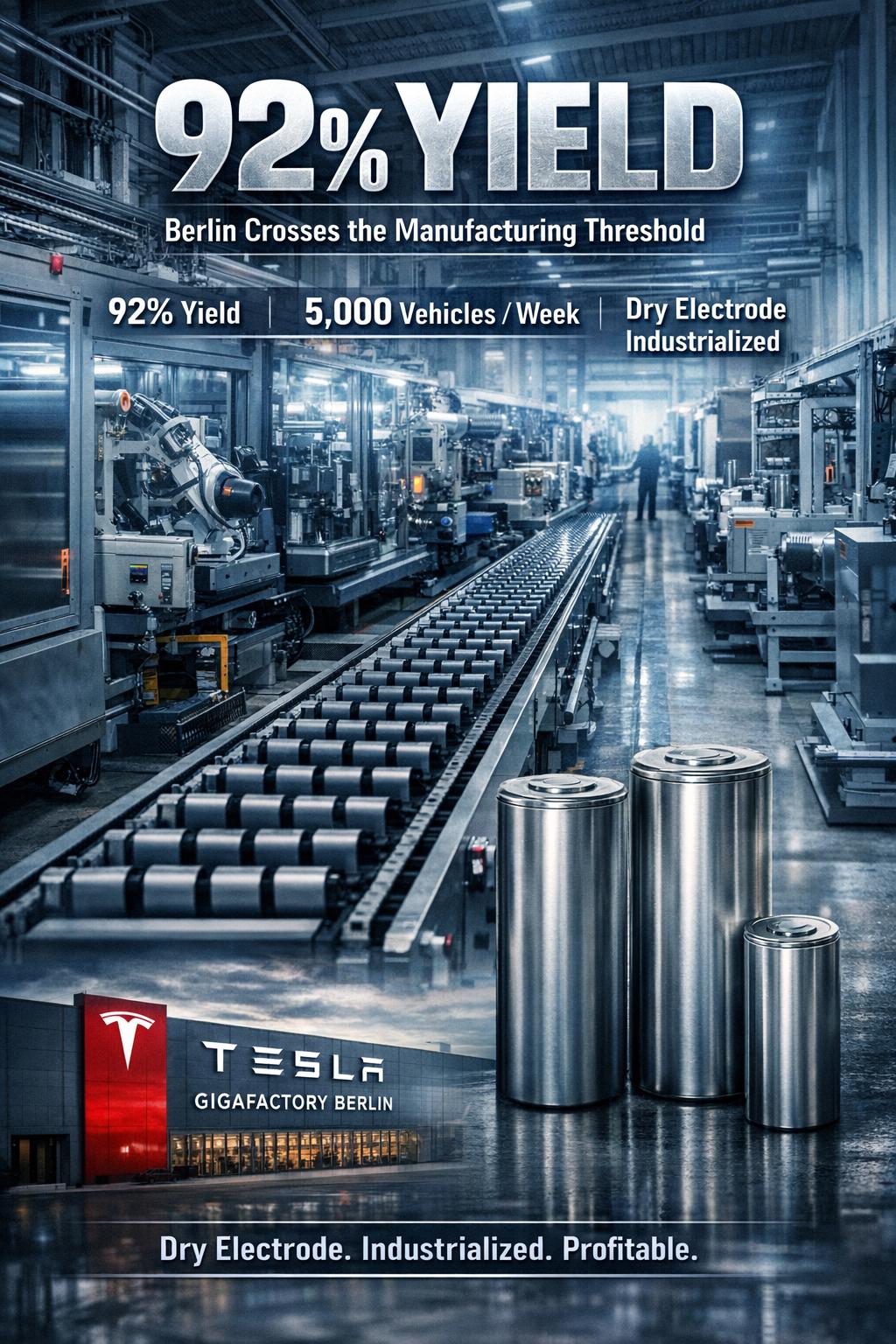
Today, Berlin operates multiple 4680 lines at 92% yield, producing 280MWh per month per line. This is not a pilot. This is the new baseline.
Chapter 1: The Yield Breakpoint — Why 92% is the Magic Number
1.1 The Algebra of Scrap
Battery manufacturing is a game of cumulative attrition. In wet coating, each step—mixing, coating, drying, calendering, slitting—adds defects. A 95% yield at coating means little if slitting kills another 3%. The industry norm for mature electrode lines hovers around 94-96% final yield.
Dry electrode introduces new failure modes: pinholes from incomplete PTFE fibrillation, edge cracking from insufficient ductility, and delamination during high-speed winding. At 70% yield, 4680 is a science project. At 80%, it is acceptable for low-volume applications like the early Cybertruck. At 92%, it becomes a weapon.
Tesla’s proprietary process, protected under US Patent Application 2025/0364562, achieves this by reordering the mixing sequence. Instead of blending binder with solvent and hoping for dispersion, the patent describes:
Step 1: Pre-mix active material (NMC811/955) and conductive carbon (≤8% by weight).
Step 2: Add dry PTFE binder (≤2% by weight) under low-shear conditions.
Step 3: High-shear jet milling to fibrillize PTFE into a spider-web matrix that entraps active particles without crushing them.
This is not incremental. It inverts the conventional wisdom that the binder must be dissolved to be effective. The result is a self-supporting film that runs through three calendar passes instead of ten—a 3x increase in line throughput that directly attacks the utilization crisis that plagued Fremont in 2024.
1.2 The Cost Curve Inflection
Wet coating requires a 100-meter drying oven, heated to 120-160°C, consuming enormous volumes of natural gas or electricity. It requires an NMP solvent recovery system—a $30-50 million capital expenditure that also carries explosion risks and environmental compliance overhead. A Dry electrode eliminates both.
The $4/kWh difference appears modest—until multiplied across a 100kWh pack ($400 savings) and a 10GWh line ($40M annualized). More importantly, dry capex enables faster depreciation and smaller capital lockup, allowing Tesla to expand capacity in granular increments rather than billion-dollar megafactories.
1.3 Why Berlin, Not Texas?
This is the question that fractures the conventional Tesla narrative. If the dry electrode is the holy grail, why does Berlin lead?
The answer is product focus. Austin must feed Cybertruck, Semi, and Model Y simultaneously, with competing cell formats and pack architectures. Berlin builds one car—Model Y—with one cell format—4680—and increasingly one process—dry electrode.
This singularity allows engineers to optimize the line without constant changeovers. It also aligns with European energy economics. In Germany, industrial electricity rates exceed $0.20/kWh. Saving 40kWh per kWh of battery capacity is not a nice-to-have; it is a competitive necessity.
Chapter 2: The Technology Behind the Wall — Inside Tesla’s Dry Electrode Fortress
2.1 The PTFE Constraint
Polytetrafluoroethylene—Teflon—is the unlikely hero of Tesla’s battery revolution. But not all PTFE is equal. Tesla’s patent specifies a specific molecular weight distribution and fibrillation threshold that commercial PTFE powders do not meet.
This is not an off-the-shelf purchase. Tesla works directly with custom formulators—in China, 3F New Materials has announced a 620 million RMB investment dedicated to dry electrode binder production, timed explicitly to Tesla’s specifications. The material is not commodity PTFE. It is process-tailored PTFE, with particle size distribution optimized for rapid fibrillation and minimal residual deformation.
2.2 Equipment as Intellectual Property
Conventional lithium-ion lines are catalog purchases. Wenzhou produces coating heads; Hirano Tecseed supplies ovens; Asahi makes slitters. Tesla’s dry electrode line has no catalog.
Yinghe Technology and Winning Health co-developed the high-shear dry mixer and multi-roll calender systems specifically for Tesla’s process window. The equipment is not sold to third parties. The control software incorporates Tesla’s proprietary pressure ramp curves and temperature setpoints, refined over 18 months of trial-and-error at Kato Road.
This is the moat. Not the patent—patents expire. But the decoupling between material behavior and machine response can only be accumulated through production experience. A competitor can buy the same mixer from Yinghe. They cannot buy the 150,000 hours of parameter tuning embedded in Tesla’s version control system.
2.3 The Solid-State Bridge
Industry observers often frame the dry electrode as a 4680 enabler. This is true but incomplete. Dry electrode is the manufacturing process required for sulfide-based all-solid-state batteries.
Solid electrolytes—particularly argyrodite-type sulfides—are exquisitely sensitive to polar solvents. Even trace moisture degrades ionic conductivity irreversibly. Wet coating is therefore untenable for the mass production of solid-state electrodes.
Tesla’s dry film process operates in a bone-dry environment, with relative humidity below 1%. The same equipment set that compresses NMC811 and PTFE into a 30µm film can, with modest modifications, co-compress solid electrolyte and cathode active material into a monolithic bilayer.
This is not speculative. Musk explicitly stated in February 2026: “Dry electrode is the core front-end process for solid-state. It creates a solvent-free environment that perfectly accommodates sulfides.”
Berlin is not just making 4680s. It is validating the production template for Tesla’s post-lithium era.
Chapter 3: The European Pivot — From Import Hub to Export Base
3.1 Tariff Arbitrage and Supply Chain Sovereignty
Europe’s battery paradox is simple: the continent consumes more EVs than it produces cells. The gap has been filled by Asian imports—primarily CATL and LGES cells assembled in China, shipped to Berlin or Shanghai, then re-exported as finished vehicles.
The Carbon Border Adjustment Mechanism (CBAM) and proposed REACH amendments threaten this model. Imported cells carry embedded carbon that increasingly carries a price tag. Tesla’s Berlin-made 4680 cells are manufactured with European renewable energy, using European-compliant supply chains—a differentiation that will matter when CBAM fully phases in by 2027.
More immediately, the IRA’s Foreign Entity of Concern (FEOC) rules create uncertainty for Chinese-content cells in US-bound vehicles. Tesla’s strategy is becoming clear: Berlin serves Europe, Austin serves America, and Shanghai serves the rest. Dry electrode enables Berlin to cut its umbilical cord to Asian anode and cathode imports.
3.2 The Consumer Impact: Visible and Invisible
For the European Tesla owner, what changes?
Visible: Very little. The 2026 Model Y produced in Berlin does not advertise its 4680 heritage. Range is unchanged; acceleration is identical; charging curves are slightly flatter but not dramatically superior.
Invisible: Everything. The car you take delivery of in June 2026 contains a battery pack that costs Tesla €800 less to manufacture than the 2170 pack it replaced. That margin is not yet being discounted—order books show stable pricing through Q2—but it is being reinvested into higher-specification LFP cells for entry models, structural pack enhancements, and absorption of rising logistics costs.
More importantly, the car is not waiting at a port in Zeebrugge for three weeks. It was built after your order, delivered within ten days, and carries zero ocean freight carbon liability.
3.3 The 2026 Cost-Out Roadmap
Tesla’s investor materials indicate a $1,800 per vehicle cost reduction attributable to the 4680 dry electrode in 2026. This flows through three channels:
Cell cost: -15% year-over-year, driven by yield and throughput gains.
Pack simplification: Elimination of module frames and cooling channels via structural pack.
Logistics: Reduced inbound freight from Asia, lower buffer inventory requirements.
Not all of this reaches the retail price. But in an inflationary environment where competitors are raising prices 2-4% annually, holding price flat is functionally a price cut.
Chapter 4: The Competitive Landscape — Who Is Chasing, Who Is Trailing?
4.1 Chinese Incumbents: The Wet-Dry Divide
CATL does not dispute the theoretical advantages of the dry electrode. Its “Golden Llama” program has produced 4680-format cells using wet cathode and dry anode—a hybrid approach that captures some energy density gains but misses the capex and opex savings of full dry.
The gap is not technological irreversibility but installed base inertia. CATL has hundreds of GWh of wet coating capacity, fully depreciated, humming at 96% yield. To pivot to dry would strand billions in assets—assets that remain perfectly functional for the automotive mass market.
Tesla has no such constraint. Every new GWh of capacity at Berlin is built on the dry template.
4.2 European Incumbents: The Procurement Trap
Volkswagen’s PowerCo, Mercedes’ ACC joint venture, and Stellantis’ ACC all rely on wet-coated cells from Asian suppliers or licensed wet processes in European gigafactories. They do not control the manufacturing IP; they purchase it. When Tesla achieves a 15% cost advantage on 4680 cells, European automakers cannot simply switch vendors—they are locked into multi-year supply contracts with fixed pricing formulas.
This is the asymmetry that worries analysts. Tesla is not merely building cheaper cells; it is building the capability to build cheaper cells faster than anyone else—a learning rate advantage that compounds annually.
Chapter 5: The Unresolved Questions
5.1 Cycle Life Parity
Tesla claims dry electrode cells achieve >90% capacity retention after 2,000 cycles. Independent testing of early 4680s from Texas showed slightly faster degradation than contemporary 2170s. The gap has narrowed but may not have closed entirely. Long-term data from Berlin production is not yet available.
5.2 Anode Dry Process Maturity
While Tesla has announced full dry electrode (both cathode and anode), the anode dry is more challenging. Graphite and silicon are brittle; PTFE fibrillation is less effective on anode active materials. The 4680 cells in current Berlin Model Ys use a dry cathode, wet anode—a hybrid configuration that delivers most of the cost and energy benefits but requires solvent handling for the anode side.
True full-dry anode remains a 2027 target.
5.3 Scalability Beyond Berlin
Berlin’s success is not automatically replicable in Austin, where line changeovers and Cybertruck demand complicate optimization. Tesla has not disclosed whether Austin has achieved comparable yields on its 4680 lines.
Conclusion: The Threshold Crossed
February 2026 will be remembered as the month dry electrode ceased to be a research aspiration and became a production reality with P&L impact. Gigafactory Berlin is now the lowest-cost cell manufacturing site in the Western world—not by virtue of cheap labor or lax regulation, but by superior process physics.
For European Tesla owners, this means:
Shorter wait times for locally configured vehicles.
Greater price stability in a volatile currency environment.
A clear technology trajectory toward solid-state packs later this decade.
The 4680 dry electrode story is not about specs. It is about sovereignty—manufacturing sovereignty, cost sovereignty, and the quiet accumulation of capabilities that cannot be licensed or reverse-engineered in a single product cycle.
Tesla has not won the battery war. But it has fortified its position behind a moat that just got 70% narrower—and 90% more energy efficient.
FAQ: Dry Electrode 4680 in Berlin
Q: Does my new Model Y from Berlin have the dry electrode 4680 battery?
A: Partial dry electrode (cathode dry, anode wet) is now standard on Berlin-built Long Range and Performance Model Ys. Full dry (both electrodes) is in pilot and expected mid-2026.
Q: Will this battery last as long as the old 2170 pack?
A: Early data suggest cycle life parity. Tesla claims 90% retention at 2,000 cycles, which exceeds the expected service life of the vehicle.
Q: Can I retrofit a 4680 pack into my older Model Y?
A: No. The structural pack architecture, voltage platform, and BMS communication protocols are incompatible with legacy vehicles.
Q: Does dry electrode mean Tesla is making solid-state batteries now?
A: No. But the dry electrode is the enabling process for solid-state manufacturing. The equipment and clean-dry environment are directly transferable.
Q: Will this make Teslas cheaper in Europe?
A: Not immediately. The cost savings are currently absorbed as margin or reinvested in specification upgrades. Price reductions are likely in 2027 as volume scales.