
Introduction: A Glimpse into the Autonomous Future
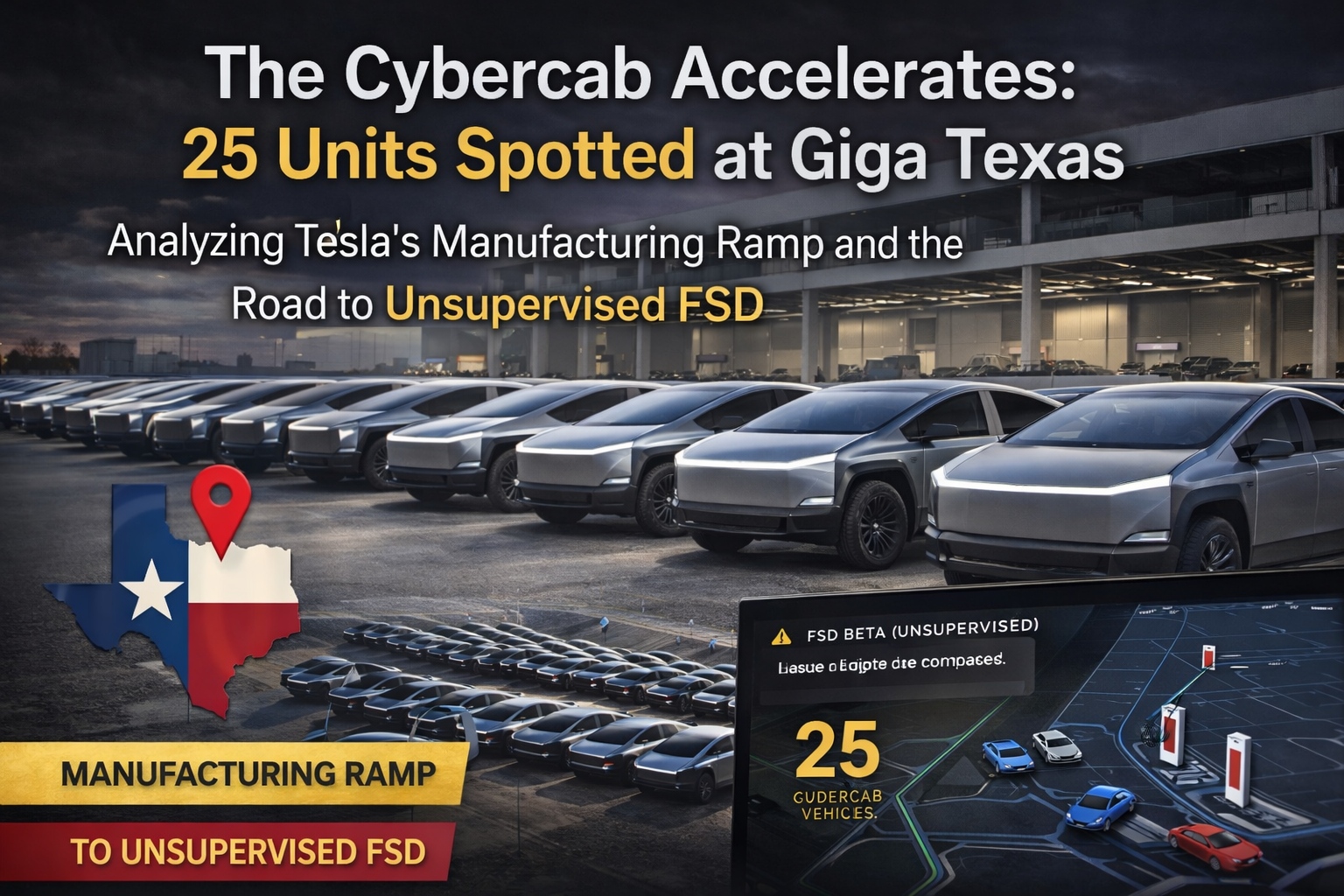
On a seemingly ordinary day in early March 2026, the future of personal transportation was quietly taking shape on the grounds of Tesla‘s Gigafactory in Austin, Texas. Drone enthusiast and frequent factory-watcher Joe Tegtmeyer captured aerial footage that sent ripples of excitement through the electric vehicle community. The video revealed a sight unseen before: a total of 25 Tesla Cybercabs, the company‘s purpose-built robotaxi, dispersed across the massive facility . Fourteen of these metallic gold, compact vehicles were parked in a tight formation outside the factory exit. Another nine were situated at the crash testing facility, undergoing structural validation, while two more were spotted at the west end-of-line area for final quality checks. Tegtmeyer also noted several other Cybercabs driving autonomously around the complex, suggesting active, real-world testing beyond the static line-up .
This sighting, the largest public grouping of Cybercabs to date, is far more than a collector‘s curiosity. It is compelling evidence that Tesla has successfully transitioned from the low-volume pilot builds that commenced in mid-February into a phase of “higher-volume test manufacturing” . With mass production officially slated to begin in April 2026, the appearance of two and a half dozen units in early March signals that the company is accelerating its validation and ramp-up processes ahead of schedule . This article delves into the significance of this manufacturing milestone, explores the revolutionary “unboxed” production process, examines the state of Full Self-Driving technology that underpins the entire Cybercab concept, and soberly assesses the regulatory and safety hurdles that remain before these vehicles can truly herald the dawn of the robotaxi era.
Section 1: From Pilot to Production – Decoding the Manufacturing Ramp at Giga Texas
The journey of the Cybercab from a conceptual prototype, unveiled at the “We, Robot” event in late 2024, to a tangible, mass-producible vehicle has been remarkably swift. On February 18, 2026, Tesla announced that the first mass-produced Cybercab had officially rolled off the line at Giga Texas, a milestone CEO Elon Musk celebrated by congratulating the team on X . This event marked the commencement of “low-volume builds” on a dedicated new assembly line. The leap from that first unit to the 25 vehicles observed by Tegtmeyer just two weeks later is a testament to the rapid maturation of the production line.
The "Unboxed" Process: A Paradigm Shift in Manufacturing
Central to the Cybercab’s viability is Tesla‘s radical new approach to vehicle assembly, known as the “unboxed” manufacturing process. For over a century, automakers have relied on the linear assembly line, where a car body is stamped, painted, and then moves down a long line as components are sequentially bolted on. This process, while refined over decades, is inherently sequential and space-intensive.
Tesla‘s “unboxed” process turns this model on its head. Inspired by the manufacturing of consumer electronics and modern logistics, it involves building different sections of the vehicle—or “sub-assemblies”—in parallel, in separate zones of the factory . Imagine four independent production lines simultaneously creating the front end, the rear floor, the left side structure, and the right side structure, complete with their integrated components like seats, wiring, and HVAC (Heating, Ventilation, and Air Conditioning) systems. At the final stage, these four major assemblies are precisely joined together, or “unboxed,” to create the complete vehicle .
The advantages of this approach are transformative. By building in parallel, the factory footprint can be significantly reduced, and the overall throughput time per vehicle can be slashed. Tesla has suggested this method could allow them to assemble a Cybercab from its major sub-assemblies in as little as 10 seconds . This efficiency is not just about speed; it‘s about cost. The Cybercab is projected to have a price point below $30,000, a figure that would be nearly impossible to achieve with traditional manufacturing methods . The sight of 25 vehicles in various stages of testing—from final assembly checks to crash validation—indicates that this novel production line is not just theoretical; it is operational and scaling.
Section 2: The Technical Heart – A Vehicle Designed for a Single Purpose
The Cybercab‘s design is a radical departure from any production vehicle before it, dictated entirely by its mission as an autonomous taxi. The most striking feature, or lack thereof, is the complete absence of a steering wheel and pedals . This is not merely a stylistic choice but a foundational design decision. From its inception, the Cybercab was conceived without any provision for human control, freeing the design team to rethink the entire vehicle architecture .
A Cabin Optimized for the Passenger
This design philosophy has profound implications for the interior space. With no driver controls, the cabin is symmetrically arranged around the passengers. The Cybercab features just two seats, a decision driven by data indicating that over 90% of vehicle trips involve two or fewer occupants . This allows for a more compact, lightweight, and efficient vehicle. Access is provided by dramatic, upward-swinging gull-wing doors, which eliminate the need to reach for a traditional door handle and allow for easy entry and exit even in tight parking spaces . Inside, the passenger experience is centered around a single, large 21-inch central display, which serves as the interface for journey information, climate control, and entertainment . There is no other instrumentation, no buttons, no controls—just a pure, uncluttered space for mobility.
This singular focus also extends to the vehicle‘s underpinnings. The Cybercab is expected to utilize a 35 kWh battery pack, providing an estimated range of around 320 kilometers (approximately 200 miles) . This is significantly less than a long-range Model Y, but it is more than sufficient for the high-utilization, urban-focused duty cycle of a robotaxi. The smaller battery pack is lighter, cheaper to produce, and faster to charge, all of which improve the economics of the vehicle. It is also expected to feature inductive charging, removing the need for passengers to handle any cables . The Cybercab is not designed to be a personal vehicle for all purposes; it is an appliance, a tool optimized for a single, specific job: providing efficient, autonomous point-to-point transportation.
Section 3: The Mind of the Machine – The Evolution of Full Self-Driving (FSD)
The Cybercab is a shell without a ghost without the software that animates it: Tesla‘s Full Self-Driving system. The vehicle’s entire reason for being is its reliance on a “supervised” version of FSD to evolve into the “unsupervised” version that will allow it to operate without a human in the loop. The progress of FSD in recent years provides the foundation for Tesla‘s bold bet.
From Beta to Supervised: A Rapid Ascent
Tesla‘s journey towards autonomy began in earnest with the release of FSD Beta in 2020. The pivotal moment came in 2021 with the launch of FSD Beta V9, which marked Tesla‘s decisive move towards a vision-only, camera-based system, abandoning radar and ultrasonic sensors . The company bet that a sufficiently advanced neural network, processing visual data in real-time, could achieve a level of understanding and reaction superior to a sensor fusion approach. The introduction of a Transformer-based Bird‘s-Eye View (BEV) network was a landmark moment, applying large language model architecture to vision, allowing the car to perceive space and objects in all directions from its eight cameras .
The pace of development has been staggering. The removal of the “Beta” tag with FSD V12 in 2024 signaled a new level of confidence. This version moved to an end-to-end neural network, where the car‘s inputs (camera feeds) are fed into a massive AI model that directly outputs driving decisions (steering, acceleration, braking), bypassing thousands of lines of hand-coded programming . The result was a system that drove with unprecedented smoothness and naturalism. FSD V13.2, released in late 2024, brought further advances, including a 2x increase in decision-making speed, the ability to start FSD from a parked position, and more sophisticated maneuvers like three-point turns .
Reading the Road Like a Human
The development has continued into 2026. A recent demonstration video posted by Tesla showed an FSD-equipped vehicle navigating the notoriously narrow roads of the Netherlands. In the clip, the car successfully interpreted a hand signal from a pedestrian or construction worker, processing the gesture and deciding to stop or proceed accordingly . Elon Musk confirmed this advancement, stating, “Tesla‘s autonomous driving system can now recognize hand signals” . This capability is a significant step towards true human-like driving, moving beyond reacting to static objects and other vehicles to understanding the nuanced, non-verbal communication that is essential for navigating complex, shared spaces.
For the Cybercab to succeed, this level of cognitive ability must become the baseline. It must handle not just clear roads, but chaotic urban environments, unpredictable human behavior, and edge cases that would stump lesser systems. Tesla‘s massive fleet, which continuously feeds data back to its AI training centers, provides an unparalleled advantage in gathering the 16 billion kilometers of data Musk has estimated is necessary for safe, unsupervised driving . According to some projections, the fleet could reach this critical mass of data by July 2026 .
Section 4: The Remaining Challenges – Regulation and the Safety Reality
Despite the breathtaking technological progress, the path to a world filled with Cybercabs is not a straight line. Two formidable hurdles remain: regulatory approval and the absolute proof of safety.
The Regulatory Labyrinth
The Cybercab‘s lack of a steering wheel and pedals places it in direct conflict with long-established Federal Motor Vehicle Safety Standards (FMVSS) in the United States, which were written with the assumption that a human driver would be in control . Tesla will need to petition for, and be granted, exemptions from these rules. This is not a simple or guaranteed process. The National Highway Traffic Safety Administration (NHTSA) must be convinced that the vehicle provides a level of safety at least equivalent to a traditional car, despite the absence of human controls. Similarly, state-level regulations governing the operation of autonomous vehicles vary widely. While Texas has been welcoming, other states may prove more cautious. California, for instance, has a history of stringent oversight of autonomous vehicle testing, and its DMV recently opted not to pursue a suspension of Tesla‘s sales licenses after the company revised its FSD descriptions . This underscores the delicate and ongoing negotiation between Tesla and regulators.
The Safety Equation: Analyzing the Data
The most critical question for any autonomous vehicle is not just “does it work?” but “is it safe enough?”. Recent data provides a mixed picture. In January 2026, NHTSA released data on Tesla‘s existing robotaxi operations, primarily using a small fleet of about 42 vehicles in Austin and San Francisco, which still operate with safety drivers . The data, covering approximately 800,000 miles (1.3 million kilometers) from July to November 2025, reported 14 incidents, equating to an accident roughly every 57,000 miles .
To put this in context, Tesla‘s own benchmark for human drivers using FSD is one accident per 229,000 miles. The North American average for a major collision is even lower, at one per 699,000 miles . This suggests that the current, supervised robotaxi fleet is getting into accidents at a rate roughly four times higher than the average human driver. Critics point to this data as evidence that the technology is not yet ready for prime time . Proponents argue that this is early-stage testing data from a small fleet, and that the incidents were mostly low-speed and without serious injury. They contend that as the software improves exponentially, the safety record will follow.
Tesla also maintains its own safety data, claiming that FSD Supervised (in personal vehicles) has driven over 8.2 billion miles, with a major collision rate that is seven times better than the US average . The discrepancy highlights the difference between a supervised system in a personal car and the early, high-scrutiny operations of a dedicated robotaxi fleet. For the Cybercab to gain public trust, Tesla will need to demonstrate not just parity with human drivers, but a significant superiority, proving that its machines are not just good, but better.
Conclusion: A Calculated Gamble on an Autonomous Tomorrow
The sight of 25 Cybercabs moving through the Gigafactory Texas complex is a powerful symbol of Tesla‘s unwavering commitment to its vision of an autonomous future. It signifies that the company has moved beyond PowerPoint presentations and concept cars to the hard realities of manufacturing, assembly, and real-world validation. The “unboxed” production line, the purpose-built design, and the relentless iteration of FSD software all point to a company executing a long-term, high-stakes plan with impressive speed.
However, the road ahead remains fraught with challenges. The vehicle must survive the proving grounds of crash testing, navigate the complex web of global regulations, and most importantly, overcome a growing body of data that questions its safety readiness. The April 2026 start of mass production will be a historic moment, but it will be just the beginning of a longer journey. The true test of the Cybercab will not be how many roll off the line, but how safely they can navigate the unpredictable, chaotic, and wonderfully human world beyond the factory gates. The Cybercab is no longer a distant promise; it is a rapidly approaching reality, and the world is watching to see if Tesla can deliver on its most audacious bet yet.