
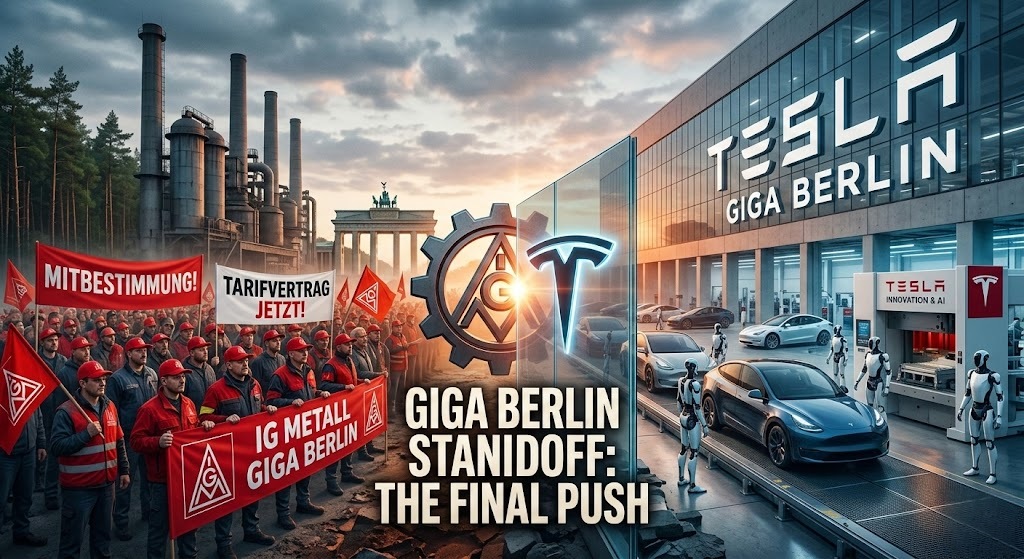
Chapter 1: The Zero Hour for Giga Berlin
Today, March 4, 2026, the quiet town of Grünheide is the epicenter of a global industrial earthquake. As the sun rises over the massive, graffiti-adorned walls of Gigafactory Berlin-Brandenburg, thousands of employees are casting ballots in what is arguably the most consequential labor election in the history of the electric vehicle (EV) industry. This is the 2026 Works Council election—a moment that has been building for over four years.
For the Tesla blogger and the European owner, this is not merely a "human resources" story. It is a fundamental clash between two irreconcilable ideologies: the Silicon Valley "First Principles" approach, which prioritizes speed, vertical integration, and individual meritocracy, and the "Social Market Economy" of Germany, which is built upon collective bargaining, co-determination (Mitbestimmung), and the immense power of IG Metall—the largest industrial union in Europe.
The outcome of today's vote will dictate whether Giga Berlin remains a fast-moving hub of innovation or becomes a standardized German industrial plant. For owners in London, Oslo, and Paris, the result will influence vehicle quality, delivery timelines, and the future pricing of the "Redwood" platform—Tesla’s long-awaited affordable EV.
Chapter 2: The IG Metall Offensive – A Multi-Year Strategy
IG Metall’s campaign to unionize Giga Berlin did not start yesterday. It began the moment Elon Musk announced the factory in 2019. However, the 2026 offensive is different in scale and intensity. Since the previous elections in 2024, the union has transitioned from "outsider agitation" to "insider organization."
The Narrative of "Safety and Speed" The union’s primary platform in 2026 revolves around occupational safety. Despite Tesla’s claims that its accident rates are lower than the industry average, IG Metall has leveraged "insider leaks" regarding the high-speed production lines of the Model Y Juniper refresh. They argue that Tesla’s relentless pursuit of "units per hour" has led to physical burnout among the 12,000-strong workforce.
The Wage Gap Myth vs. Reality A central pillar of the standoff is the Collective Bargaining Agreement (Tarifvertrag). In early 2026, Tesla announced a 5% "voluntary" wage increase for all Giga Berlin staff. IG Metall quickly countered, claiming that while Tesla’s base pay is competitive, it lacks the rigid structure, seniority bonuses, and transparent promotion paths found at Volkswagen or BMW. For Tesla, the refusal to sign a Tarifvertrag is not about the money; it is about the control of the workforce. Musk’s philosophy requires the ability to pivot staff between departments instantly—a flexibility that traditional German union contracts often stifle.
Chapter 3: The Musk Ultimatum – Investment at a Crossroads
In the weeks leading up to today’s election, the rhetoric from Tesla’s C-suite has turned sharp. Elon Musk has hinted at a "strategic reallocation of capital" should the factory become "unmanageable" due to labor friction.
The Shadow of Giga Texas and Giga Mexico The threat is credible because Tesla has done it before. In 2024, during a similar dispute in Sweden that spread to German logistics, Tesla redirected key battery assembly equipment from Berlin to Austin, Texas, citing the benefits of the U.S. Inflation Reduction Act (IRA).
In 2026, the stakes are even higher. Tesla is currently deciding where to house the primary European line for the "Next-Gen" platform. If IG Metall secures a dominant majority in the Works Council today, Tesla’s board may choose to expand production in Giga Mexico or even a potential "Giga France" (where labor relations, surprisingly, have been smoother for Tesla’s service sectors) rather than doubling down on Brandenburg.
Economic Implications for Brandenburg The state of Brandenburg has become economically dependent on Tesla. The factory has turned the region into a "Green Tech" hub. However, the political friction between the pro-Tesla local government and the pro-union federal labor ministry has created a "deadlock of uncertainty" that investors are starting to watch with concern.
Chapter 4: Engineering and the "First Principles" Conflict
To understand the standoff, one must look at the assembly line itself. Giga Berlin is the most advanced car factory in the world, utilizing massive "Giga Presses" to reduce the car's body into a few large castings.
The Automation Factor Tesla’s response to labor pressure has always been more automation. In 2026, Giga Berlin is the pilot site for the "Optimus" Gen-3 integration—humanoid robots performing repetitive tasks in the battery pack assembly area. IG Metall views this not as progress, but as a threat to job security. The union is demanding a "Technology Protection Clause," which would give the Works Council a veto over the introduction of AI-driven labor replacement.
The Dry Electrode Breakthrough Berlin was intended to be the center of Tesla’s 4680 battery production in Europe. However, the technical difficulty of the "Dry Cathode" process has meant that only a fraction of Berlin-made Model Ys use local cells. The labor dispute complicates the "hiring of excellence"—Tesla needs top-tier chemical engineers who are often wary of joining a factory embroiled in a high-profile "union war."
Chapter 5: The Geopolitical Chessboard – Tesla vs. China in Europe
The timing of the IG Metall push couldn't be worse for Tesla. As of March 2026, Chinese manufacturers like BYD, MG, and NIO have established a firm grip on the European "value" segment. These companies are currently building factories in Hungary and Spain, often working closely with local governments to ensure labor peace.
The "German Premium" at Risk Tesla’s "Made in Germany" badge carries immense weight in the European market. It signifies build quality and engineering prowess. If the labor standoff leads to prolonged strikes or work-to-rule actions, Tesla risks losing its market share lead in Germany—a lead that has already been squeezed by the 2026 release of the Volkswagen ID.7 and the BMW i3 (Neue Klasse).
Tesla’s strategy has been to out-innovate the competition to justify its margins. However, if the Works Council becomes a hurdle for software updates or production line pivots, that innovation advantage evaporates.
Chapter 6: Impact on the Global Tesla Community
For the average owner in the United States or Western Europe, this German dispute seems distant—until it isn't.
-
Supply Chain Ripple Effects: Giga Berlin produces components that are occasionally shipped to other regions. A slowdown in Berlin affects the global inventory of specific Model Y parts.
-
Software Localization: The engineering team in Berlin is responsible for fine-tuning FSD (Full Self-Driving) for European road signs and roundabouts. Labor unrest often leads to "brain drain," where top software talent leaves for quieter environments, delaying the rollout of FSD in the EU.
-
The "Tesla Culture" Brand: For many owners, part of the brand’s appeal is its "disruptor" status. However, a significant portion of the European customer base (especially in Scandinavia and Germany) is socially conscious. A negative "anti-labor" reputation can hurt sales in the most affluent EV markets.
Chapter 7: Conclusion – The Path Forward
As the polls close tonight in Grünheide, the future of Tesla in Europe sits on a razor's edge. A victory for the "Pro-Tesla" independent lists would signal that the workforce believes in Musk’s vision and prefers stock options over collective bargaining. A landslide for IG Metall would force Tesla to the negotiating table, potentially standardizing the factory but also, perhaps, stabilizing a volatile work environment.
Regardless of the result, the "Giga Berlin Standoff" has proven that even the most disruptive company in the world must eventually reckon with the deep-rooted social and political traditions of the regions it inhabits. For Tesla to truly "accelerate the world's transition to sustainable energy," it must find a way to make its labor relations as sustainable as its vehicles.
FAQ: What Every Tesla Owner Needs to Know About the Berlin Dispute
Q1: Will this affect the price of a new Model Y in Europe? Directly, yes. If IG Metall wins and successfully negotiates a 15-20% increase in total labor costs (including benefits and shorter hours), Tesla will likely have to raise MSRPs or reduce the frequency of "price cuts" to maintain its 2026 margin targets.
Q2: Are there "quality concerns" if the factory is under strike threat? Historically, labor tension can lead to minor assembly variances. However, Tesla’s highly automated QA (Quality Assurance) systems, which use AI-vision to check every bolt and panel gap, are designed to mitigate human-centric production errors.
Q3: Does Elon Musk really intend to close Giga Berlin? Highly unlikely. The capital expenditure (CapEx) already sunk into the Brandenburg soil is in the billions. What is more likely is a "soft exit" for future projects—meaning the next factory (Giga 2 in Europe) might be built in a more "business-friendly" country like Poland or France, leaving Berlin as a legacy site rather than the frontier of innovation.
Q4: How does this affect FSD (Full Self-Driving) in Europe? The Berlin engineering hub is vital for "ground truthing" European data. If labor disputes lead to a loss of key engineering personnel, the validation of FSD Supervised for European roads could see further delays into late 2026 or 2027.