
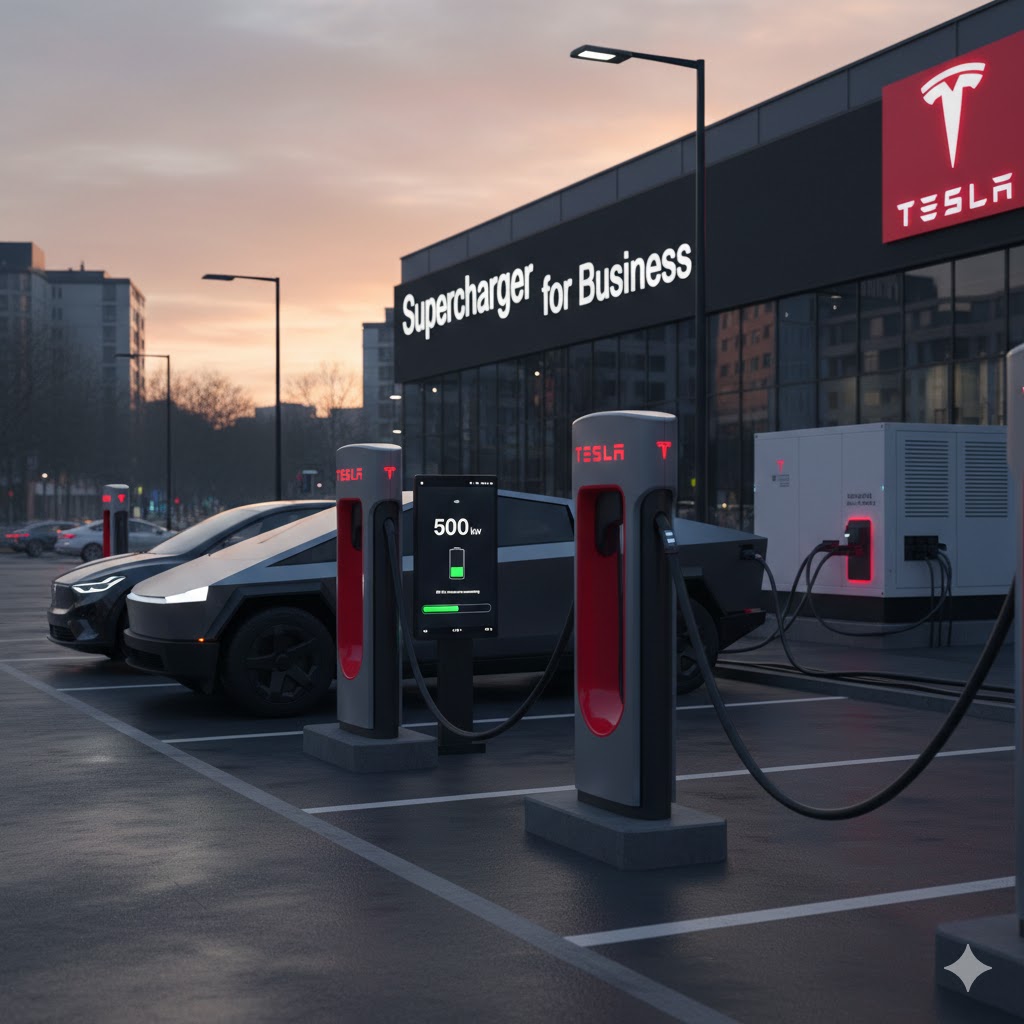
The year 2026 marks a historic pivot in the history of electric vehicle (EV) transportation. For over a decade, the "Supercharger" was a branding term that signified 120kW to 250kW speeds—fast for the 2010s, but increasingly challenged by the arrival of 800V architectures from rivals like Porsche and Hyundai. Today, that ceiling has shattered. With the mass rollout of the V4 Supercharger Cabinet, Tesla has moved from a "closed garden" fast-charger to a global energy utility.
This deep dive explores the technical leap to 500kW, the strategic "Supercharger for Business" model in Europe, and the final unification of the North American charging landscape under the J3400 (NACS) standard.
Chapter 1: The V4 Cabinet Secret—Breaking the 500kW Barrier
For many owners, the sight of the tall, monolithic V4 stall is now common. However, until late 2025, those stalls were often "V3.5" hybrids—new posts connected to old 250kW V3 cabinets. The real revolution is the V4 Cabinet, which officially reached scale production in February 2026.
1.1 From 400V to 1000V Architecture
The most critical technical upgrade in the V4 cabinet is its voltage range. While V3 cabinets were capped at 500V DC, the V4 cabinet supports 180V to 1000V DC.
-
The Cybertruck and Beyond: This allows the Cybertruck—Tesla’s first 800V passenger vehicle—to finally hit its theoretical peak of 500kW.
-
Future-Proofing: By supporting up to 1000V, Tesla is ready for the next generation of 2026/2027 Model S and X refreshes, which are rumored to adopt the higher voltage platform to reduce heat and weight.
1.2 Unprecedented Power Density
The V4 cabinet is a marvel of power electronics. It can deliver 1.2MW (1200kW) of total power shared across 8 stalls. In previous generations, cabinets shared power in pairs or quads. The V4’s "Global Bus" logic dynamically allocates power to the vehicle that needs it most.
"The V4 cabinet delivers 3x the power density of V3. We can now power 8 stalls with a smaller physical footprint than 4 stalls used to require." — Tesla Charging Update, January 2026.
Chapter 2: "Supercharger for Business" and the European Grid
In Europe, Tesla is executing a "Trojan Horse" strategy. Having opened the network to non-Teslas via CCS2 years ago, Tesla is now transitioning from a hardware operator to a hardware supplier.
2.1 The "SfB" Rollout in the UK and Southern Europe
Through the Supercharger for Business program, Tesla is selling V4 hardware to third-party hosts like malls, hotel chains, and logistics hubs in France, Italy, and Spain. This allows for an "Asset-Light" expansion. Tesla provides the hardware, the software, and the "Plug & Charge" ecosystem, while the business owner provides the land and electricity.
2.2 Megapack Integration: The Sweden "Blockade" Strategy
In early 2026, Tesla proved that its energy division is the infrastructure’s greatest ally. In response to regional grid constraints (and labor disputes in Sweden), Tesla deployed Megapack-backed Superchargers. These sites use utility-scale batteries to "buffer" electricity from the grid during off-peak hours and discharge it at 500kW during peak travel times. This prevents the "brown-outs" that have plagued rival European networks.
Chapter 3: The NACS (J3400) Victory Lap in North America
As of February 2026, the "Charging Wars" in North America are over. Every major automaker has now released at least one model with a native NACS (J3400) port.
3.1 Ending the Adapter Era
While 2025 was the year of the "NACS Adapter," 2026 is the year of native integration. New vehicles from Ford, Rivian, and General Motors are rolling off assembly lines with Tesla-style ports. The V4's 3-meter (10-foot) cable has finally solved the "wrong side" charging issue that caused chaos in 2024.
3.2 Reliability as a Service
Standardization under SAE J3400 has allowed Tesla to maintain a 99.9% uptime—a metric that third-party networks like Electrify America still struggle to hit. The simplicity of the NACS connector (sharing AC and DC pins) makes the hardware more robust and less prone to mechanical failure at the handle.
Chapter 4: The 500kW User Experience—Real-World Implications
What does 500kW actually feel like for a driver? For a Cybertruck owner in 2026, it is the difference between a "chore" and a "pause."
-
The 15-Minute Rule: On a V4 cabinet, a Cybertruck can recover 150+ miles in approximately 10 minutes.
-
Thermal Management: The v13.3 software (discussed in Article 1) communicates with the V4 cabinet to perform "Predictive Pre-Conditioning." The car starts cooling or heating its battery miles before it arrives, ensuring the 500kW peak is hit the moment the cable is plugged in.
-
Liquid-Cooled Cables: The V4 cable uses an advanced immersive coolant that allows for 615A continuous current without the cable becoming too heavy or rigid for elderly or disabled users.
Conclusion: The Utility of the Future
Tesla’s charging dominance in 2026 is no longer about selling cars; it’s about selling throughput. By opening their network to all brands and providing the fastest, most reliable hardware, Tesla has turned its infrastructure into a profit center that rivals its vehicle sales. As 800V architectures become the global standard, the V4 cabinet ensures that the "Red T" remains the gold standard of the electric highway.
FAQ: V4 Charging and 500kW Compatibility
Q: Can my 400V Model 3/Y use the 500kW power? A: No. Your car will still be capped at approximately 250kW. However, because V4 cabinets have higher total capacity, you are less likely to experience "power sharing" slowdowns when the stall next to you is occupied.
Q: Does every V4 stall have a credit card reader? A: Yes. To comply with EU (AFIR) and US (NEVI) regulations, all V4 posts now come equipped with an integrated NFC/Credit Card terminal for universal access without the Tesla App.
Q: Is 500kW charging available in Europe yet? A: As of February 2026, the first "True V4" sites (with V4 cabinets) have launched in Germany and Norway. Most other European V4 stalls are still using V3 cabinets (250kW) but are scheduled for cabinet upgrades through the rest of the year.