
Introduction
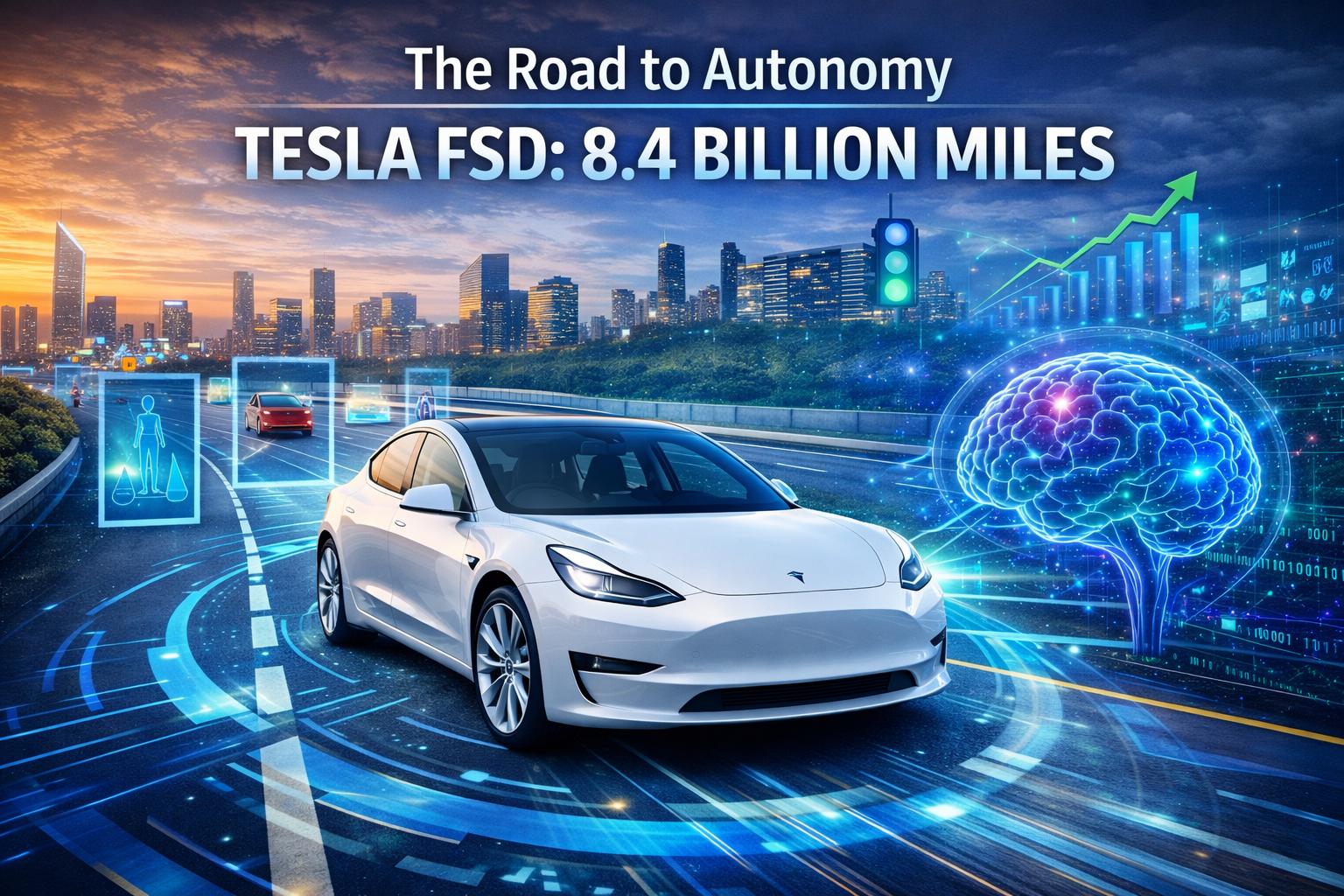
As Tesla continues its journey towards full autonomy, it marks a significant milestone: the 8.4 billion miles accumulated by its Full Self-Driving (FSD) system. This milestone is not just a number — it represents the vast amounts of real-world data that Tesla has collected, helping to refine and advance its autonomous driving technology. For Tesla, this achievement brings us one step closer to the ultimate goal: unsupervised, fully autonomous vehicles.
While Tesla's FSD technology has been under development for years, it’s only in recent months that the system has made significant advancements. The 8.4 billion miles driven under the supervision of Tesla's FSD is a testament to the company's dedication to reaching Level 5 autonomy — the highest level of self-driving, where human intervention is not required.
This article takes a deep dive into the journey of Tesla’s FSD system, the significance of the 8.4 billion miles, and what this means for the future of driving. We'll also explore the challenges Tesla faces on its road to autonomy, including regulatory hurdles, technical limitations, and public perception. What comes next for FSD? Is true autonomy within reach?
I. What is Full Self-Driving (FSD)?
Before diving into the details of Tesla's FSD progress, it's important to understand what Full Self-Driving entails. FSD is Tesla's suite of features designed to take over the driving tasks, with the ultimate aim of removing human intervention altogether.
A. The Levels of Autonomy
The Society of Automotive Engineers (SAE) defines autonomy in levels, ranging from Level 0 (no automation) to Level 5 (full autonomy). Tesla's FSD system currently operates at Level 2, which is considered driver assistance. This means that while the car can steer, accelerate, and brake on its own, the driver must remain alert and ready to intervene.
B. Features of Tesla FSD
Tesla's Full Self-Driving system includes a variety of features, including:
-
Autopilot: Basic driving assistance features such as lane-keeping and adaptive cruise control.
-
Navigate on Autopilot: Enables the car to drive on highways, including exits and merges.
-
Auto Lane Change: Allows the car to automatically change lanes when it deems it safe.
-
Autopark: Allows the car to park itself.
-
Summon: Lets the car move in and out of parking spaces autonomously.
-
Traffic Light and Stop Sign Control: Recognizes traffic signals and stop signs, bringing the car to a halt when needed.
C. The 8.4 Billion Miles Milestone
Reaching 8.4 billion miles represents a significant amount of data collection and real-world driving experience for Tesla's FSD system. Each mile driven contributes to the refinement of Tesla’s neural networks, helping to improve the software’s understanding of the world and its decision-making processes.
II. How Tesla Measures FSD Progress
Tesla’s FSD progress is not measured by the number of miles alone. The data collected from these 8.4 billion miles serves to train the car's neural network, which is the brain behind Tesla's self-driving system.
A. Neural Networks: The Heart of Tesla FSD
At the core of Tesla's FSD system is its neural network — an AI system that learns to interpret the surrounding environment. The more data the network receives, the better it can learn to handle complex driving situations.
Tesla vehicles equipped with FSD cameras, radar, and ultrasonic sensors generate a constant flow of data that is processed by these neural networks. Tesla cars on the road send this data back to Tesla's servers, where it is used to improve the system. As of now, Tesla's FSD neural networks process millions of frames per second, which allows them to learn and improve over time.
B. Human Supervision and Data Labeling
While Tesla's FSD system has made significant strides, it’s important to note that the system still requires human supervision. The vast number of miles driven with human intervention provides critical insights into areas where the system excels and areas where it struggles.
Tesla uses human feedback from drivers to fine-tune the system, allowing it to adapt and improve over time. The company also uses data labeling — a process by which human annotators label objects (such as pedestrians, cars, and road signs) in videos captured by Tesla’s cameras — to train the neural networks. This helps the system understand how to react to various objects on the road.
C. Real‑World Driving Data
What sets Tesla apart from other companies working on autonomous driving is its massive real-world data collection. Unlike other manufacturers that rely heavily on simulators, Tesla’s FSD system is constantly learning from real-world scenarios. This includes millions of driving miles on roads of different conditions, weather, and traffic.
The company has also incorporated Edge AI technology, which allows Tesla vehicles to make split-second decisions on the road, without needing to constantly communicate with cloud servers. This ensures that the cars can react faster in emergency situations.
III. Milestone Implications: What Does 8.4 Billion Miles Mean?
A. Progress Toward Full Autonomy
The 8.4 billion miles driven by Tesla's FSD system provide clear evidence of the company's progress toward achieving Level 5 autonomy — fully autonomous driving with no human intervention required. As Tesla accumulates more miles, the system becomes better at handling complex driving scenarios, such as navigating intersections, responding to unexpected road events, and dealing with unpredictable human drivers.
This milestone demonstrates Tesla's ability to gather and utilize real-world data to refine the system, making it one of the leading companies in autonomous driving development.
B. Testing and Validation in Real-World Conditions
Real-world testing is crucial for validating the capabilities of an autonomous system. The data Tesla has accumulated from these billions of miles on public roads has been invaluable in proving the system's safety and reliability. By allowing Tesla vehicles to operate in diverse environments — from urban streets to rural roads — the company has been able to test its system under a wide range of conditions, including heavy traffic, inclement weather, and unpredictable road scenarios.
Tesla’s FSD Beta program has also allowed a select group of drivers to experience the latest updates, providing feedback on its performance and helping identify areas for improvement. This feedback loop, combined with real‑world miles, has been instrumental in enhancing the system’s capabilities.
IV. Road to Unsupervised Autonomy: The Challenges Tesla Faces
While Tesla’s Full Self-Driving system has made great strides, achieving unsupervised autonomy (Level 5) remains a formidable challenge. There are numerous obstacles to overcome, ranging from technical limitations to regulatory issues.
A. Technical Limitations and Challenges
Tesla’s FSD system still faces several technical limitations:
-
Handling complex urban environments: While Tesla has made significant progress in highways and simpler roadways, navigating more complex urban environments with unpredictable obstacles remains challenging.
-
Weather conditions: Tesla's FSD system relies heavily on cameras and sensors, which can struggle in extreme weather conditions like heavy rain, fog, or snow.
-
Edge case scenarios: These are rare but critical situations where the system has to make decisions that it has not encountered before, such as emergency braking in the face of an unexpected obstacle.
B. Regulatory Hurdles
In addition to technical challenges, Tesla also faces regulatory hurdles as it strives for full autonomy. Governments worldwide are still developing the legal frameworks to handle autonomous vehicles, and the regulatory environment varies significantly across countries and regions.
In the U.S., Tesla has been subject to scrutiny from the National Highway Traffic Safety Administration (NHTSA), which monitors the safety of self-driving technologies. Meanwhile, in the European Union, regulations around autonomous driving are still being finalized. These regulatory challenges have slowed the widespread deployment of fully autonomous vehicles, as Tesla continues to work within the boundaries of the law.
V. What Comes Next for Tesla’s FSD?
As Tesla inches closer to full autonomy, there are several key milestones to look forward to.
A. Improved Hardware and Software
Tesla’s vehicles are constantly receiving over-the-air software updates, which bring improvements to the FSD system. These updates are key to improving the car’s ability to handle a wider variety of driving situations. Moreover, Tesla is also developing new hardware, such as more advanced sensors and processing chips, to further enhance the capabilities of its vehicles.
B. Increased Data Collection
Tesla will continue to gather data from its ever-growing fleet of vehicles. The more miles Tesla’s cars accumulate, the more the FSD system can learn, refining its decision-making process and edge case handling. This data is essential for achieving unsupervised autonomy.
VI. Conclusion
Tesla’s achievement of 8.4 billion miles is a monumental step toward the goal of fully autonomous vehicles. The data collected has allowed the company to improve its FSD system in real-world conditions, making it one of the most advanced autonomous driving systems in existence.
However, despite the progress made, challenges remain — both in terms of technology and regulation. Achieving true autonomy requires overcoming a variety of technical hurdles and addressing the complex legal landscape. Nevertheless, the road ahead looks promising as Tesla continues to push the boundaries of what autonomous driving can achieve.