
Introduction: The Moment We’ve Been Waiting For
For years, Tesla owners have listened to promises of “V4 Supercharging.” We saw the tall, sleek new stalls appear at stations across the country, their longer cables and built-in touchscreens hinting at a future of faster, more accessible charging. But for most of us, the reality didn’t match the hardware. When we plugged in, the charging speeds remained stubbornly familiar—peaking around 250 kW, just like the V3 stations we’d been using for years.
That changed on March 19, 2026.
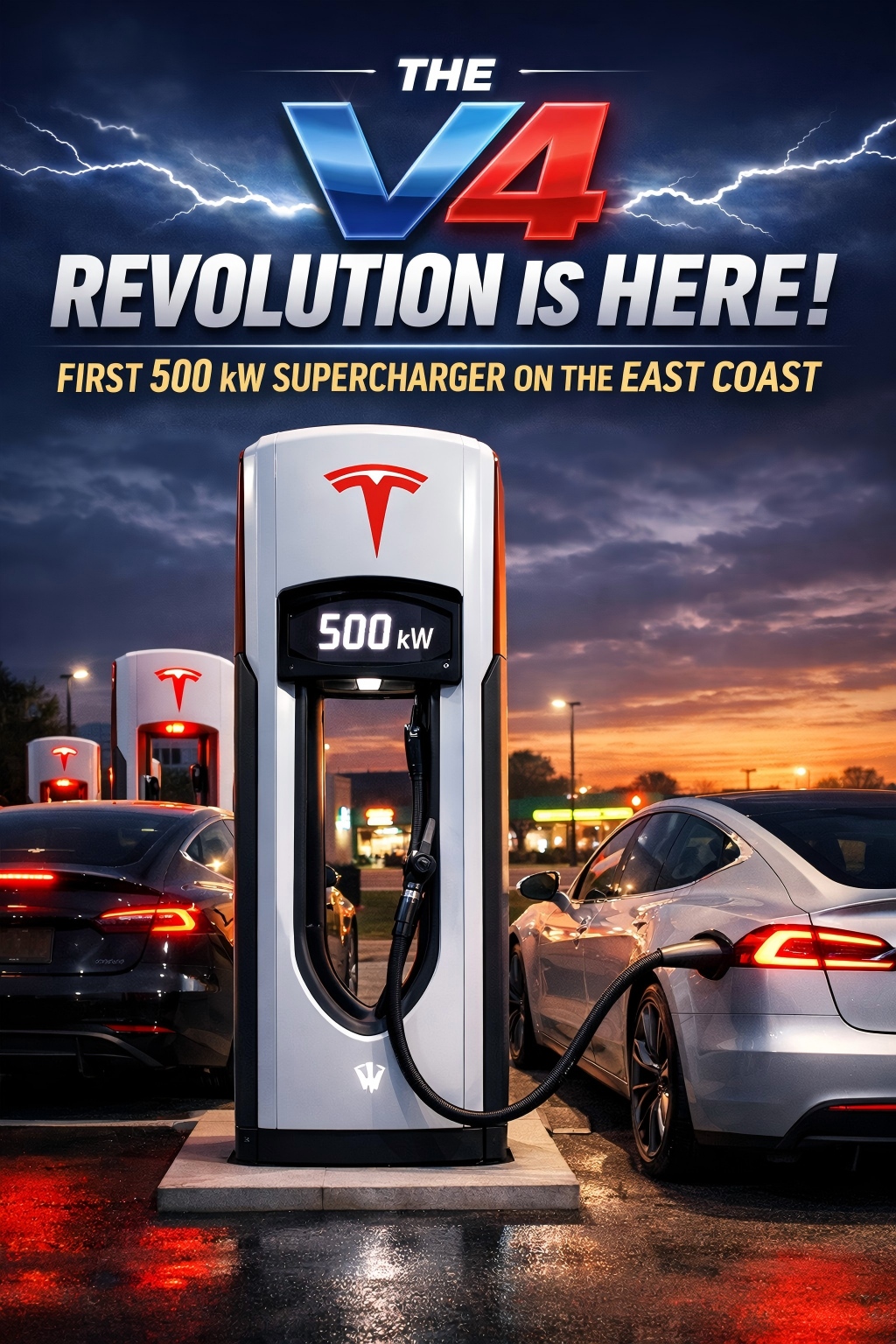
Tesla quietly switched on a new eight-stall Supercharger station in Kissimmee, Florida, just south of Orlando. At first glance, it looked like any other V4 site. But this one was different. Behind the familiar dispensers, a new generation of power cabinet was working—one capable of delivering up to 500 kW per stall. For the first time on the East Coast, a “true” V4 Supercharger was live.
This is not merely an incremental upgrade. The Kissimmee station represents a fundamental shift in Tesla’s charging architecture, one that will reshape expectations for charging speed, grid efficiency, and vehicle compatibility. For Cybertruck owners, it unlocks the vehicle’s full potential. For Model 3 and Model Y drivers, it offers a glimpse of a future where charging stops become brief pauses rather than planned events. And for the broader EV ecosystem, it signals Tesla’s intent to maintain—and extend—its commanding lead in charging infrastructure.
Chapter 1: Understanding the “True V4” Distinction
To appreciate the significance of the Kissimmee station, we must first clear up a source of considerable confusion within the Tesla community: the difference between a V4 dispenser and a true V4 Supercharger.
1.1 The V4 Dispenser Era (2023–2025)
Since early 2023, Tesla has been deploying V4 dispensers across its global network. These posts introduced several welcome physical upgrades:
-
Longer, liquid-cooled cables designed to reach the charge ports of non-Tesla vehicles, which are often located in different positions (front left, rear right, etc.)
-
Built-in touchscreen displays providing clearer charging information and interactive capabilities
-
Integrated credit-card readers enabling seamless access for drivers without the Tesla app
-
Improved ergonomics making the cable lighter and easier to handle, especially for older or disabled users
These dispensers looked like the future. But for nearly three years, they were mostly powered by the same V3 power cabinets that had been in service since 2019. This hybrid configuration—informally dubbed “V3.5” by the EV community—delivered charging curves virtually identical to standard V3 stations. Peak speeds typically topped out between 250 kW and 325 kW, depending on vehicle architecture and site conditions.
1.2 The True V4 Architecture
The Kissimmee station represents the first true V4 installation on the East Coast because it pairs the V4 dispenser with Tesla’s next-generation 1.2 MW power cabinet. This is where the real engineering leap occurs.
The V4 power cabinet is rated to support battery voltages up to 1,000 V—double the 500 V limit of V3 systems. This higher voltage capability is the key to unlocking faster charging speeds. By operating at up to 1,000 V, the system can push up to 500 kW to a single stall without generating excessive heat or stressing the vehicle’s battery management system.
Perhaps more impressive is the cabinet’s power density. A single 1.2 MW cabinet can power all eight stalls at the Kissimmee site, dynamically allocating power based on real-time demand. This represents a significant improvement over V3, where cabinets typically powered two to four stalls and shared a fixed power budget. The new architecture also reduces the physical footprint of the station and reportedly lowers deployment costs to under $40,000 per stall—a critical factor as Tesla accelerates network expansion.
1.3 Why This Distinction Matters
For Tesla owners, the difference between V3.5 and true V4 is not merely technical trivia. It affects:
-
Charging curve: True V4 enables sustained high-power delivery deeper into the battery’s state of charge
-
Vehicle compatibility: 800V vehicles like the Cybertruck can finally charge at their maximum potential
-
Network reliability: Higher power density means fewer cabinets per site, simplifying maintenance and improving uptime
-
Future-proofing: Stations built today will support the next generation of Tesla vehicles with advanced battery architectures
The Kissimmee station is one of only four true V4 sites currently operating in the United States. But as Tesla’s New York gigafactory ramps production of V4 cabinets—having built its last V3 cabinet in early 2026—this number will grow rapidly .
Chapter 2: Technical Deep Dive – How 500 kW Charging Works
To understand what 500 kW charging actually means for your vehicle, it helps to look at the underlying technology. The V4 architecture is not simply a matter of turning up the power dial. It represents a complete rethinking of how energy moves from the grid to your battery.
2.1 Voltage, Current, and the 800V Advantage
Charging power is the product of voltage and current (Watts = Volts × Amps). To increase power, you can raise either the voltage or the current—or both.
V3 Superchargers operated at a maximum of 500 V and could deliver up to 500 A, yielding a theoretical peak of 250 kW. In practice, real-world conditions often limited this to slightly less.
True V4 Superchargers can operate at up to 1,000 V while delivering similar current levels, enabling up to 500 kW. The higher voltage reduces resistive losses (heat) in the charging cable and the vehicle’s internal wiring, making the system more efficient.
The Cybertruck is Tesla’s first passenger vehicle designed for an 800V architecture. When plugged into a true V4 Supercharger, it can accept power at much higher rates—especially at lower states of charge where the battery’s internal resistance is lowest. This allows Cybertruck owners to add hundreds of miles of range in the time it takes to grab a coffee.
2.2 The Charging Curve Breakthrough
Peak power numbers make for good headlines, but the charging curve—how much power the vehicle can sustain as the battery fills—is what determines real-world charging time.
Early tests of V4 cabinets with compatible vehicles suggest a significant improvement over V3. A 2026 Model Y Long Range, while still limited by its 400V architecture, can hold over 350 kW from 10% state of charge (SoC) all the way to 40% before gradually tapering. This compares favorably to V3, where the peak of 250 kW would begin tapering almost immediately.
For Cybertruck owners, the improvement is even more dramatic. On a true V4 cabinet, the vehicle can maintain peak power for a sustained period, reducing the time to add 200 miles of range from approximately 25 minutes to under 15 minutes.
2.3 Thermal Management and Liquid-Cooled Cables
One of the engineering challenges of high-power charging is heat management. The V4 system addresses this through advanced thermal design.
The charging cable uses an immersive liquid-cooling system that allows for continuous current delivery of up to 615 A without the cable becoming too heavy or rigid. This makes the cable easier to handle than one might expect given its power capacity.
The power cabinet itself incorporates advanced silicon carbide (SiC) power electronics, which generate less heat than traditional silicon-based components. This allows the cabinet to operate more efficiently and maintain sustained peak output even in warm climates.
Vehicle-side preconditioning also plays a role. Tesla’s software, now at version 2026.8, includes “Predictive Pre-Conditioning” that communicates with the Supercharger to optimize battery temperature before arrival. When you navigate to a true V4 site, the vehicle will heat or cool the battery to ensure it can accept the highest possible charge rate the moment you plug in.
Chapter 3: Pricing Strategy and Network Monetization
The Kissimmee station also reveals important details about Tesla’s evolving approach to pricing and network access. As the Supercharger network opens to non-Tesla vehicles, Tesla is implementing sophisticated time-of-use pricing designed to balance demand, manage grid stress, and reward its own customers.
3.1 Time-of-Use Rates
At the Kissimmee V4 station, Tesla owners pay:
-
$0.40 per kWh during peak hours (8:00 a.m. to midnight)
-
$0.20 per kWh during off-peak hours (midnight to 8:00 a.m.)
This 50% discount for off-peak charging is not arbitrary. By encouraging drivers to charge overnight, Tesla helps smooth the demand curve on local electrical grids. During peak daytime hours, when energy costs are higher and grid capacity is strained, higher rates discourage unnecessary charging and help ensure availability for drivers who truly need it.
3.2 Non-Tesla Pricing
Non-Tesla electric vehicles, which can now plug directly into the NACS ports at V4 stations, pay a premium:
-
$0.56 per kWh during peak hours
-
$0.28 per kWh during off-peak hours
This represents roughly a 40% premium over Tesla owner rates. The pricing structure serves two purposes:
-
Monetization: By opening the network to non-Tesla vehicles, Tesla creates a significant new revenue stream
-
Loyalty incentive: The price advantage for Tesla owners reinforces the value of staying within the Tesla ecosystem
As more automakers—Ford, General Motors, Rivian, and others—transition to native NACS ports, this pricing strategy positions Tesla as the primary fuel provider for the electric age, regardless of vehicle brand.
3.3 European Pricing Models
European Tesla owners have seen similar pricing structures, though local energy costs and regulations create variations. In Germany and Norway, where the first true V4 cabinets have been installed, Tesla has implemented comparable time-of-use rates. The V4 stalls also comply with EU AFIR regulations by providing integrated card readers that allow any EV driver to charge without needing the Tesla app.
Chapter 4: Who Benefits from 500 kW Charging Today?
Not all Tesla vehicles can take full advantage of 500 kW charging. The primary determinant is the vehicle’s electrical architecture.
4.1 Cybertruck: The Primary Beneficiary
The Cybertruck is Tesla’s first passenger vehicle designed with an 800V architecture. This allows it to accept power at rates that 400V vehicles simply cannot match. When plugged into a true V4 Supercharger, Cybertruck owners can expect:
-
Peak charging rates approaching 500 kW at low states of charge
-
150+ miles of range added in approximately 10 minutes
-
Dramatically reduced total charging time for long trips
For Cybertruck owners, the true V4 rollout transforms the ownership experience. Towing, which significantly reduces range, becomes more practical when you can add 200 miles of range in the time it takes to stop for a meal.
4.2 Model 3, Model Y, and 400V Vehicles
Owners of Tesla’s most popular models will see little immediate difference in peak charging speeds. The 400V architecture of these vehicles limits their maximum charge rate to approximately 250 kW—the same as V3.
However, there are still benefits:
-
Reduced power sharing: Because V4 cabinets have higher total capacity, you are less likely to experience slowdowns when the stall next to you is occupied
-
Improved curve: Even at 250 kW, the charging curve may be sustained longer due to the cabinet’s advanced thermal management
-
Future compatibility: When you eventually upgrade to a vehicle with 800V architecture, the infrastructure will already be in place
4.3 Model S and Model X
The Model S and Model X, while capable of higher charging rates than the 3/Y, are also limited by their 400V architectures. Newer Model S and X vehicles may see modest improvements, but the most significant gains will come with future refreshes expected to adopt 800V platforms.
Chapter 5: The European V4 Rollout-Germany and Norway Lead the Way
While the Kissimmee station represents the first true V4 on the East Coast, Europe has been at the forefront of V4 deployment. Tesla’s strategy in Europe differs in important ways from North America, reflecting regional market conditions and regulatory requirements.
5.1 First European True V4 Sites
Tesla began installing true V4 cabinets in Germany and Norway in early 2026, with sites operational along major corridors such as the A9 between Munich and Berlin.
Germany represents a critical test for any charging technology. The Autobahn network demands high-speed, reliable charging for long-distance travel. Norwegian conditions test cold-weather performance and high utilization rates—the country has the highest EV penetration in the world.
5.2 Cold-Weather Performance
One of the unsung benefits of the V4 cabinet is its improved cold-weather performance. The cabinet’s advanced thermal management allows it to preheat the cable and ensure that power delivery is not throttled by freezing temperatures. In Norway, where winter charging speeds have historically been a pain point, this is a game-changer.
The V4 system also uses intentional losses during power transfer to warm batteries in cold weather, eliminating the need for separate heating systems. This integrated approach improves efficiency and reliability.
5.3 “Supercharger for Business” Program
In Europe, Tesla is executing a strategy that goes beyond building its own stations. Through the “Supercharger for Business” program, Tesla sells V4 hardware to third-party hosts like shopping malls, hotel chains, and logistics hubs in France, Italy, and Spain.
This “asset-light” expansion allows Tesla to grow its network faster than it could through company-owned sites alone. Tesla provides the hardware, software, and “Plug & Charge” ecosystem, while the business owner provides the land and electricity. For Tesla owners, this means more charging options in more locations.
5.4 Megapack Integration
In response to regional grid constraints, Tesla has deployed Megapack-backed Superchargers in some European markets. These sites use utility-scale batteries to store energy during off-peak hours and discharge it at high rates during peak travel times. This prevents the “brown-outs” that have plagued rival charging networks and ensures consistent performance.
Chapter 6: The NACS (J3400) Unification in North America
As of early 2026, the charging wars in North America are effectively over. The North American Charging Standard (NACS), now formalized as SAE J3400, has become the de facto standard for EV charging.
6.1 Ending the Adapter Era
While 2025 was the year of the “NACS adapter,” 2026 is the year of native integration. New vehicles from Ford, Rivian, and General Motors are rolling off assembly lines with Tesla-style ports. The V4’s 10-foot cable—significantly longer than V3 cables—has finally solved the “wrong side” charging issue that caused chaos when non-Tesla vehicles first gained Supercharger access.
6.2 Reliability as a Service
Standardization under SAE J3400 has allowed Tesla to maintain a 99.9% uptime across its network—a metric that third-party networks like Electrify America still struggle to achieve. The simplicity of the NACS connector, which shares AC and DC pins rather than requiring separate ports, makes the hardware more robust and less prone to mechanical failure.
For Tesla owners, this means that when you arrive at a Supercharger, you can expect it to work. That reliability is perhaps the network’s most valuable asset.
Chapter 7: The Road Ahead – What to Expect in 2026 and Beyond
The Kissimmee station is just the beginning. Tesla has ambitious plans for V4 deployment in both North America and Europe.
7.1 North American Expansion
With V3 production ended at the New York gigafactory, all new Supercharger stations will now use V4 cabinets. Tesla is also expected to retrofit high-utilization existing stations with V4 cabinets, bringing true V4 speeds to more locations.
Key corridors to watch include:
-
I-95 from Florida to New York: The East Coast’s main artery will see multiple true V4 sites by year-end
-
I-10 across the South: Critical for travel between Florida, Texas, and California
-
California’s major highways: The state with the highest EV concentration will see extensive V4 deployment
7.2 European Expansion
In Europe, France, the Netherlands, and the United Kingdom are expected to see V4 upgrades in the second half of 2026. The “Supercharger for Business” program will continue to expand, bringing V4 hardware to more locations.
7.3 Megacharger Integration
The V4 cabinet’s 1.2 MW capability is designed not only for passenger vehicles but also for the Tesla Semi. While dedicated Megacharger depots will serve trucking fleets, V4 cabinets allow for “opportunity charging” of Semis at regular passenger vehicle stations. As the Tesla Semi fleet expands in Europe with customers like DHL and ASOS, this infrastructure will become increasingly important.
7.4 Future Vehicle Compatibility
The V4 architecture’s support for up to 1,000 V positions Tesla for the next generation of vehicles. Rumored 2026–2027 Model S and Model X refreshes are expected to adopt 800V platforms, and future vehicles will likely follow. By deploying true V4 infrastructure now, Tesla ensures that its network will not become obsolete as vehicle capabilities advance.
Conclusion: A Glimpse of the Charging Future
The first true V4 Supercharger on the East Coast is more than just another station. It represents a fundamental shift in what Tesla owners can expect from charging infrastructure.
For Cybertruck owners, the Kissimmee station unlocks the vehicle’s full potential. For Model 3 and Model Y drivers, it offers a glimpse of a future where charging stops become brief pauses rather than planned events. For the broader EV ecosystem, it signals Tesla’s intent to maintain—and extend—its commanding lead in charging infrastructure.
The true V4 rollout will accelerate throughout 2026. More stations will come online. More vehicles will be able to take advantage of the higher speeds. And the experience of owning an electric vehicle will continue to converge with—and eventually surpass—the convenience of gasoline refueling.
For now, if you find yourself in central Florida with a Cybertruck, the Kissimmee station is worth a detour. For the rest of us, it’s a preview of what’s coming to a Supercharger near you.
FAQ: True V4 Supercharging
Q: Can my Model Y charge at 500 kW at a true V4 station?
A: No. The Model Y’s 400V architecture limits its maximum charge rate to approximately 250 kW. However, you will benefit from reduced power sharing and potentially improved charging curves.
Q: How do I know if a Supercharger is a true V4 station?
A: In the Tesla navigation system, true V4 stations are typically labeled with “up to 500 kW” in the description. As of March 2026, only four such stations exist in the US, but that number will grow rapidly.
Q: Does true V4 charging cost more than V3 charging?
A: Pricing is determined by location and time of day, not by cabinet type. The Kissimmee station’s rates ($0.40/kWh peak, $0.20/kWh off-peak) are comparable to other Florida Superchargers.
Q: Can non-Tesla EVs use true V4 stations?
A: Yes. Non-Tesla EVs with native NACS ports (or adapters) can charge at V4 stations, but they pay higher rates than Tesla owners.
Q: Is true V4 available in Europe?
A: Yes. The first true V4 cabinets have been installed in Germany and Norway, with additional European countries expected to receive upgrades in 2026.
Q: Will Tesla retrofit existing V3 stations to true V4?
A: Tesla has indicated that high-utilization existing stations will be upgraded, though the timeline for retrofits is not yet public.