
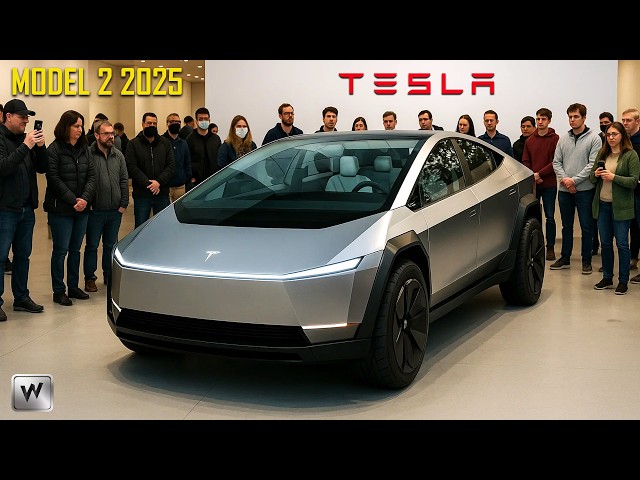
For years, it has been the subject of hushed whispers, feverish speculation, and countless artist renderings. It was the "missing piece" in Tesla's master plan, the key to unlocking true global scale. Today, the wait is finally over. The world has officially been introduced to Tesla's long-awaited affordable electric vehicle, a car poised to be the company's most critical product launch since the game-changing Model 3. While the final nameplate may vary by region, its mission is singular and unambiguous: to democratize electric mobility and deliver a compelling, high-tech EV for the masses.
This article provides a comprehensive deep-dive into this landmark vehicle. We will unpack the official specifications, analyze the revolutionary manufacturing process that makes its price point possible, and explore its potential to seismically shift the automotive landscapes of both the United States and Europe. The new model, which we will refer to as the "Model 2" for clarity, is not just another car in Tesla's lineup. It is a meticulously crafted strategic maneuver, designed from the ground up to fundamentally reshape the entry-level automotive market and dramatically accelerate the global transition to sustainable energy.
Chapter 1: The $25,000 EV is Here: Official Specs, Pricing, and Availability
The headline feature of the Model 2 is, without question, its disruptive price point. But a low price is meaningless without the substance to back it up. Tesla's achievement lies in delivering on its core brand promises of performance, technology, and range in a package that is now accessible to millions more buyers.
Confirmed Specifications
Tesla has unveiled two primary configurations at launch:
-
Standard Range: This entry-level model is the one targeting the headline "$25,000" price point. It features a real-world WLTP-estimated range of approximately 450 kilometers (around 280 miles), making it eminently practical for daily commuting and regional travel. Acceleration is brisk, with a 0-100 km/h (0-60 mph) time of around 6.5 seconds, continuing Tesla's tradition of making even its base models feel energetic and responsive.
-
Long Range: For a premium, a Long-Range version will be offered, pushing the WLTP range to nearly 600 kilometers (around 370 miles). This version will likely feature a slightly quicker acceleration time and will appeal to those who frequently undertake long-distance journeys or live in colder climates where range degradation is a concern.
Top speed for both models is expected to be software-limited to around 180 km/h (112 mph).
Battery Technology and Charging
The key to the Model 2's affordability lies in its battery technology. The Standard Range model utilizes a new generation of Lithium Iron Phosphate (LFP) cells. These batteries forego more expensive materials like cobalt and nickel, drastically reducing the cost. Furthermore, LFP chemistry is renowned for its excellent durability and long cycle life, allowing owners to regularly charge to 100% without significant long-term degradation—a key usability advantage over previous NCA/NMC chemistries.
Charging speeds remain impressive. Despite the lower-cost chemistry, the new battery pack architecture is designed to take full advantage of Tesla's Supercharger network. Owners can expect to add around 250 kilometers (155 miles) of range in approximately 15-20 minutes on a V3 or V4 Supercharger, eliminating range anxiety and making long trips seamless.
Pricing and Trims for the US and Europe
-
United States: The Standard Range model will start at $25,000 before any federal or state incentives. Depending on the final battery sourcing and assembly location (Gigafactory Texas), it is expected to qualify for the full $7,500 federal tax credit, potentially bringing the effective starting price below $20,000 for eligible buyers. This positions it directly against the most popular gasoline-powered compact cars.
-
Europe: The European pricing will start at approximately €27,000, varying slightly by country due to VAT and import duties. Critically, with production planned for Gigafactory Berlin, the Model 2 will be a "Made in Germany" product, a significant marketing advantage. It will also be eligible for various government incentives across the continent, such as Germany's "Umweltbonus" or France's "Bonus Écologique," making its total cost of ownership highly competitive.
Production and Delivery Timelines
The production ramp-up will be aggressive. Initial production has already begun at Gigafactory Texas, with the first North American customer deliveries slated for early 2026. Gigafactory Berlin is currently being retooled to incorporate the new manufacturing process, with European production expected to commence in the latter half of 2026. Tesla is aiming for a production volume that will eventually eclipse that of the Model 3 and Model Y combined, targeting several million units per year globally once all factories are at full steam.
Chapter 2: Design and Manufacturing: The "Unboxed" Revolution
The Model 2's accessible price is not just a result of cheaper batteries; it is enabled by a complete reimagining of how a car is built. Tesla's "unboxed" manufacturing process is arguably a more significant innovation than the car itself.
Exterior and Interior Design Philosophy
Visually, the Model 2 is instantly recognizable as a Tesla, yet it charts its own course. It is a compact hatchback, smaller and more city-friendly than the Model 3. The design is an exercise in extreme aerodynamic efficiency to maximize range from a smaller battery pack. The lines are clean and taut, with a low-slung, sporty stance.
Inside, the signature Tesla minimalism is taken a step further. A central, landscape-oriented touchscreen (slightly smaller than the Model 3's) controls nearly all vehicle functions. The focus is on creating a sense of spaciousness within a compact footprint. The material quality, while not luxurious, is designed to be durable, sustainable, and cost-effective. By eliminating traditional instrument clusters, physical buttons, and complex interior trim pieces, Tesla has drastically simplified the assembly process.
The "Unboxed" Manufacturing Process Explained
The traditional automotive assembly line has remained fundamentally unchanged for a century: a body shell moves down a line, and parts are progressively added to it. This is an inherently inefficient process, as the physical constraints of the body shell limit how many people or robots can work on the car simultaneously.
The "unboxed" method, pioneered by Tesla for the Model 2, shatters this paradigm. The car is not built as a single unit. Instead, it is produced as a series of major sub-modules that are almost fully complete in themselves. For example:
-
The entire front sub-assembly (suspension, steering, motors) is built on one parallel line.
-
The rear sub-assembly is built on another.
-
The floor, which is the structural battery pack itself, forms a third line.
-
The left and right side panels, with doors and windows pre-installed, are assembled separately.
These complete, complex sub-modules are then brought together for a single, final marriage. This allows for unprecedented levels of parallel assembly. More robots and people can work on the constituent parts simultaneously in an open, unconstrained space, dramatically reducing the factory footprint, the number of steps required, and the total time it takes to build a car. Tesla estimates this method will cut manufacturing costs by up to 50% compared to the already efficient Model 3/Y production line.
Materials and Sustainability
Sustainability is woven into the Model 2's design. The interior will feature extensive use of recycled plastics and plant-based textiles. The manufacturing process itself is designed to use less water and energy per vehicle produced. The simplified design means fewer parts, which in turn means less raw material extraction and a smaller carbon footprint from the supply chain.
Practicality and Space
Despite its compact exterior dimensions, the "unboxed" process allows for surprisingly efficient packaging. The lack of a transmission tunnel and the "skateboard" battery platform create a flat floor and a spacious cabin. Passenger volume is expected to be on par with or even exceed that of larger C-segment hatchbacks. The hatchback design provides a large, practical cargo opening, and while smaller than its siblings, a modest "frunk" (front trunk) is retained, adding a useful extra storage area. It is engineered to be a practical and versatile choice for singles, couples, and small families.
Chapter 3: Market Impact and Competitive Landscape
The arrival of a sub-$20,000 (after incentives) Tesla is a seismic event for the global auto industry. Its impact will be felt across all segments of the market.
The US Market Disruption
In the United States, the Model 2's primary competitors are not other EVs, but the titans of the internal combustion engine (ICE) world: the Honda Civic, Toyota Corolla, and Hyundai Elantra. For the first time, a buyer walking into a dealership can choose a Tesla for the same price as a comparably equipped gasoline-powered compact car. When factoring in the significantly lower "fuel" costs (electricity vs. gasoline) and reduced maintenance (no oil changes, spark plugs, or exhaust systems), the total cost of ownership for the Model 2 will be substantially lower. This compelling financial argument has the potential to sway millions of mainstream buyers who were previously on the fence about going electric.
The European Challenge
In Europe, the battleground is different but equally crucial. The Model 2, built in Berlin, will go head-to-head with the continent's most beloved hatchbacks, such as the Volkswagen Golf and its electric sibling the ID.3, the Renault Megane E-Tech, and the Peugeot e-208. The "Made in Germany" label will carry significant weight, helping to overcome any lingering skepticism about build quality. Its combination of performance, range, access to the superior Supercharger network, and competitive pricing will present a formidable challenge to legacy European automakers on their home turf.
The "Tesla Ecosystem" Entry Point
Buying a Model 2 is about more than just acquiring a mode of transport; it's about gaining access to the entire, seamlessly integrated Tesla ecosystem. This is a powerful, Apple-like competitive advantage. New owners will experience the intuitive Tesla mobile app, receive regular over-the-air software updates that improve the car over time, and enjoy the unparalleled convenience and reliability of the Supercharger network. This ecosystem creates a sticky customer relationship that competitors find incredibly difficult to replicate. The Model 2 will act as a "gateway drug," introducing a new generation of customers to the Tesla experience, who may then aspire to upgrade to a Model Y, Cybertruck, or invest in Tesla Energy products in the future.
Will it Cannibalize Model 3 Sales?
One of the most debated questions is whether the Model 2 will steal sales from the more expensive Model 3. While some cannibalization is inevitable, Tesla has been careful to differentiate the two products. The Model 3 will be positioned as a more premium, larger, and higher-performance sports sedan. The Model 2 is the practical, efficient, and affordable hatchback. They appeal to slightly different life stages and priorities. Furthermore, the overall market for EVs is expanding so rapidly that there is ample room for both models to achieve massive sales volumes. The goal is not just to shuffle existing EV buyers, but to convert millions of ICE vehicle owners, and for that mission, both cars are essential.
Conclusion
The Tesla Model 2 is a triumph of engineering and manufacturing innovation. It is the physical embodiment of the second part of Tesla's secret master plan: to use the profits from its premium cars to build an affordable, high-volume electric vehicle. It's a car that makes very few compromises, offering compelling performance, cutting-edge technology, and a practical design at a price point that was once thought impossible.
This vehicle is not just a new product; it is a catalyst. It has the potential to trigger a tipping point in EV adoption rates across the globe, forcing legacy automakers to accelerate their own electrification plans or risk being left behind. The challenges ahead are immense—scaling a revolutionary new manufacturing process to unprecedented volumes will be Tesla's greatest test yet. But if successful, the Model 2 won't just be the best-selling electric car in the world; it could very well become the best-selling car of any kind, period. And in doing so, it will bring the vision of a future powered by sustainable energy one giant leap closer to reality for everyone.
FAQ Section
-
Will the Model 2 come with Autopilot as standard? Yes, all Teslas, including the Model 2, come with standard Autopilot, which includes traffic-aware cruise control and autosteer. The more advanced Enhanced Autopilot and Full Self-Driving (FSD) Capability will be available as optional software upgrades.
-
Is the Model 2 eligible for the full US federal tax credit? This is highly likely, especially for the version produced at Gigafactory Texas. Tesla has been actively working to onshore its battery supply chain to meet the requirements of the Inflation Reduction Act. Buyers should consult official government sources for the latest eligibility information at the time of purchase.
-
What are the color and wheel options at launch? To streamline production and keep costs down, the initial launch will likely feature a limited color palette (e.g., white, black, grey, blue, red) and one or two standard wheel designs with optional aerodynamic covers.
-
Will there be a performance version of the Model 2? While the focus at launch is on the standard and long-range models, a future dual-motor, all-wheel-drive performance version is a distinct possibility, following the pattern of Tesla's other vehicle lineups. It would likely arrive 12-18 months after the initial launch.
-
How does the sound system compare to the Model 3? The standard sound system will be engineered to be high-quality and immersive but will likely have fewer speakers and a less powerful amplifier than the premium audio systems found in the Model 3 and Y, as a cost-saving measure. An optional premium audio upgrade may be offered.
-
Is the Model 2 designed to be a robotaxi platform? Yes. The "unboxed" manufacturing process and durable LFP battery chemistry are key enablers for Tesla's long-term vision of a dedicated, fully autonomous robotaxi network. The consumer version of the Model 2 is the first step, built on a platform designed from the outset for high-utilization autonomous driving in the future.